
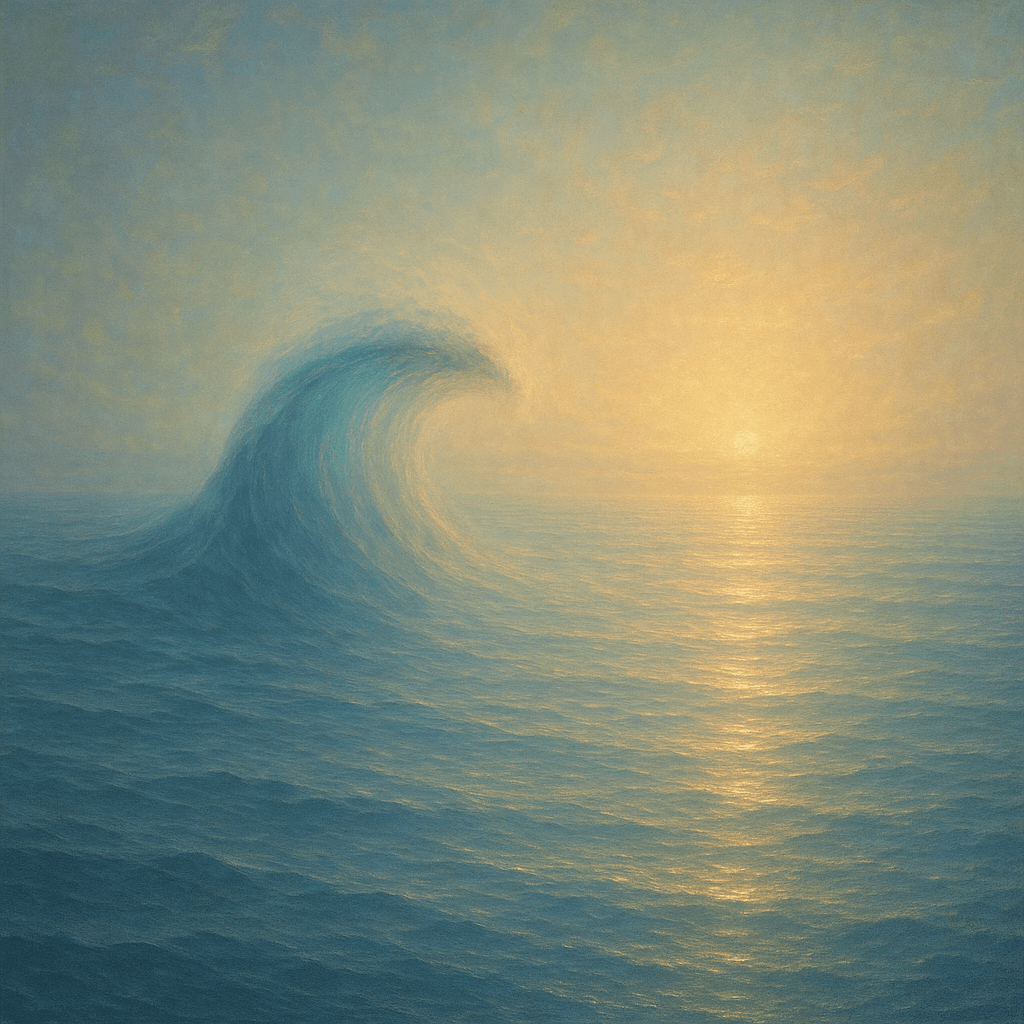
Enlightenment is when a wave realizes it is the ocean. — Thich Nhat Hanh
—What lingers after this line?
The Metaphor of the Wave and the Ocean
Thich Nhat Hanh’s metaphor draws on the simple yet profound imagery of a wave recognizing itself as part of the vast ocean. This represents the journey from individuality to a broader consciousness. Much like a wave, individuals often perceive themselves as separate entities, distinct from the larger world. Yet, as the wave is inseparable from the ocean, so too are we from the fabric of existence.
Breaking Down the Illusion of Separateness
This metaphor addresses the illusion of separateness—the idea that we are isolated beings, disconnected from each other and from nature. Buddhist teachings frequently explore this concept; the Avatamsaka Sutra, for instance, emphasizes the interconnectedness of all phenomena. Thich Nhat Hanh suggests that enlightenment arises when we see through this illusion and acknowledge our unity with all that is.
Realizing True Identity and Belonging
Once the wave recognizes it is the ocean, it no longer fears dissolution or loss. Similarly, realizing our true identity as part of the whole dissolves existential anxieties. This release mirrors the teachings of many spiritual traditions—in Hindu philosophy, the concept of 'Tat Tvam Asi' ('Thou art that') invites us to recognize divinity within ourselves, blurring boundaries between self and cosmos.
Compassion and Interbeing
Understanding oneself as the ocean cultivates compassion. Thich Nhat Hanh’s principle of ‘interbeing’ posits that everything exists in relation to everything else. Accepting our unity leads to a deeper empathy for the joys and sufferings of others. When we realize that the pain or happiness of another affects the whole, our sense of responsibility and kindness expands accordingly.
Enlightenment as Everyday Realization
Finally, enlightenment is portrayed not as a distant or mystical achievement, but as a practical realization accessible in daily life. Thich Nhat Hanh encourages mindful awareness in each moment—recognizing the ocean within every wave of our thoughts and actions. In doing so, we cultivate peace, freedom from fear, and a profound sense of connectedness with all beings.
One-minute reflection
Why might this line matter today, not tomorrow?
Related Quotes
6 selectedWe must find ways to see the world not merely in terms of our own interests. — Thich Nhat Hanh
Thich Nhat Hanh
Thich Nhat Hanh encourages us to broaden our perspective beyond our personal interests. By doing so, we can develop a more compassionate and understanding view of the world.
Read full interpretation →Everything in the world is full of signs. All events are coordinated. All things depend on each other. Everything breathes together. — Plotinus
Plotinus
At first glance, Plotinus presents the world not as a collection of isolated objects, but as a living whole in which every part participates in a larger order. His claim that everything is full of signs suggests that rea...
Read full interpretation →We are all so deeply interconnected; we have no option but to love all. — Amit Ray
Amit Ray
Amit Ray’s statement begins with a simple but far-reaching premise: human beings are not isolated units, but participants in a shared web of life. If our lives constantly shape one another through family, community, econ...
Read full interpretation →We are in it together and the company of spiritual friends helps us realize our interconnectedness. — Tara Brach
Tara Brach
Tara Brach’s statement begins with a simple but profound correction to the modern illusion of separateness: we are not moving through life alone. By saying “we are in it together,” she frames human experience as fundamen...
Read full interpretation →We are like islands in the sea, separate on the surface but connected in the deep. — William James
William James
William James’s metaphor begins with a simple visual truth: islands appear isolated when viewed from above. In the same way, human beings often seem self-contained, bounded by private thoughts, personal histories, and in...
Read full interpretation →In nature we never see anything isolated, but everything in connection with something else which is before it, beside it, under it and over it. — Johann Wolfgang von Goethe
Johann Wolfgang von Goethe
Goethe’s remark begins with a simple observation and expands into a profound worldview: nothing in nature exists alone. Every plant, stone, current, and creature belongs to a web of relations shaped by time, place, and s...
Read full interpretation →More From Author
More from Thich Nhat Hanh →If we are facing in the right direction, all we have to do is keep walking. — Thích Nhất Hạnh
Thích Nhất Hạnh’s words begin with a simple but profound premise: progress depends first on direction, not speed. If a person is turned toward compassion, clarity, healing, or truth, then each modest step becomes meaning...
Read full interpretation →You must love in such a way that the person you love feels free. — Thich Nhat Hanh
At its core, Thich Nhat Hanh’s statement redefines love as an act of care that does not confine. To love someone so that they feel free means offering affection without turning it into control, guilt, or dependence.
Read full interpretation →We are not islands; we are threads in a tapestry. To pull away from the weave is to lose the very texture that makes life hold together. — Thich Nhat Hanh
At its core, Thich Nhat Hanh’s image of threads in a tapestry rejects the fantasy of total self-sufficiency. A single thread may exist on its own, yet it gains meaning, strength, and beauty only through its relation to o...
Read full interpretation →When you learn how to suffer, you suffer far less. Resilience is not about avoiding the fire; it is about becoming fireproof. — Thich Nhat Hanh
At first glance, Thich Nhat Hanh’s quote appears paradoxical: how could learning to suffer make suffering lighter? Yet his point is that pain intensifies when we resist it, fear it, or treat it as a personal failure.
Read full interpretation →