
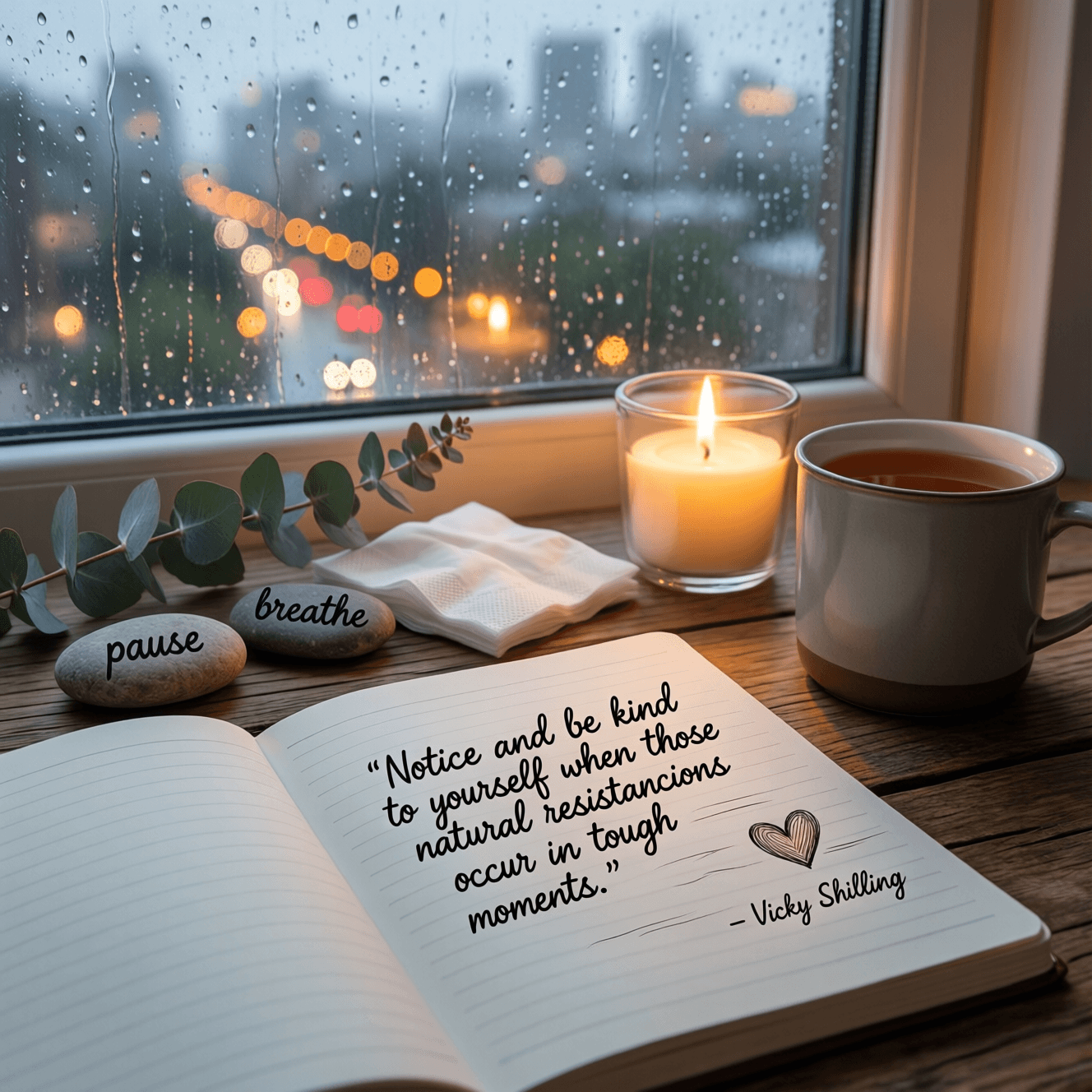
Notice and be kind to yourself when those natural resistances occur in tough moments. — Vicky Shilling
—What lingers after this line?
Resistance as a Normal Human Response
Vicky Shilling’s line reframes “resistance” not as a personal flaw, but as something natural that shows up when life gets difficult. In tough moments, the mind may hesitate, avoid, procrastinate, or tighten into self-protection, and her wording implies this is simply part of being human under strain. From there, the quote subtly shifts the goal: instead of trying to eliminate resistance, we’re invited to expect it and relate to it differently. That expectation alone can reduce the shame that often piles on top of the original struggle.
The Power of Noticing Before Fixing
The first instruction—“Notice”—places awareness ahead of action. Rather than forcing ourselves forward immediately, we pause to observe what’s happening internally: a clenched jaw, racing thoughts, a sudden urge to scroll, or the feeling of “I can’t deal with this.” This transition from autopilot to attention echoes mindfulness-based approaches such as Jon Kabat-Zinn’s *Full Catastrophe Living* (1990), which emphasizes observing experience as it is. By noticing resistance, we create a small space where choice becomes possible, even if the situation itself hasn’t changed.
Why Kindness Works Better Than Pressure
Shilling’s second instruction—“be kind to yourself”—addresses what often follows noticing: self-criticism. Many people respond to resistance with inner pressure (“What is wrong with me?”), which can intensify stress and make the resistance stronger. In contrast, self-kindness treats the moment as one that deserves care, not punishment. Kristin Neff’s work on self-compassion, summarized in *Self-Compassion* (2011), describes how responding to difficulty with warmth and understanding can support resilience. The quote’s message is practical: when you stop fighting yourself, you conserve energy for the actual challenge.
Tough Moments Reveal Hidden Needs
Once we combine noticing with kindness, resistance can be read as information. It may signal overwhelm, fear of failure, grief, uncertainty, or simply fatigue. Instead of interpreting the reaction as laziness or weakness, we begin to ask, “What is this protecting me from?” or “What do I need right now?” This is where the quote becomes gently diagnostic: resistance is not only an obstacle but a clue. By approaching it with compassion, we’re more likely to identify the unmet need underneath—rest, clarity, support, or a smaller next step.
A Simple Practice for Real Life
In everyday terms, Shilling’s advice can look like a brief check-in: “I notice I’m bracing. Of course I am—this is hard.” For instance, before sending a difficult email, you might feel your stomach drop and your mind search for distractions. Rather than escalating into self-judgment, you acknowledge the discomfort and speak to yourself the way you would to a friend. From that softer stance, it becomes easier to act wisely—perhaps by taking two minutes to breathe, drafting a rough version first, or asking someone for feedback. The resistance may not vanish, but it becomes less controlling.
Turning Self-Compassion into Momentum
Finally, the quote implies a hopeful sequence: noticing leads to kindness, and kindness makes movement possible. When you stop treating resistance as an enemy, you can work with it—adjusting expectations, breaking tasks down, or choosing rest without guilt. Over time, this approach can reshape your inner relationship during hardship. Instead of “I’m failing because I’m struggling,” the story becomes “I’m struggling because this is hard, and I can support myself through it.” That shift doesn’t erase tough moments, but it can make them more survivable—and more humane.
One-minute reflection
What feeling does this quote bring up for you?
Related Quotes
6 selectedMindfulness is a way of befriending ourselves and our experience. — Jon Kabat-Zinn
Zinn
At its core, Jon Kabat-Zinn’s statement reframes mindfulness as an act of friendship rather than self-improvement. To be mindful is not merely to pay attention, but to meet our thoughts, feelings, and bodily sensations w...
Read full interpretation →Rest for you could look like moving slower as you clean the house or being mindful while you make a meal. It probably means being nicer to yourself. — Jeff Brown
Jeff Brown
At first glance, Jeff Brown’s reflection challenges the common idea that rest only happens when all activity stops. Instead, he suggests that rest can exist inside ordinary moments: in the pace we choose, the attention w...
Read full interpretation →Beyond a wholesome discipline, be gentle with yourself. — Jim Rohn
Jim Rohn
At first glance, Jim Rohn’s line places two values side by side that are often treated as opposites: discipline and gentleness. Yet the force of the quote lies in its quiet correction.
Read full interpretation →It is not a sign that you are doing something wrong to need a break; it is a sign that you are human. — Nedra Glover Tawwab
Nedra Glover Tawwab
At its core, Nedra Glover Tawwab’s quote rejects the harsh belief that constant productivity is the measure of worth. Instead, it reframes the need for a break as evidence of our basic humanity: bodies tire, minds overlo...
Read full interpretation →Being kind enough to give yourself a break is the wisest thing you can do for your future. — Julia Cameron
Julia Cameron
At first glance, Julia Cameron’s line sounds gentle, but its core claim is surprisingly strong: giving yourself a break is not indulgence, it is wisdom. She reframes rest as a strategic act, suggesting that the future is...
Read full interpretation →Self-care is not about fixing everything; it's about tending to yourself with the same consistency and care you give to others. — Erica Diamond
Erica Diamond
At first glance, Erica Diamond’s quote challenges a common misunderstanding: self-care is not a dramatic solution to every personal struggle. Instead, it is a sustained practice of noticing what you need and responding w...
Read full interpretation →More From Author
More from Vicky Shilling →