
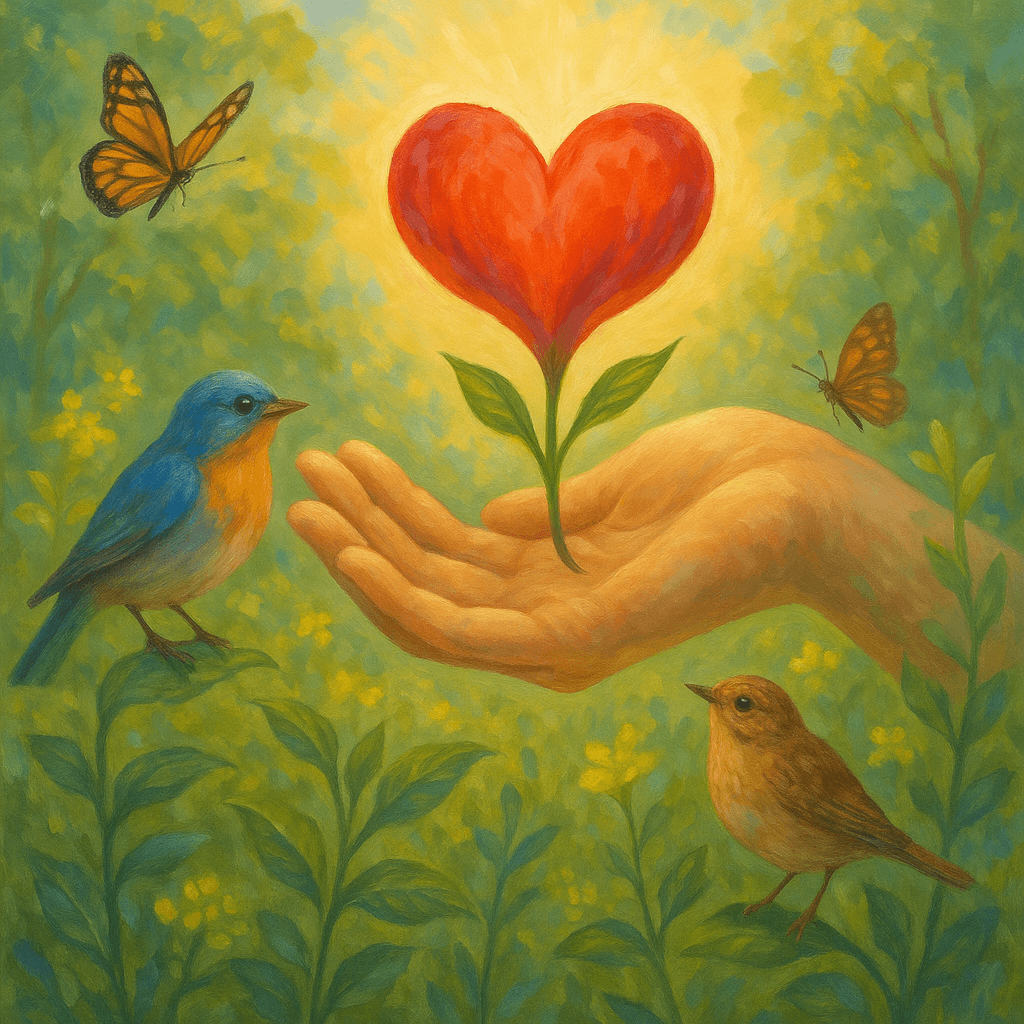
The open hand is the open heart. — African Proverb
—What lingers after this line?
The Symbolism of the Open Hand
At the heart of this African proverb lies the evocative image of an open hand—a universal symbol of giving and welcoming. Unlike a closed fist that clings and guards, the open hand offers without reservation. This gesture transcends culture, communicating trust, readiness to help, and a willingness to connect with others. The proverb implies that material generosity is intricately linked to emotional openness.
Connecting Generosity to Emotional Openness
Moving beyond physical gestures, the proverb deftly draws a line between generosity of resources and generosity of spirit. In many African communities, communal living and resource sharing are vital survival strategies, but they are also profound acts of empathy. An open hand, therefore, isn't merely about giving material goods—it reflects a heart that is likewise unguarded and receptive. As anthropologist Marcel Mauss noted in his study *The Gift* (1925), the act of giving forges bonds that transform communities.
Examples from Literature and History
This alignment of hand and heart surfaces throughout literature and history. In Chinua Achebe's *Things Fall Apart* (1958), acts of hospitality—such as sharing kola nuts and meals—represent affection and respect. Such customs underscore how open-handedness sustains not just individuals but entire societies. From early village traditions to modern philanthropic movements, the intertwining of outward and inward generosity remains a powerful societal glue.
Modern Implications of the Proverb
In a world increasingly defined by individualism, the proverb’s wisdom remains relevant. Today, social scientists emphasize the psychological benefits of altruism: people who give freely also report higher rates of happiness and fulfillment. Thus, the open hand is not just a metaphor but a practical approach to cultivating resilient, empathetic relationships. By fostering openness, communities can transcend isolation and forge genuine connections.
The Enduring Legacy of Generosity
Ultimately, ‘The open hand is the open heart’ reminds us that material generosity and emotional empathy are inseparable virtues. As we navigate complex social landscapes, embodying this proverb can bridge divides, heal wounds, and inspire reciprocal kindness. By keeping both hand and heart open, we align ourselves with a legacy of compassion that continues to shape societies worldwide.
One-minute reflection
What's one small action this suggests?
Related Quotes
6 selectedYour heart is your greatest treasure. Keep it safe, but give it freely. — Vietnamese Proverb
Vietnamese Proverb
The proverb highlights the significance of the heart, metaphorically representing one’s emotions, love, and compassion. It underscores that these aspects are incredibly valuable and should be cherished.
Read full interpretation →Act from the center of your compassion and let generosity be your compass. — Kahlil Gibran
Kahlil Gibran
To begin, Gibran’s counsel places motivation before method: act from the center of your compassion. The word center suggests an interior equilibrium rather than a passing impulse, an anchoring place where concern for oth...
Read full interpretation →You must love in such a way that the person you love feels free. — Thich Nhat Hanh
Thich Nhat Hanh
At its core, Thich Nhat Hanh’s statement redefines love as an act of care that does not confine. To love someone so that they feel free means offering affection without turning it into control, guilt, or dependence.
Read full interpretation →The sort of fearless openness required to turn toward our suffering is only possible within the spacious receptivity of love. — Frank Ostaseski
Frank Ostaseski
Frank Ostaseski’s statement begins with a striking claim: real courage is not simply toughness or willpower. Instead, the bravery required to face suffering honestly arises from love’s presence.
Read full interpretation →Healing is an art. It takes time, it takes practice, it takes love. — Maza Dohta
Maza Dohta
Maza Dohta’s quote begins by reframing healing as an art rather than a mechanical repair. That distinction matters, because art is rarely instant: it involves sensitivity, patience, revision, and care.
Read full interpretation →The only way to exist in a world that feels increasingly cold is to be the warmth you wish to receive from others. — Maya Angelou
Maya Angelou
At its core, Maya Angelou’s line reframes loneliness as a call to action rather than a verdict on the world. If life feels impersonal, distant, or harsh, she suggests that waiting passively for kindness may only deepen t...
Read full interpretation →More From Author
More from African Proverb →When the roots are deep, there is no reason to fear the wind. — African Proverb
The proverb frames life as weather and character as a tree: when roots run deep, wind becomes something to endure rather than something to dread. In that image, fear is not denied so much as put in its place—storms still...
Read full interpretation →The closer one comes to truth, the simpler everything becomes. — African Proverb
The proverb suggests that truth has a clarifying power: as you approach what is real, the extra clutter—misdirection, anxiety, and needless complication—falls away. In other words, complexity often signals that we are st...
Read full interpretation →The sun does not hurry to rise, yet it never misses its mark. — African Proverb
The proverb begins with an image so familiar it’s easy to overlook: sunrise. The sun appears without strain, without haste, and without visible anxiety about being “on time.” And yet, day after day, it arrives.
Read full interpretation →Do not look where you fell, but where you slipped. — African Proverb
The proverb urges a subtle but powerful change in attention: don’t fixate on the place where you landed in pain or embarrassment; instead, examine the moment your footing first failed. In other words, the visible setback...
Read full interpretation →