
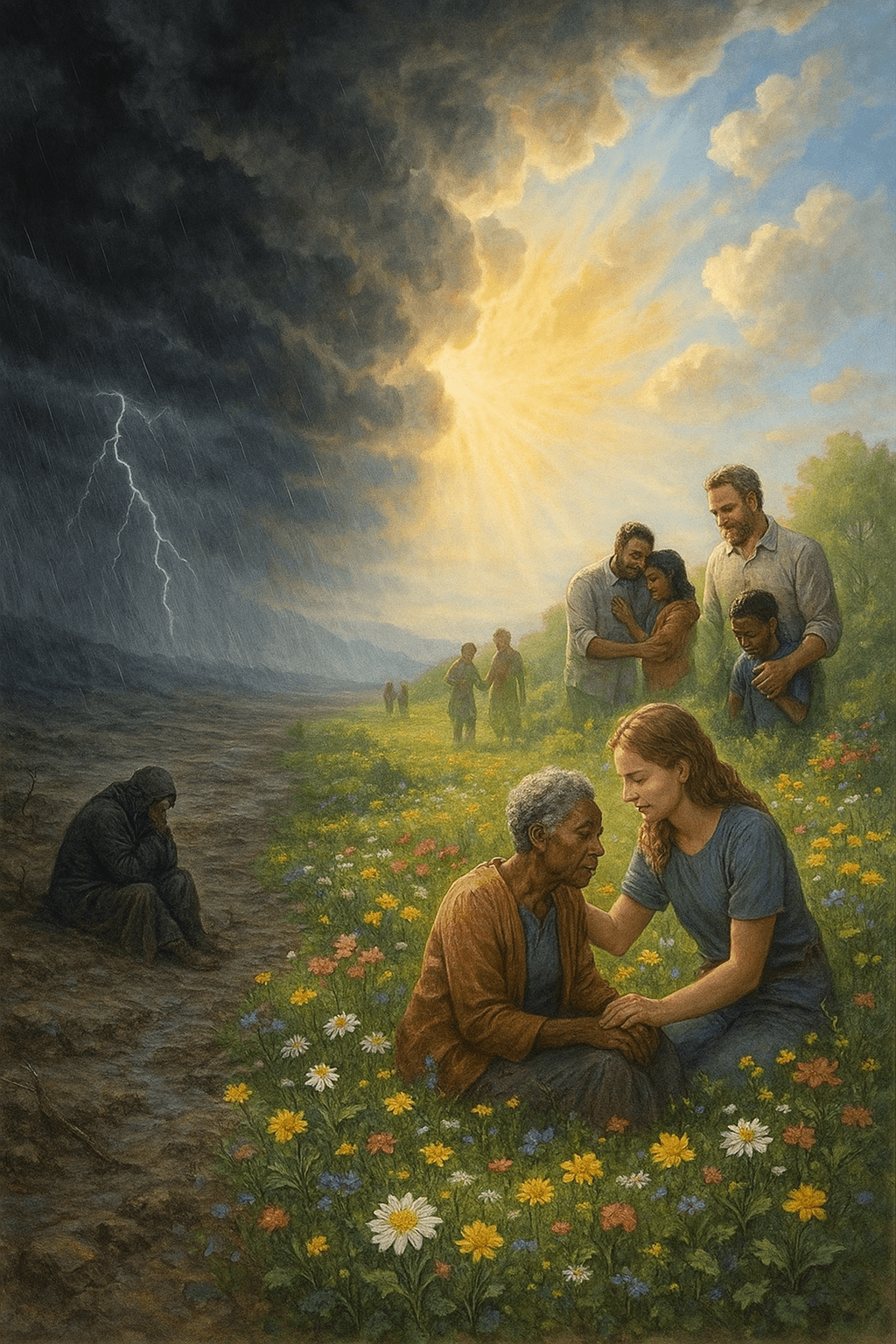
To be hopeful in bad times is not just foolishly romantic. It is based on the fact that human history is a history not only of cruelty but also of compassion. — Howard Zinn
—What lingers after this line?
Redefining Hope in Troubling Times
Often dismissed as naïve, hope during adversity is more than mere wishful thinking. Howard Zinn challenges the notion that optimism is delusional, asserting instead that it draws legitimacy from historical experience. By insisting that hope is rooted in human behavior across the ages, Zinn invites us to see optimism as a rational—and even courageous—response to hardship.
Human History: A Tapestry of Contrasts
Human history, as Zinn observes, is not a monolithic narrative of cruelty and suffering. It is equally woven with acts of compassion, solidarity, and courage. For example, during World War II’s darkest hours, ordinary individuals risked their lives to save others, as in stories of resistance in Nazi-occupied Europe. These moments serve as reminders that even amidst cruelty, humanity’s capacity for good persists.
Hope as a Catalyst for Action
Zinn’s perspective transitions seamlessly into the idea that hope is not passive. Rather, it is a motivating force that empowers people to challenge injustice and imagine alternate futures. The U.S. civil rights movement, led by figures like Martin Luther King Jr., exemplifies how collective hope fueled societal transformation. Far from disengaging, hope compels individuals and communities to act in pursuit of a better world.
Romanticism Versus Realism
While some may view belief in compassion’s triumph as unrealistic, Zinn’s analysis offers a pragmatic balance between romanticism and realism. Historical accounts, such as those documented in Zinn’s own ‘A People’s History of the United States’ (1980), reveal countless episodes where empathy and justice shaped events as profoundly as violence ever did. Recognizing this duality allows us to avoid cynicism and appreciate the full scope of the human journey.
Nurturing Hope Through Shared Memory
As we move forward, Zinn’s insight asks us to remember and amplify stories of kindness and resistance. By celebrating these moments, societies can nurture hope and resilience, inspiring new generations to continue the legacy of compassion. Thus, hope becomes not only an emotion but a conscious stance—one that acknowledges hardship yet insists on the transformative power inherent in the human spirit.
One-minute reflection
Why might this line matter today, not tomorrow?
Related Quotes
6 selectedJust because your light flickers does not mean it is about to go out. — Yohancé Salimu
Yohancé Salimu
At first glance, Yohancé Salimu’s line separates appearance from reality. A flicker suggests instability, fatigue, or interruption, yet it does not automatically signal extinction.
Read full interpretation →Today's tears water tomorrow's gardens. — Matshona Dhliwayo
Matshona Dhliwayo
At first glance, Matshona Dhliwayo’s line transforms grief into something unexpectedly fertile. Tears, usually seen as signs of pain or loss, become water for a future garden, suggesting that suffering is not merely endu...
Read full interpretation →You must love in such a way that the person you love feels free. — Thich Nhat Hanh
Thich Nhat Hanh
At its core, Thich Nhat Hanh’s statement redefines love as an act of care that does not confine. To love someone so that they feel free means offering affection without turning it into control, guilt, or dependence.
Read full interpretation →Hope is passion for the possible. — Søren Kierkegaard
Søren Kierkegaard
At first glance, Kierkegaard’s line transforms hope from a passive feeling into an active force. To call hope “passion for the possible” means that hope is not mere daydreaming; rather, it is an inward energy that leans...
Read full interpretation →The sort of fearless openness required to turn toward our suffering is only possible within the spacious receptivity of love. — Frank Ostaseski
Frank Ostaseski
Frank Ostaseski’s statement begins with a striking claim: real courage is not simply toughness or willpower. Instead, the bravery required to face suffering honestly arises from love’s presence.
Read full interpretation →A ship should not ride on a single anchor, nor life on a single hope. — Epictetus
Epictetus
At first glance, Epictetus turns a practical image into a moral lesson: a ship secured by only one anchor is vulnerable to shifting winds, rough tides, and hidden strain. In the same way, a life fastened to a single hope...
Read full interpretation →More From Author
More from Howard Zinn →The future is an infinite succession of presents, and to live now as we think human beings should live is a defiance of all that is bad around us. — Howard Zinn
Howard Zinn’s statement begins by reframing time itself: the future is not a distant realm waiting to arrive, but an endless chain of present moments. In that sense, he strips away the comforting illusion that justice ca...
Read full interpretation →In every society, it is the self-serving that prosper. — Howard Zinn
Howard Zinn highlights the systemic injustice in societies where those who prioritize their own interests over the collective good tend to succeed. This suggests that wealth and power often go to those who manipulate the...
Read full interpretation →Act in accordance with your values and you will find your soul. — Howard Zinn
This quote emphasizes the importance of living according to one’s values and moral beliefs. Zinn suggests that true self-realization—or finding one's soul—comes from acting in ways that are consistent with who we truly a...
Read full interpretation →