
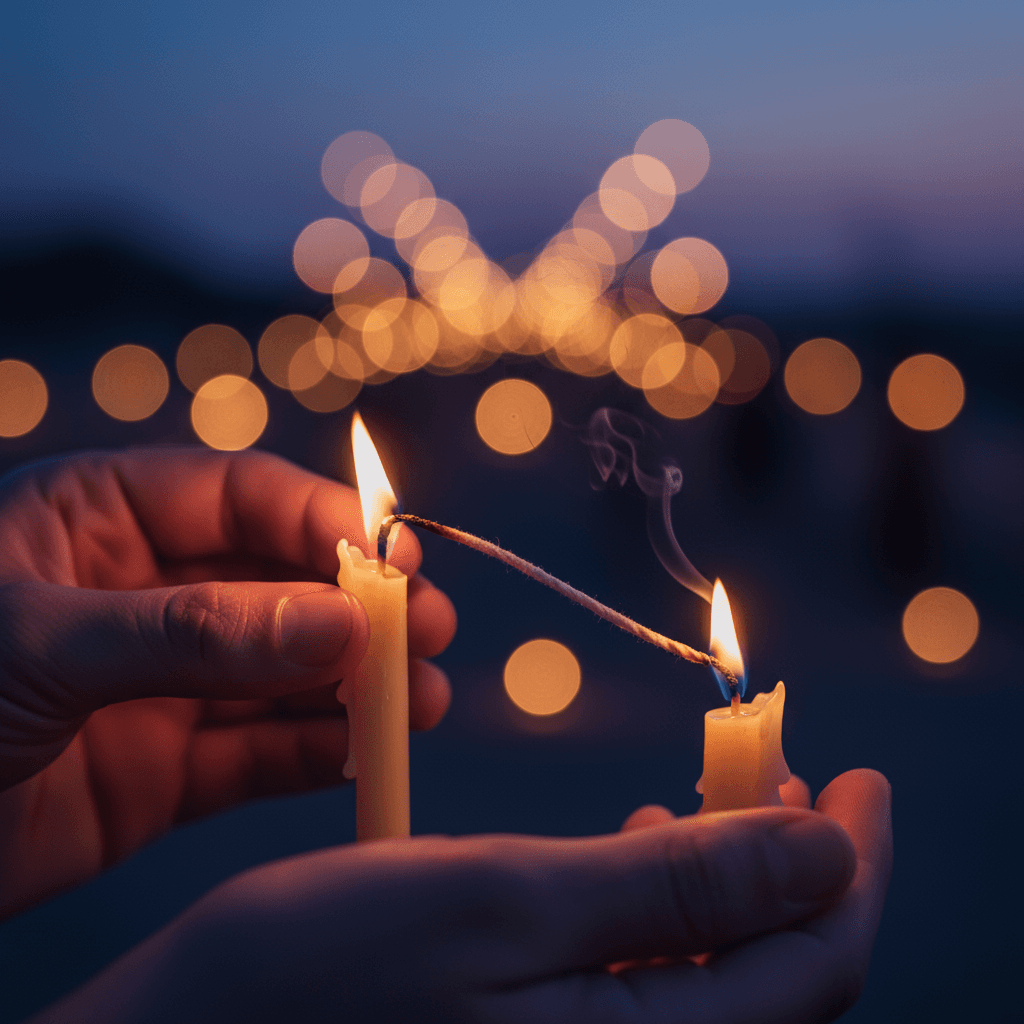
Protect your spark and share it—light spreads best when it meets another flame. — Malala Yousafzai
—What lingers after this line?
The Double Duty of Light
Malala Yousafzai’s line carries a twinned imperative: safeguard your inner energy while letting it kindle others. In other words, resilience and generosity are not rivals but partners. A spark that is hoarded risks suffocation, yet a spark shared without care can burn out. Holding both truths at once reframes service as sustainable: we keep our flame steady so it can meet, and then multiply with, other flames. This balance sets the stage for collective change that neither isolates the self nor dissolves it.
A Flame’s Physics, A Movement’s Logic
The metaphor works because it mirrors how fire behaves. A candle can light another without losing its own flame; what matters is shelter from wind and a steady supply of fuel. Likewise, ideas and courage amplify when they are protected—think boundaries, rest, and mentors—and then shared intentionally. The lantern comes before the lighthouse. By translating this simple physics into social action, we see why personal care is not indulgence but infrastructure for impact.
How Courage Spreads in Networks
Social science backs the image of light meeting light. Christakis and Fowler’s Connected (2009) shows behaviors—helping, quitting smoking, even happiness—travel through networks across several degrees of separation. Moreover, moral emotions are contagious: Haidt (2000) describes “moral elevation,” the uplift we feel when witnessing courage, which then nudges us to act. Through the lens of social learning, Bandura (1977) explains how modeled behavior becomes a template others adopt. Thus, when your spark visibly meets another, it doesn’t just add—it cascades.
Malala’s Spark Meeting Other Flames
Malala’s own path exemplifies the principle. Her BBC Urdu diary (2009) protected a fragile spark by giving it a discreet, structured outlet; after surviving the 2012 attack, her 2013 UN address—“Malala Day”—became a torch passed to millions. Crucially, the Malala Fund channels resources to local champions, the so‑called Gulmakai Network, letting many flames burn where they live. The transition from solitary testimony to distributed leadership shows how safeguarded courage scales when it encounters equally committed peers.
Historical Proof of Shared Illumination
History repeatedly demonstrates light spreading on contact. Rosa Parks’s quiet defiance in 1955 ignited the Montgomery Bus Boycott, but only because it met a prepared community—Jo Ann Robinson’s organizing and the Montgomery Improvement Association’s networks were already in place. Earlier, the suffrage movement advanced when local clubs linked into national coalitions, amplifying lone voices into mass action (e.g., NAWSA conventions, early 1900s). In each case, the initial spark did not blaze in isolation; it fused with other flames to create sustained heat.
Practices to Guard and Give Your Light
Practically speaking, first wind‑proof your candle: establish rest rhythms, peer supervision, and clear boundaries to prevent burnout. Then, share deliberately: tell concrete stories, invite co‑ownership, and host small circles where agency is distributed, not centralized. Micro‑mentoring—brief, regular check‑ins—often sustains more light than sporadic grand gestures. Finally, design for handoffs: write playbooks, document lessons, and make pathways for newcomers so the flame can leap without you as the bottleneck.
Ethics of Sharing Without Overpowering
Yet, as Paulo Freire’s Pedagogy of the Oppressed (1970) cautions, illumination must be dialogical, not domineering. Sharing your light should increase others’ capacity, not cast shadows that erase their agency. Seek consent, credit local knowledge, and expect reciprocity rather than dependence. In this way, the meeting of flames becomes a commons—not a spotlight—where many can see, contribute, and carry fire onward.
One-minute reflection
Why might this line matter today, not tomorrow?
Related Quotes
6 selectedYour presence is a form of resistance against a culture that profits from your isolation. Show up for those you love, even when it is inconvenient. — bell hooks
bell hooks
At first glance, bell hooks reframes something ordinary—being present for others—as a political and moral act. Her words suggest that care is not merely private sentiment; rather, it pushes back against a social order th...
Read full interpretation →Live like a tree, alone and free, and like a forest in brotherhood. — Nâzım Hikmet
Nâzım Hikmet
Nâzım Hikmet’s line opens with a vivid pairing: the solitary tree and the interwoven forest. A tree suggests a life rooted in self-reliance—standing on its own, taking up space without apology, and growing according to i...
Read full interpretation →Joy is found where we lend our hands to another's burden. — Desmond Tutu
Desmond Tutu
Desmond Tutu’s line reframes joy as something discovered rather than stored up—an experience that arises when our lives intersect with someone else’s needs. Instead of treating happiness like a private achievement, he su...
Read full interpretation →You can't hold a man down without staying down with him. — Booker T. Washington
Booker T. Washington
Booker T. Washington’s line turns a physical act—holding someone down—into a moral diagram.
Read full interpretation →Trust the small sparks within you; they will set meaning alight. — William Blake
William Blake
Blake’s invitation to “trust the small sparks within you” begins with the simple act of noticing them. These sparks are the fleeting intuitions, half-formed ideas, and quiet longings that surface between the demands of d...
Read full interpretation →The will of fire burns brightest when shared. — Hashirama Senju, Naruto Series
Hashirama Senju, Naruto Series
Hashirama Senju’s line, “The will of fire burns brightest when shared,” captures a paradox at the heart of human motivation: some inner flames strengthen not by being guarded, but by being given. In the world of Naruto,...
Read full interpretation →More From Author
More from Malala Yousafzai →Stand firm in tenderness; strength without compassion narrows the soul. — Malala Yousafzai
Malala Yousafzai’s line reframes tenderness not as softness, but as a disciplined stance—something you “stand firm” in. In other words, compassion is not a mood that comes and goes; it is a choice that can hold steady un...
Read full interpretation →Let your questions be louder than your fears. — Malala Yousafzai
Malala Yousafzai’s line hinges on a simple but powerful metaphor: fears and questions both speak inside us, yet we can choose which one gets the microphone. Rather than pretending fear doesn’t exist, she implies it will...
Read full interpretation →Let your voice be the river that nourishes the valleys of doubt — Malala Yousafzai
Malala Yousafzai’s line turns “voice” into something living and vital: a river that continuously moves, carries, and gives. Rather than portraying speech as a single act—one speech, one post, one declaration—she frames i...
Read full interpretation →Stand where your heart points, even if the road is less traveled. — Malala Yousafzai
Malala Yousafzai’s line treats the heart not as a fickle impulse but as a moral compass—an inner pointer toward what feels true and necessary. To “stand” where it points suggests steadiness: not merely choosing once, but...
Read full interpretation →