
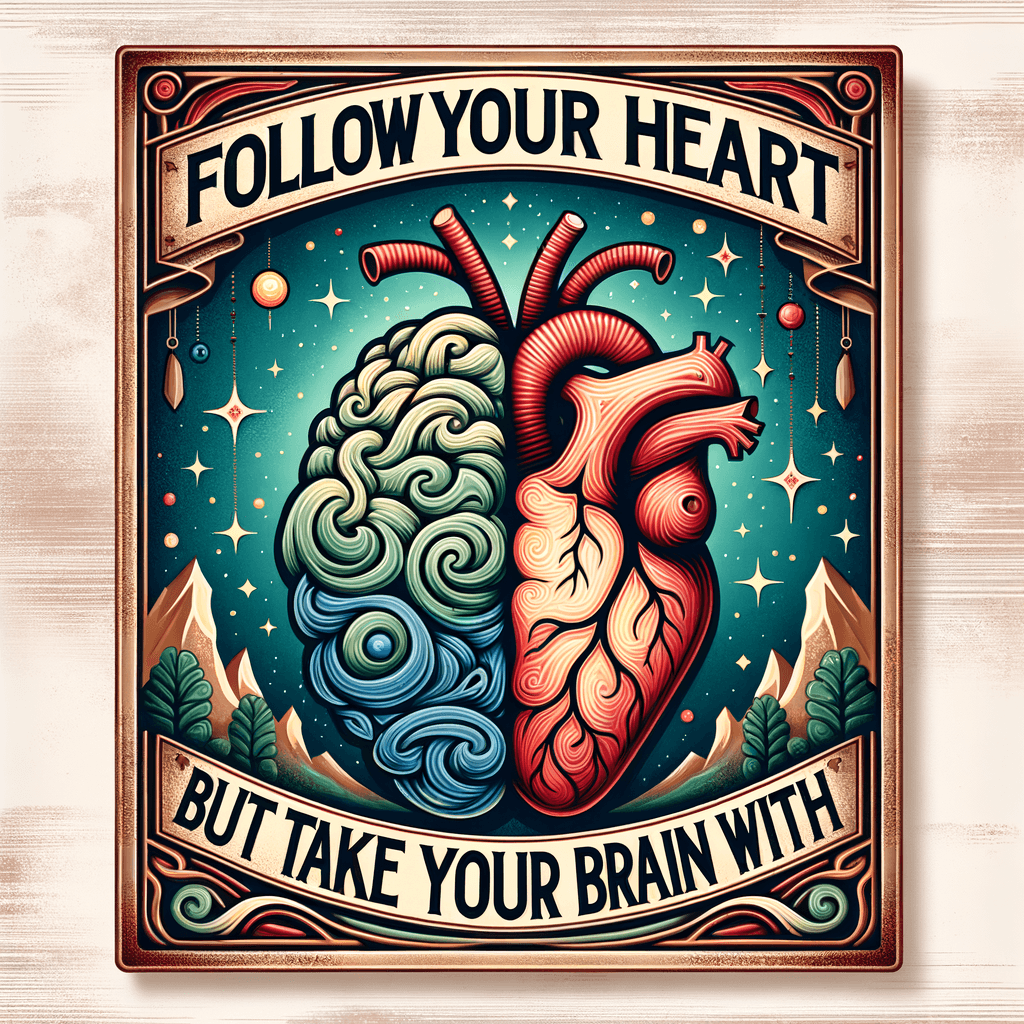
Follow your heart, but take your brain with you. — Franklin P. Jones, USA.
—What lingers after this line?
Balance Between Emotion and Reason
This quote emphasizes the importance of finding a balance between your emotions and rational thinking. While it encourages pursuing one's passions and feelings, it also highlights the necessity of using logic to guide those pursuits.
Practical Decision-Making
By suggesting to 'take your brain with you,' the quote underscores the idea that decisions made solely on emotion can lead to complications. It advises that practicality and reason should accompany emotional choices.
Wisdom in Pursuing Desires
The phrase advocates for wisdom when following one's heart. It suggests that while passion is vital, being equipped with knowledge and foresight is essential to achieve meaningful and fulfilling outcomes.
Self-Awareness and Reflection
This perspective encourages self-reflection and self-awareness, urging individuals to assess their motivations and the potential consequences of their actions before acting on their feelings.
Franklin P. Jones' Influence
Franklin P. Jones was an American writer renowned for his witty aphorisms. His quotes often carry a blend of humor and wisdom, reflecting a pragmatic yet positive outlook on life.
One-minute reflection
What feeling does this quote bring up for you?
Related Quotes
6 selectedTo handle yourself, use your head; to handle others, use your heart. — Eleanor Roosevelt, United States.
Eleanor Roosevelt, United States.
This quote highlights the importance of rational thinking and self-discipline in managing one’s own emotions and decisions. Using your head implies making thoughtful choices based on logic and reason.
Read full interpretation →In an age of technical speed, the most valuable skills are the human ones: empathy, adaptability, and the quiet strength of emotional intelligence. — Chamidu Weerasinghe
Chamidu Weerasinghe
Chamidu Weerasinghe’s quote begins with a simple observation: technology accelerates everything—communication, production, decision-making—until speed feels like the natural condition of modern life. Yet as our tools bec...
Read full interpretation →Temper desire with reason; in balance you find the strength to move. — Seneca
Seneca
Seneca’s counsel, “Temper desire with reason; in balance you find the strength to move,” captures a central ideal of Stoic philosophy: passion is not the enemy, but a force that must be guided. Rather than urging us to e...
Read full interpretation →Emotionally intelligent people recognize the impact of their thoughts on their feelings and, in turn, their actions. — Daniel Goleman
Daniel Goleman
This quote emphasizes how emotionally intelligent individuals are self-aware enough to understand that their thoughts play a key role in shaping their emotions. Instead of reacting impulsively, they carefully monitor the...
Read full interpretation →Act not according to thy desires, but according to thy reason. — Marcus Aurelius
Marcus Aurelius
This quote emphasizes the importance of using reason rather than being led by desires. Marcus Aurelius, a Stoic philosopher, believed that rational thinking should guide actions rather than impulsive emotions or fleeting...
Read full interpretation →The heart is the chief feature of a functioning mind. — Frank Lloyd Wright
Frank Lloyd Wright
This quote suggests that emotions and intellect are not separate but deeply interconnected. A truly functioning mind is not just rational but also guided by emotions and empathy.
Read full interpretation →More From Author
More from Franklin P. Jones, USA. →