
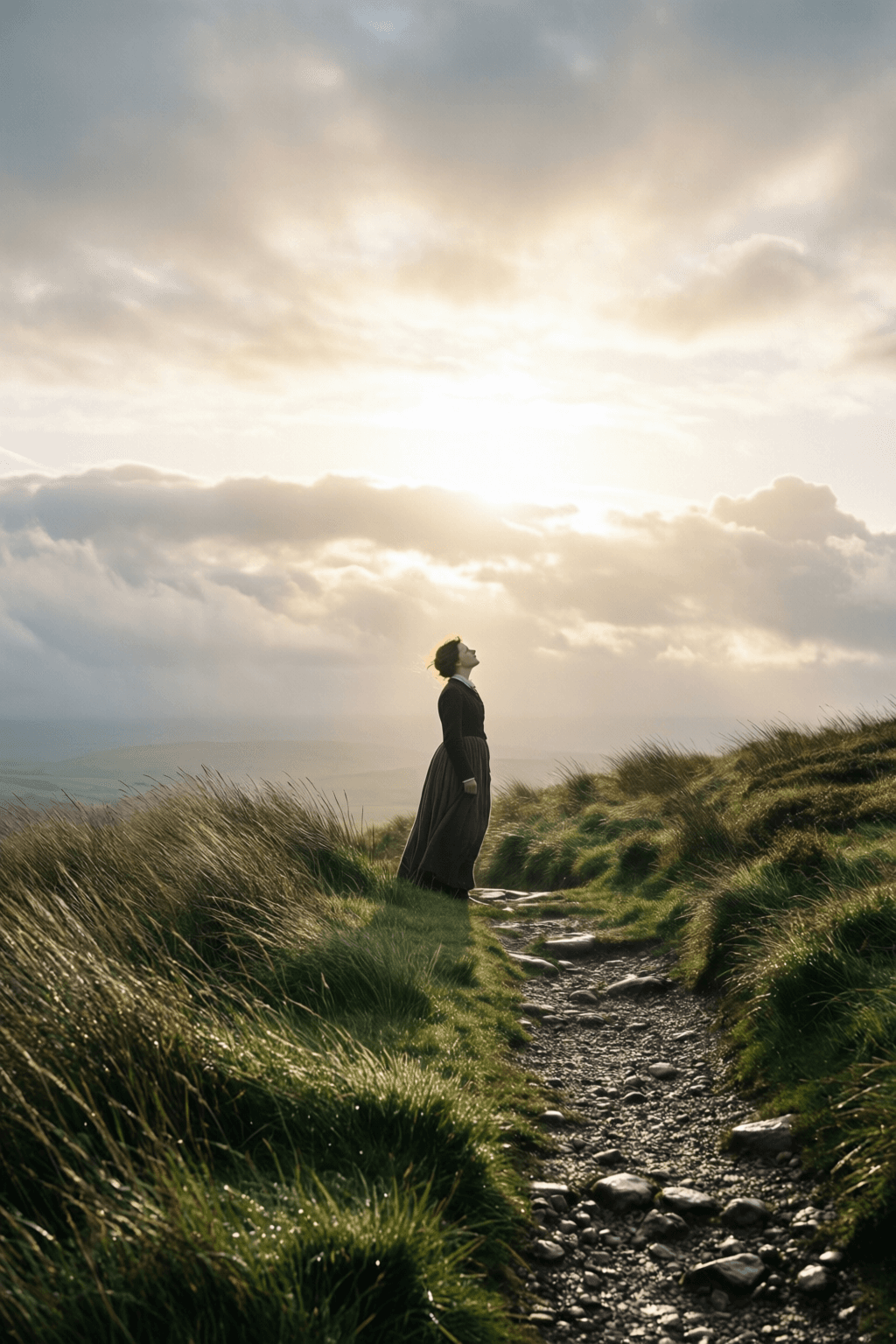
I avoid looking forward or backward, and try to keep looking upward. — Charlotte Brontë
—What lingers after this line?
A Discipline Beyond Regret and Anxiety
Charlotte Brontë’s words begin with a quiet act of discipline: she refuses to be governed by what lies behind or ahead. Looking backward can trap the mind in regret, while looking forward can invite fear of uncertainty. By turning instead “upward,” Brontë suggests a third path—one rooted in hope, faith, and moral steadiness.
The Brontë Context of Hardship
This perspective gains force when placed beside Brontë’s own life. She endured the deaths of siblings, professional rejection, and the emotional isolation of a woman writer in the nineteenth century. Yet, rather than presenting endurance as mere survival, her statement implies a conscious elevation of the spirit above circumstance.
Faith as an Inner Direction
Moving from biography to belief, “upward” can be read as a spiritual orientation. In Victorian England, religious language often shaped how suffering was understood, and Brontë’s phrasing echoes that tradition without becoming narrowly doctrinal. The upward gaze becomes a symbol of trust—an insistence that meaning may exist beyond immediate pain.
Echoes in Jane Eyre
This same moral verticality appears in Brontë’s *Jane Eyre* (1847), where Jane repeatedly resists despair by appealing to conscience and dignity. When she refuses to become Rochester’s mistress, she is not looking backward to injury or forward to comfort; she is looking upward toward principle. In this way, the novel dramatizes the very posture the quote describes.
A Psychology of Resilience
Seen through a modern lens, Brontë’s idea resembles the practice of attention management. Contemporary psychology often emphasizes that rumination about the past and worry about the future can intensify distress. Brontë’s “upward” focus, therefore, anticipates a resilient habit: directing the mind toward values, purpose, and perspective.
The Lasting Lesson of the Upward Gaze
Ultimately, the quote does not ask us to ignore history or abandon planning. Rather, it warns against letting either memory or anticipation become a prison. Brontë’s upward gaze offers a balanced form of courage: to live in the present while drawing strength from something higher than fear, regret, or circumstance.
One-minute reflection
What feeling does this quote bring up for you?
Related Quotes
6 selectedWhen I hear somebody sigh, 'Life is hard,' I am always tempted to ask, 'Compared to what?' — Sydney J. Harris
Sydney J. Harris
Sydney J. Harris’s remark begins with an ordinary expression of fatigue: “Life is hard.” Yet his response, “Compared to what?” quietly turns complaint into inquiry.
Read full interpretation →Where you stand determines what you see and what you do not see; a change in where you stand changes everything. — Søren Kierkegaard
Søren Kierkegaard
Kierkegaard’s insight begins with a simple but unsettling claim: vision is never neutral. Where we stand—socially, emotionally, spiritually, or intellectually—determines not only what comes into view but also what remain...
Read full interpretation →The point is to have a long-term perspective. — Dalai Lama XIV
Dalai Lama XIV
At its core, the Dalai Lama XIV’s remark urges us to lift our eyes from the pressures of the present moment and consider the wider arc of life. A long-term perspective does not deny today’s difficulties; rather, it place...
Read full interpretation →Sometimes all it takes is a tiny shift of perspective to see something familiar in a totally new light. — Dan Brown
Dan Brown
At first glance, Dan Brown’s quote seems simple, yet its force lies in how little it asks of us: not a total reinvention, but a slight adjustment in viewpoint. He suggests that familiarity can dull perception, making peo...
Read full interpretation →Just because your light flickers does not mean it is about to go out. — Yohancé Salimu
Yohancé Salimu
At first glance, Yohancé Salimu’s line separates appearance from reality. A flicker suggests instability, fatigue, or interruption, yet it does not automatically signal extinction.
Read full interpretation →Today's tears water tomorrow's gardens. — Matshona Dhliwayo
Matshona Dhliwayo
At first glance, Matshona Dhliwayo’s line transforms grief into something unexpectedly fertile. Tears, usually seen as signs of pain or loss, become water for a future garden, suggesting that suffering is not merely endu...
Read full interpretation →More From Author
More from Charlotte Brontë →I care for myself. The more solitary, the more friendless, the more unsustained I am, the more I will respect myself. — Charlotte Brontë
Charlotte Brontë’s words begin as a quiet but forceful act of self-possession. Rather than treating loneliness as proof of failure, the speaker transforms it into evidence of resilience.
Read full interpretation →Gratitude is a divine emotion: it fills the heart, but not to bursting; it warms it, but not to fever. — Charlotte Brontë
Charlotte Brontë presents gratitude as both elevated and restrained, calling it a “divine emotion” that enriches the heart without overwhelming it. From the start, her phrasing suggests that true thankfulness is powerful...
Read full interpretation →Stand up to the day with honest work and temperate courage — Charlotte Brontë
Charlotte Brontë’s line begins with a bracing image: you “stand up to the day,” as if daylight itself can challenge your resolve. Rather than drifting into hours on autopilot, she implies a deliberate posture—upright, at...
Read full interpretation →I am not a bird; and no net ensnares me: I am a free human being with an independent will. — Charlotte Brontë
This quote highlights the importance of personal freedom and autonomy. The speaker rejects the notion of being trapped or controlled, emphasizing their inherent right to self-determination.
Read full interpretation →