
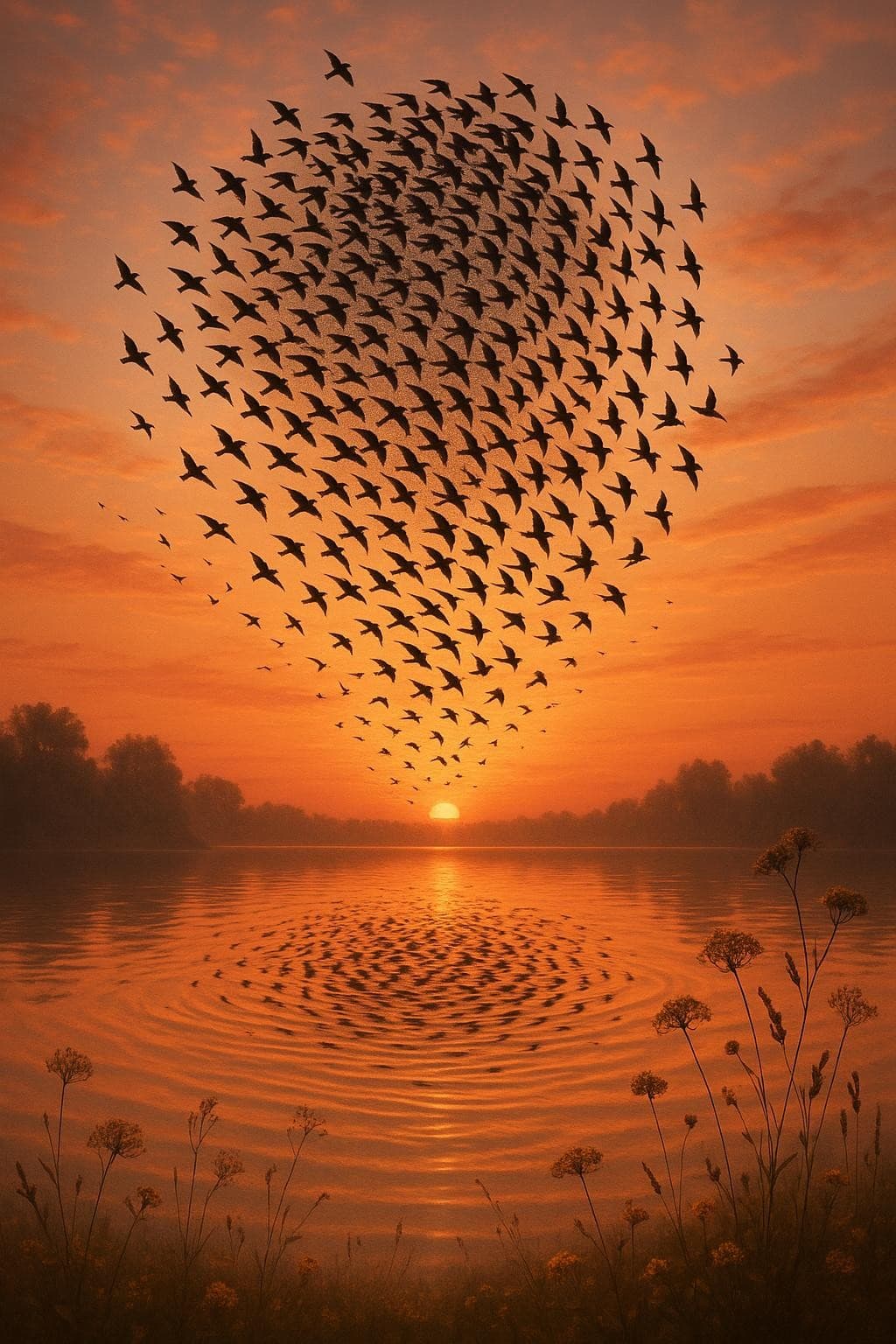
In the dance of life, movement writes the music. — Deng Ming-Dao
—What lingers after this line?
The Interplay of Action and Experience
Deng Ming-Dao’s evocative metaphor suggests that in our journey through life, it is our actions—our ‘movement’—that give rise to meaning and rhythm. While we might often think of music as the underlying structure guiding a dance, here the roles are reversed: it is movement itself that brings music into existence. This inversion encourages us to see how the choices we make and the steps we take generate the emotional landscape we inhabit.
Creativity Through Initiative
Building upon this theme, the act of ‘writing music’ through movement emphasizes the power of initiative and creativity. Just as a dancer improvising on stage can inspire an entirely new musical phrase, our willingness to engage with life’s challenges and opportunities shapes the melody of our existence. In this way, passive waiting is replaced by active engagement, transforming uncertainty into possibility—as famously echoed in Martha Graham’s assertion that ‘movement never lies.’
Ancient Wisdom in Motion
Drawing from Daoist philosophy, which profoundly influences Deng Ming-Dao’s writings, we see movement not only as physical action but as a principle of natural flow. The Dao De Jing (c. 400 BC) teaches that all life is change and that being attuned to the ongoing currents allows us to act in harmony with the world. Thus, ‘movement’ encompasses adaptation, resilience, and an openness to transformation, crafting the music of our lives in harmony with a greater Whole.
Everyday Examples of Movement Creating Meaning
In everyday life, small decisions and actions—be it reaching out to a friend, pursuing a career shift, or simply walking outdoors—carry the power to shift our emotional ‘soundtrack.’ Consider the example of an artist who begins a project with no clear idea of the outcome; each brushstroke or gesture gradually reveals a theme, a tempo, a song unique to that journey. Through this process, the music of one’s life is composed in real time, shaped by movement and intention.
Embracing Authorship of Our Life’s Song
Ultimately, this perspective invites us to recognize our own agency. By consciously moving—both physically and metaphorically—we become composers of our personal symphony. Rather than waiting for external circumstances to set the tone, it is through our proactive engagement with each moment that we give rise to something beautiful and distinct. Thus, embracing movement as the author of music encourages a life lived deliberately, with awareness that every motion shapes the melody ahead.
One-minute reflection
Why might this line matter today, not tomorrow?
Related Quotes
6 selectedMovement is life; without movement life is unthinkable. — Moshe Feldenkrais
Moshe Feldenkrais
At its core, Moshe Feldenkrais’s statement collapses the distance between living and moving. He is not speaking only of walking, stretching, or exercise, but of the constant activity that makes existence possible: breath...
Read full interpretation →Rest is not a passive indulgence; it is the essential rhythm that allows the heart to beat again. — Pema Chödrön
Pema Chödrön
At first glance, Pema Chödrön’s line challenges a common assumption: that rest is mere inactivity or a reward for productivity. Instead, she frames it as an essential rhythm, something woven into life itself rather than...
Read full interpretation →Clarity rarely comes from urgency; it comes from rhythm. — The Balanced Edit
The Balanced Edit
At its heart, this quote sets urgency against rhythm as two very different ways of moving through thought. Urgency pushes for immediate output, often mistaking speed for insight, whereas rhythm suggests steadiness, pacin...
Read full interpretation →Movement is medicine for the soul; you don't need a destination, only the willingness to keep going. — Haruki Murakami
Haruki Murakami
Murakami’s line begins with a simple but profound claim: movement itself can heal. Rather than treating motion as merely a way to arrive somewhere, he frames it as a restorative act for the inner life.
Read full interpretation →There is no use in being in a hurry; it is much better to be in a rhythm. — Tunde Oyeneyin
Tunde Oyeneyin
Tunde Oyeneyin’s line challenges the modern reflex to equate speed with progress. Being “in a hurry” often feels productive, yet it can scatter attention and invite avoidable mistakes, leaving us tired without moving mea...
Read full interpretation →Sing what you will do, then let your feet keep time. — Sappho
Sappho
Sappho’s line invites a union of declaration and embodiment: first voice the plan, then let the body prove it. In archaic Greek lyric, songs were not just heard; they were performed with lyre, breath, and often choreogra...
Read full interpretation →More From Author
More from Dao →The moon does not fight. It attacks no one. It does not worry. It does not try to crush others. It keeps to its course, but by its very nature, it gently influences. What other body could pull an entire ocean from shore to shore? The moon is faithful to its nature, and its power is never diminished. - Deng Ming-Dao
The quote highlights the moon's ability to influence without aggression. Unlike entities that employ force or conflict, the moon exemplifies gentle, yet profound influence, suggesting that power can be wielded peacefully...
Read full interpretation →The moon does not fight. It attacks no one. It does not worry. It does not try to crush others. It keeps to its course, but by its very nature, it gently influences. What other body could pull an entire ocean from shore to shore? The moon is faithful to its nature, and its power is never diminished. - Deng Ming-Dao
This quote highlights the strength that can be found in gentleness and non-aggression. Like the moon, one can have a profound impact without force or conflict.
Read full interpretation →Your doubts are paper tigers. — Deng Ming-Dao
Deng Ming-Dao’s evocative phrase positions doubt as a ‘paper tiger’—a creature that appears menacing but is ultimately harmless. This metaphor, rooted in Chinese idiom, highlights the disparity between fear’s appearance...
Read full interpretation →