
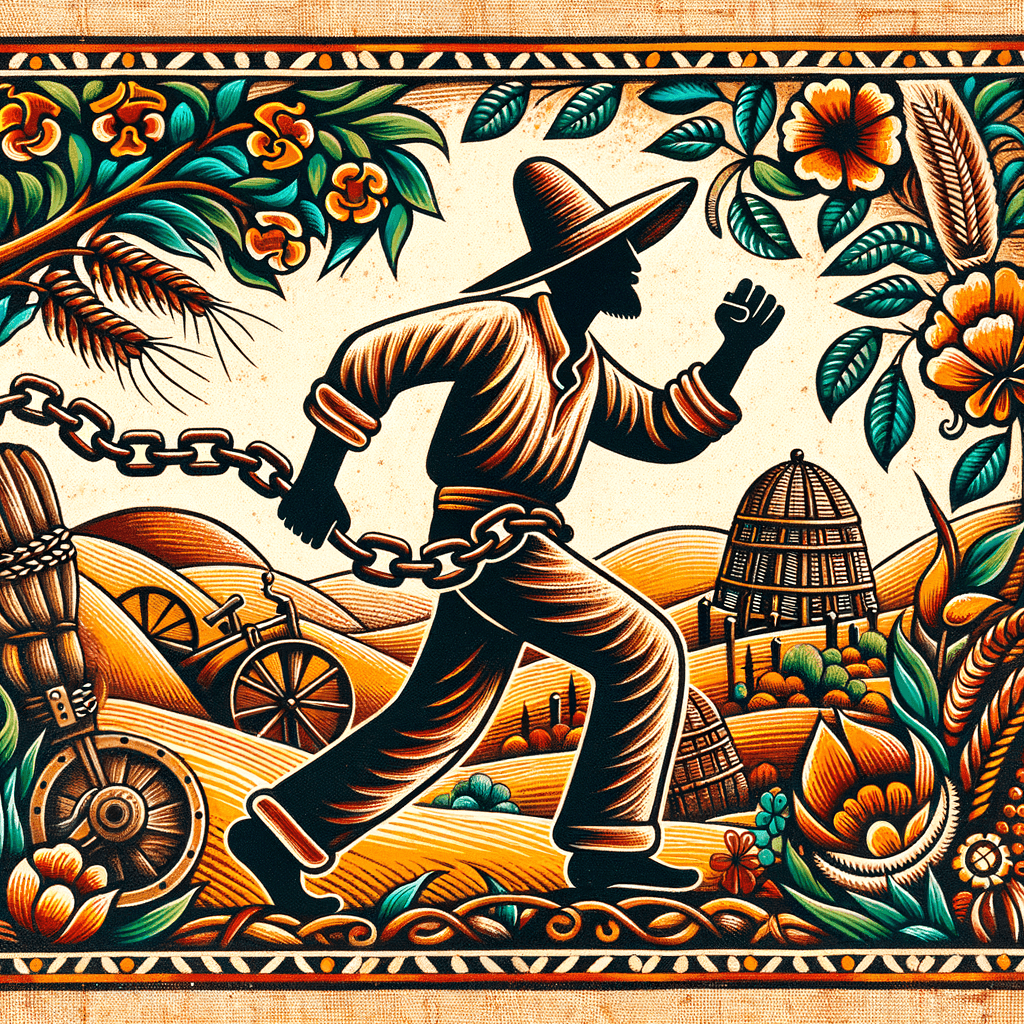
He who moves does not feel the chains. - Mexican Proverb
—What lingers after this line?
Awareness of Limitations
This proverb suggests that a person who is constantly active or busy may not be fully aware of their limitations or constraints. It implies that it is the stillness or lack of movement that makes one feel constrained.
Complacency and Compliance
It can be interpreted as a commentary on complacency. By continuing to move and not questioning their situation, a person might remain unaware of the restrictions or 'chains' placed upon them, thus never striving for change.
Adaptation and Endurance
The proverb also touches on human resilience and adaptation. It suggests that when one is actively engaged in life, they might endure difficult situations better because they adapt and cope more effectively.
Illusion of Freedom
This saying can be seen as a reflection on the illusion of freedom. Even if one is bound by invisible chains (such as societal expectations or obligations), continuous movement can create a sense of freedom, masking the true restrictions.
Cultural Context
Mexican proverbs often reflect deep cultural wisdom and insights. This particular saying may mirror the historical and social realities of Mexican life, emphasizing the importance of perseverance and the often unseen nature of constraints.
One-minute reflection
What's one small action this suggests?
Related Quotes
6 selectedYour home should lower your shoulders the moment you walk in. — Unknown (attributed to design philosophy/experts, but skipping as per rules: switching to:) The boundary to what we can accept is the boundary to our freedom. — Tara Brach
Tara Brach
At first glance, Tara Brach’s statement sounds simple, yet it points to a profound inner mechanism: the limits of our freedom are often set not only by external conditions, but by what we refuse to face within ourselves....
Read full interpretation →Movement is life; without movement life is unthinkable. — Moshe Feldenkrais
Moshe Feldenkrais
At its core, Moshe Feldenkrais’s statement collapses the distance between living and moving. He is not speaking only of walking, stretching, or exercise, but of the constant activity that makes existence possible: breath...
Read full interpretation →The boundary to what we can accept is the boundary to our freedom. — Tara Brach
Tara Brach
At first glance, Tara Brach’s statement suggests that freedom is not only shaped by external circumstances but also by our inner willingness to face reality. What we cannot accept—whether grief, uncertainty, fear, or imp...
Read full interpretation →True freedom is found in the discipline to choose what you want most over what you want in this fleeting moment. — Arden Mahlberg
Arden Mahlberg
At first glance, freedom is often imagined as the ability to do whatever one wants at any given moment. Arden Mahlberg’s statement gently overturns that assumption by suggesting that real freedom is not impulsive indulge...
Read full interpretation →Freedom is knowing what is yours to influence. — Zeno of Citium
Zeno of Citium
At its heart, Zeno’s statement defines freedom not as unlimited power, but as clear discernment. The founder of Stoicism, writing in the early 3rd century BC, argued that human beings suffer when they confuse what belong...
Read full interpretation →The things you own end up owning you. It is only after you lose everything that you're free to do anything. — Chuck Palahniuk
Chuck Palahniuk
At first glance, Palahniuk’s line appears to criticize materialism, yet it goes further by describing a reversal of power. We believe we possess objects, but gradually those objects begin to dictate our time, anxiety, an...
Read full interpretation →More From Author
More from Mexican Proverb →