
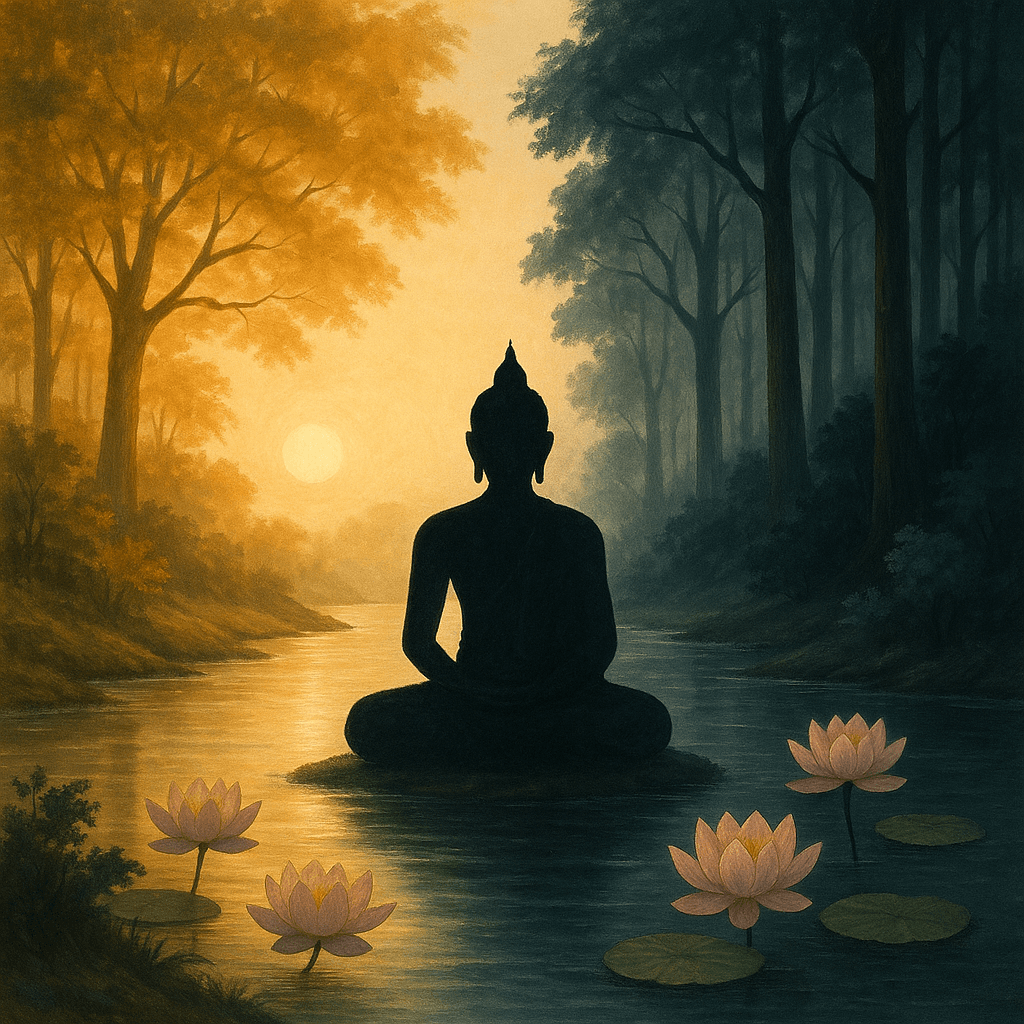
Life is about balance. Be kind, but don’t let people abuse you. Trust, but don’t be deceived. — Buddha
—What lingers after this line?
The Principle of Middle Way
Buddha famously taught the Middle Way, which advocates for moderation and avoiding extremes. In the Dhammapada (c. 3rd century BCE), he emphasizes leading a balanced life rooted in awareness and equanimity. Just as Buddha abandoned both self-indulgence and self-mortification in his search for enlightenment, he urges us to find harmony in kindness and self-protection.
Kindness with Boundaries
True compassion does not mean allowing others to exploit or mistreat us. In Buddhist folklore, the story of the generous king Vessantara (Jataka tales) illustrates how excessive generosity without discernment can lead to suffering for oneself and others. Healthy kindness requires the wisdom to set boundaries.
Trust Versus Naivety
Trust is essential for meaningful relationships, but unchecked trust can make one vulnerable to deceit. In the Mahayana Buddhist text, Buddha advises his followers to employ 'wise attention' (yoniso manasikara) by balancing openness with discernment to avoid being misled.
Self-Respect and Assertiveness
Balancing kindness with self-respect ensures we do not lose ourselves in service to others. The Buddha’s teachings to the Kalama people (*Kalama Sutta*) stress the importance of critical thinking and not surrendering one's judgment to authority or peer pressure.
Relevance to Modern Life
This teaching resonates in today's world, where kindness and trust are often exploited. Setting limits while remaining compassionate mirrors the approach of figures like Martin Luther King Jr., who advocated for nonviolence but also demanded justice and dignity for all.
One-minute reflection
Why might this line matter today, not tomorrow?
Related Quotes
6 selectedWisdom is knowing when to have rest, when to have activity, and how much of each to have. — Etty Hillesum
Etty Hillesum
Etty Hillesum’s insight begins with a simple but demanding idea: wisdom is not merely knowing what is good, but knowing when it is good. Rest and activity are both necessary, yet either can become harmful when taken at t...
Read full interpretation →Be fast when it makes sense to be fast, and be slow when slowness is called for. — Carl Honoré
Carl Honoré
Carl Honoré’s line begins with a practical admission: speed is not the enemy. There are moments when urgency, efficiency, and quick response are exactly what life requires.
Read full interpretation →When you can be still and still dance, you are a great dancer. When you can move and still be still, you are a greater dancer. — Donna Goddard
Donna Goddard
Donna Goddard’s line begins with a seeming contradiction: how can someone be still and still dance? Yet that paradox is precisely the point.
Read full interpretation →The world will not fall apart if you rest. Your balance might return. — Tessa Romero
Tessa Romero
At first glance, Tessa Romero’s line confronts a fear many people quietly carry: that if they stop, everything around them will collapse. By saying the world will not fall apart if you rest, she gently exposes how often...
Read full interpretation →You can't do a good job if your job is all you do. — Katie Thurms
Katie Thurms
At first glance, Katie Thurms’s line sounds playful, but its message is sharp: when a person’s identity narrows entirely to work, both life and work begin to suffer. The quote challenges the common belief that total prof...
Read full interpretation →Life should be touched, not strangled. You've got to relax, let it happen at times, and at others move forward with it. — Ray Bradbury
Ray Bradbury
Ray Bradbury’s line begins with a vivid contrast: life can be touched, or it can be strangled. In that image, he warns against trying to control every outcome so tightly that experience itself loses its vitality.
Read full interpretation →More From Author
More from Buddha →To keep the body in good health is a duty, otherwise we shall not be able to keep our mind strong and clear. — Buddha
At its core, this saying presents physical care not as vanity or indulgence, but as a duty. The body is treated as the necessary ground on which mental clarity stands, so neglecting it becomes more than a personal lapse—...
Read full interpretation →However many holy words you read, however many you speak, what good will they do you if you do not act upon them? — Buddha
Buddha’s question cuts through spiritual comfort by shifting attention from what we consume—holy texts and pious speech—to what we embody. Reading and reciting can feel like progress because they are visible and repeatab...
Read full interpretation →Better than a thousand hollow words, is one word that brings peace. — Buddha
Buddha’s saying begins with a simple comparison: quantity versus consequence. A thousand words can impress, distract, or even manipulate, yet still remain “hollow” if they do not reduce suffering or clarify the mind.
Read full interpretation →The way is not in the sky. The way is in the heart. — Buddha
Buddha’s line redirects spiritual seeking away from distant, external places—“the sky”—and toward the intimate terrain of lived experience. Instead of imagining truth as something hidden in the heavens or guarded by spec...
Read full interpretation →