
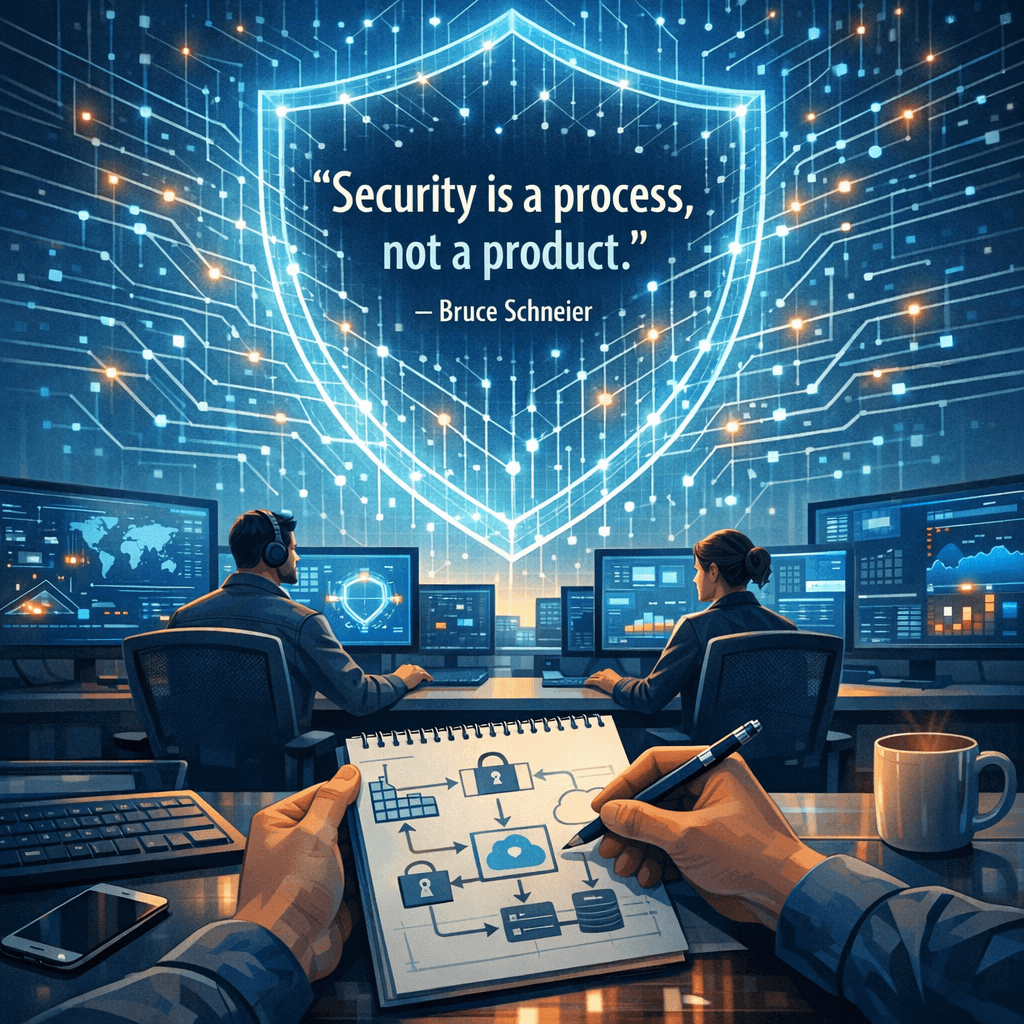
Security is a process, not a product. - Bruce Schneier
—What lingers after this line?
The Core Meaning of Schneier’s Claim
At its heart, Bruce Schneier’s remark rejects the comforting illusion that safety can be bought once and for all. A firewall, an antivirus suite, or a smart lock may help, yet none of them can guarantee lasting protection on their own. Instead, security emerges from continual attention: assessing risks, updating defenses, training people, and responding when conditions change. In that sense, the quote shifts the conversation from objects to habits. Schneier, a leading security technologist, argued throughout works like Secrets and Lies (2000) that systems fail not only because tools are weak, but because environments evolve. As threats adapt, security must adapt with them, making vigilance more important than any single purchase.
Why Products Alone Cannot Keep Us Safe
From there, it becomes clear why products so often disappoint when they are treated as complete solutions. A company may buy expensive software, but if employees reuse passwords or ignore phishing warnings, the organization remains exposed. Likewise, a homeowner can install cameras, yet poor maintenance or predictable routines may still create vulnerabilities. This is precisely the weakness in product-centered thinking: it assumes danger is static. In reality, attackers study defenses, discover gaps, and exploit human behavior. The history of cybersecurity repeatedly confirms this pattern. For example, major breaches such as the 2013 Target incident were not caused by the absence of security products, but by failures in monitoring, access control, and response.
Security as an Ongoing Cycle
Once we accept that limitation, security begins to look less like a purchase and more like a repeating cycle. First comes preparation: identifying assets, understanding likely threats, and setting policies. Next comes implementation, where tools do matter—but only as part of a larger plan. After that, organizations must monitor systems, test assumptions, and revise practices when weaknesses appear. This cycle mirrors well-established frameworks such as the NIST Cybersecurity Framework, first released in 2014, which emphasizes identifying, protecting, detecting, responding, and recovering. The sequence itself carries Schneier’s insight: security is never finished. Each stage leads naturally to the next, because every defense eventually needs review, reinforcement, or replacement.
The Human Factor at the Center
Just as important, Schneier’s quote reminds us that security is deeply human. People create policies, make exceptions, ignore warnings, and improvise under pressure. Consequently, even sophisticated systems can fail when users are confused, rushed, or poorly trained. Social engineering attacks succeed precisely because they target trust and habit rather than technology alone. Therefore, a real security process must include education, communication, and culture. Airlines, hospitals, and banks all rely on checklists and repeated drills because human reliability improves through practice. In the same way, secure behavior grows from routine reinforcement. A team that regularly reviews permissions and reports suspicious messages is often safer than one relying solely on impressive tools.
Resilience in a Changing World
Moreover, treating security as a process encourages resilience rather than false confidence. If leaders believe a product has “solved” security, they may overlook warning signs and underinvest in preparation. By contrast, a process-oriented mindset expects incidents to occur and plans for recovery. That expectation does not signal pessimism; it reflects maturity. This distinction matters because modern threats change quickly, from ransomware campaigns to supply-chain attacks. The 2020 SolarWinds breach demonstrated how trusted systems themselves can become attack vectors, forcing organizations to rethink assumptions. In such an environment, the goal is not perfect invulnerability, but the ability to detect problems early, limit damage, and recover intelligently.
A Broader Lesson Beyond Cybersecurity
Finally, Schneier’s insight applies well beyond digital systems. Public health, physical safety, financial fraud prevention, and even personal privacy all depend on repeated practices rather than one-time purchases. A smoke detector helps, but so do fire drills and exit plans; a bank vault matters, but so do audits and oversight. In every case, durable protection comes from sustained attention. Seen this way, the quote offers a practical philosophy of modern risk. Security is not an item to acquire and forget, but a discipline to maintain. The deepest value of Schneier’s statement is its realism: safety is built through continuous learning, adjustment, and care, because the world we are trying to secure never stands still.
One-minute reflection
Where does this idea show up in your life right now?
Related Quotes
6 selectedTo understand success, pay less attention to the final product and more to the mundane process. — Adam Grant
Adam Grant
At first glance, Adam Grant’s quote challenges a common habit: judging success by polished outcomes alone. Instead, he redirects attention to the repetitive, often unremarkable actions that make those outcomes possible.
Read full interpretation →Luxury becomes being able to say no without panic. — Anne Helen Petersen
Anne Helen Petersen
At first glance, luxury often suggests expensive goods, exclusive spaces, or polished ease. Yet Anne Helen Petersen shifts the idea inward, arguing that real luxury is not possession but freedom: the ability to say no wi...
Read full interpretation →The craft of the master is not in the final product alone, but in the devotion to the process that brought it into being. — Richard Sennett
Richard Sennett
At first glance, Richard Sennett’s remark shifts attention away from the polished artifact and toward the labor that shaped it. He argues that true mastery cannot be measured only by what the audience sees at the end; ra...
Read full interpretation →The beauty of a thing is not just in its final form, but in the slow, deliberate history of how it was made. — William Morris
William Morris
At first glance, William Morris shifts attention away from the polished object and toward the human story embedded within it. His point is not that the final form does not matter, but that its beauty deepens when we unde...
Read full interpretation →Success is not the destination, but the road that you're on. — Marlon Wayans
Marlon Wayans
This quote emphasizes that success should be viewed as a continuous process rather than a final goal. The experiences and growth you encounter along the way are what truly define success.
Read full interpretation →The how is often more important than the what. — John Steinbeck
John Steinbeck
This quote suggests that the manner in which we achieve something can be more crucial than the end result itself. The process, methods, and values we employ often define the quality and significance of our achievements.
Read full interpretation →More From Author
More from Bruce Schneier →