
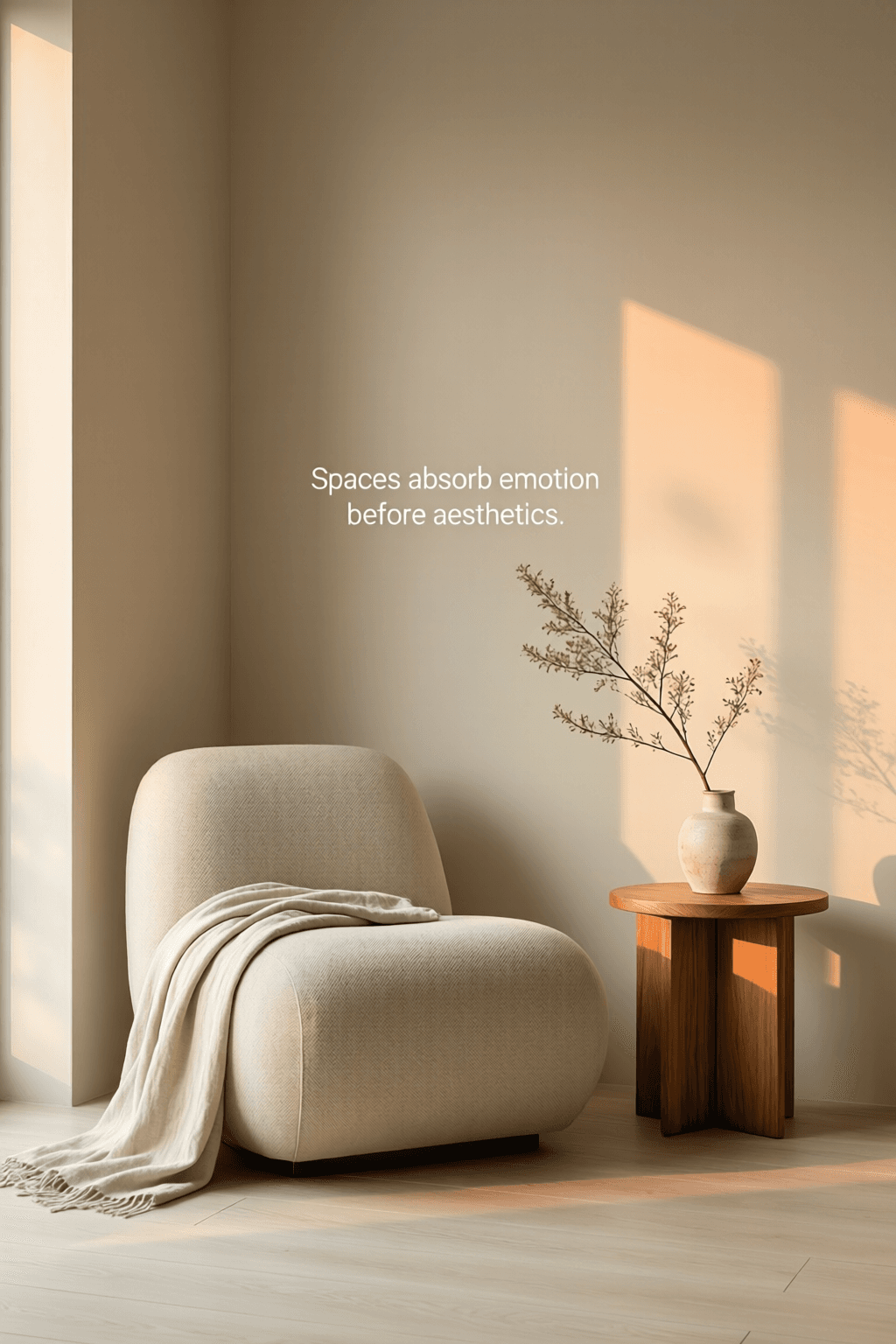
Spaces absorb emotion before aesthetics. — Farah Agarwal
—What lingers after this line?
Emotion Comes First
Farah Agarwal’s line suggests that our first encounter with a room is not visual judgment but emotional registration. Before we admire a color palette, a chair, or a carefully chosen object, we sense whether a place feels calming, cold, intimate, tense, or welcoming. In this way, space is never neutral; it quietly speaks to the body before it is interpreted by the eye.
The Body Reads a Room
From there, the quote points toward an almost instinctive human response to environment. Ceiling height, light, texture, sound, and even emptiness shape mood long before we consciously label them as beautiful or ugly. As architectural historian Juhani Pallasmaa argues in The Eyes of the Skin (1996), we inhabit places through the full sensorium, not through sight alone, which helps explain why a simple room can feel more moving than a spectacular one.
Why Aesthetics Still Matter
Yet Agarwal is not dismissing aesthetics; rather, she is placing them in sequence. Beauty becomes meaningful when it supports the emotional atmosphere of a place instead of overpowering it. A minimalist home may feel serene, for example, while the same visual restraint in another context can feel sterile, showing that design succeeds not when it merely looks refined, but when it reinforces the feeling people need.
Memory Settles Into Place
As this idea deepens, spaces can be understood as containers of lived experience. A grandmother’s kitchen may be visually ordinary, yet it can carry extraordinary warmth because repeated rituals—tea, conversation, care—have saturated it with feeling. Gaston Bachelard’s The Poetics of Space (1958) similarly explores how intimate places become emotionally charged, turning houses into repositories of memory rather than mere structures.
Design as Emotional Stewardship
Consequently, the quote also offers a quiet ethic for architects, designers, and homeowners. To shape a space well is not simply to decorate it attractively, but to ask what emotional life it will hold: rest, trust, belonging, concentration, or joy. In that sense, aesthetics become a tool of stewardship, because the most memorable spaces are often those that make people feel deeply cared for before they ever notice the design.
A Broader Lesson About Living
Ultimately, Agarwal’s observation reaches beyond interiors into a philosophy of human experience. Just as people often remember how someone made them feel more than how they looked, we remember spaces by their emotional residue more than their style. The quote therefore reframes beauty as secondary but not irrelevant: what endures is the atmosphere that absorbs life first, and only then presents itself as art.
One-minute reflection
What feeling does this quote bring up for you?
Related Quotes
4 selectedGratitude is a divine emotion: it fills the heart, but not to bursting; it warms it, but not to fever. — Charlotte Brontë
Charlotte Brontë
Charlotte Brontë presents gratitude as both elevated and restrained, calling it a “divine emotion” that enriches the heart without overwhelming it. From the start, her phrasing suggests that true thankfulness is powerful...
Read full interpretation →The main thing is to be moved, to love, to hope, to tremble, to live. — Auguste Rodin
Auguste Rodin
Rodin’s statement begins with a striking priority: “the main thing” is not to possess, achieve, or control, but to feel deeply. To be moved suggests openness to beauty, sorrow, wonder, and human connection.
Read full interpretation →Everything that is beautiful and noble is the result of reason and calculation. — Charles Baudelaire
Charles Baudelaire
At first glance, Baudelaire’s statement seems to challenge the romantic belief that beauty springs mainly from spontaneous feeling. By declaring that everything beautiful and noble comes from reason and calculation, he s...
Read full interpretation →The truth is not always beautiful, nor beautiful words the truth. — Lao Tzu
Lao Tzu
Lao Tzu, in his influential work the Tao Te Ching (circa 6th century BC), presents a compelling paradox: that truth does not automatically align with beauty, nor do beautiful words always convey truthful intent. He invit...
Read full interpretation →More From Author
More from Farah Agarwal →