
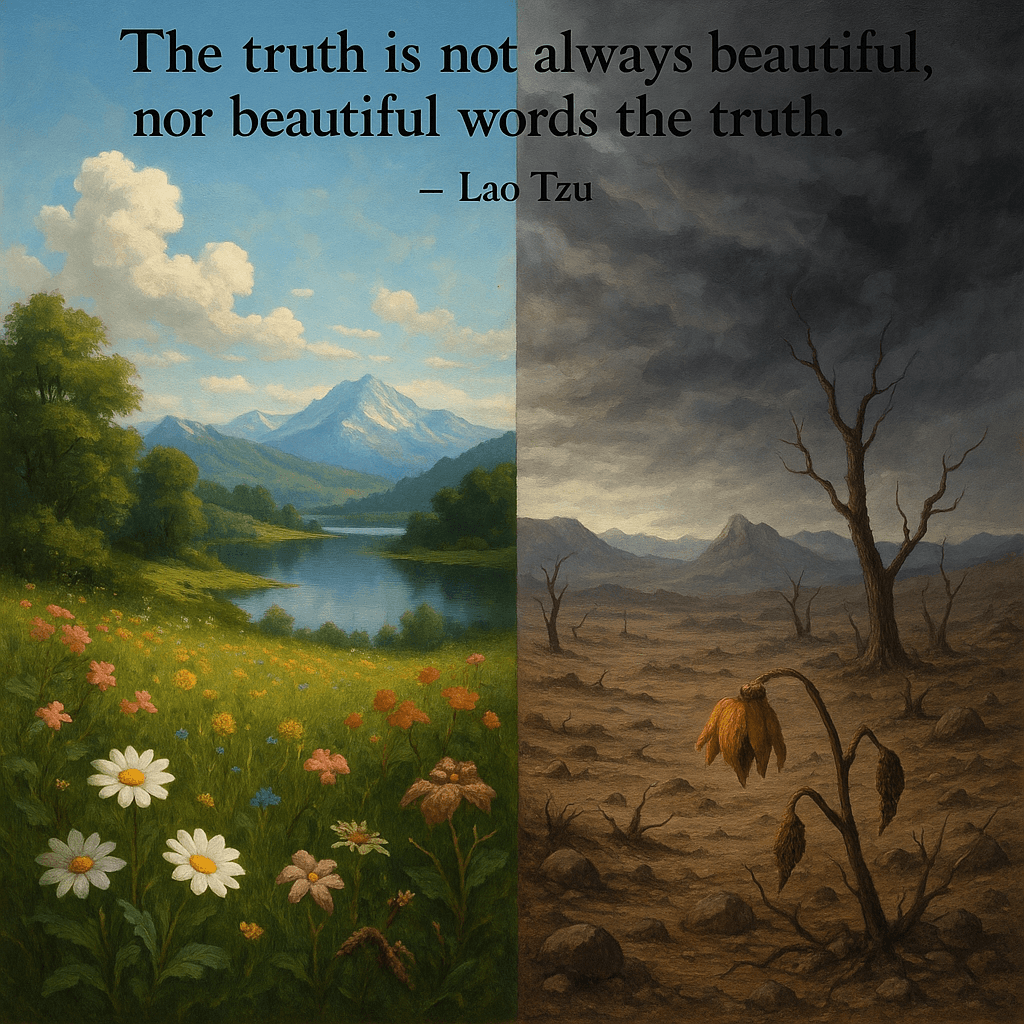
The truth is not always beautiful, nor beautiful words the truth. — Lao Tzu
—What lingers after this line?
Lao Tzu’s Paradox of Truth and Beauty
Lao Tzu, in his influential work the Tao Te Ching (circa 6th century BC), presents a compelling paradox: that truth does not automatically align with beauty, nor do beautiful words always convey truthful intent. He invites us to reflect on the limitations of language and the often uncomfortable nature of reality, challenging the assumption that what sounds pleasing must also be correct or virtuous.
Historical Examples of Hard Truths
Expanding from ancient wisdom, history is replete with instances where the truth was neither comfortable nor welcome. Galileo’s defense of heliocentrism in the 17th century, for example, was met with resistance precisely because it clashed with prevailing beliefs; his words were not embraced as beautiful, but their later vindication illustrates how truth can inconvenience and disrupt.
The Seduction of Beautiful Language
Conversely, eloquence has long been a tool for persuasion, sometimes at the expense of honesty. Rhetoricians since Cicero have warned that flowery oratory can cloak falsehoods in allure. Advertisements and propaganda often deploy striking language to mask ulterior motives—demonstrating Lao Tzu’s warning that beautiful words do not guarantee sincerity.
Psychological Comfort Versus Authenticity
Human psychology contributes to this dynamic; we are drawn to pleasant narratives and instinctively resist information that challenges our worldview, a phenomenon known as cognitive dissonance. As psychologist Leon Festinger argued in the 1950s, people tend to favor harmonious stories—sometimes at the expense of confronting harder, harsher truths.
Embracing the Complexity of Communication
Ultimately, Lao Tzu’s observation urges a more mindful relationship with words and reality. Rather than equating eloquence with truth or shunning discomfort, we are called to explore the deeper layers beneath what is spoken or written. By cultivating discernment and humility, we honor both the beauty and the difficulty inherent in seeking what is genuinely true.
One-minute reflection
What feeling does this quote bring up for you?
Related Quotes
6 selectedArt is the lie that enables us to realize the truth. - Pablo Picasso
Pablo Picasso
This quote introduces a paradoxical idea that art, while being a form of deception or illusion, helps us understand deeper truths about life, humanity, and the world.
Read full interpretation →Art is the lie that enables us to realize the truth. - Pablo Picasso
Pablo Picasso
This quote highlights the function of art in society, suggesting that art provides a unique means to understand and interpret deeper truths that might not be immediately apparent in reality.
Read full interpretation →Truth is beautiful, without doubt; but so are lies. — Ralph Waldo Emerson
Ralph Waldo Emerson
Ralph Waldo Emerson’s observation boldly pairs the beauty of truth with that of lies, challenging a prevailing moral instinct to venerate one and vilify the other. In doing so, he invites us to recognize not only the inh...
Read full interpretation →The truth is rarely comfortable, but it is the only thing that will actually set you free. Stop hiding from your reality and start owning your choices. — Pema Chödrön
Pema Chödrön
At its core, Pema Chödrön’s statement argues that freedom does not come from denial, distraction, or carefully managed appearances. Instead, it begins with the willingness to confront what is real, even when that reality...
Read full interpretation →Be a loner. That gives you time to wonder, to search for the truth. Have holy curiosity. Make your life worth living. — Albert Einstein
Albert Einstein
At first glance, Einstein’s advice to “be a loner” may sound like a rejection of society, yet his deeper point is about protecting the inner space where thought can mature. Solitude gives a person room to hear their own...
Read full interpretation →Even in literature and art, no man who bothers about originality will ever be original: whereas if you simply try to tell the truth, you will, nine times out of ten, become original without ever having noticed it. — C.S. Lewis
C.S. Lewis
At first glance, C.S. Lewis presents a paradox: the harder an artist chases originality, the less likely it is to appear.
Read full interpretation →More From Author
More from Lao Tzu →If you want to be out front, then act as if you were behind. — Lao Tzu
Lao Tzu’s saying begins with a paradox: to move ahead of others, one must behave as though one is behind them. Rather than urging weakness or hesitation, the quote points to a subtler form of strength—leadership that doe...
Read full interpretation →Do you have the patience to wait until your mud settles and the water is clear? — Lao Tzu
Lao Tzu’s question frames patience not as passive delay but as an active kind of wisdom. The image of muddy water settling on its own suggests that confusion often clears not through force, but through restraint.
Read full interpretation →Anything that is living must have a rest. If it does not rest, it will lose its strength. — Lao Tzu
Lao Tzu’s insight begins with a simple observation: all living things move in cycles, not in endless exertion. By saying that anything alive must rest, he frames rest not as laziness but as a biological and spiritual nec...
Read full interpretation →Yield and overcome, bend and be straight. — Lao Tzu
At first glance, Lao Tzu’s line seems contradictory: how can yielding lead to overcoming, or bending result in straightness? Yet this paradox lies at the heart of Taoist thought.
Read full interpretation →