
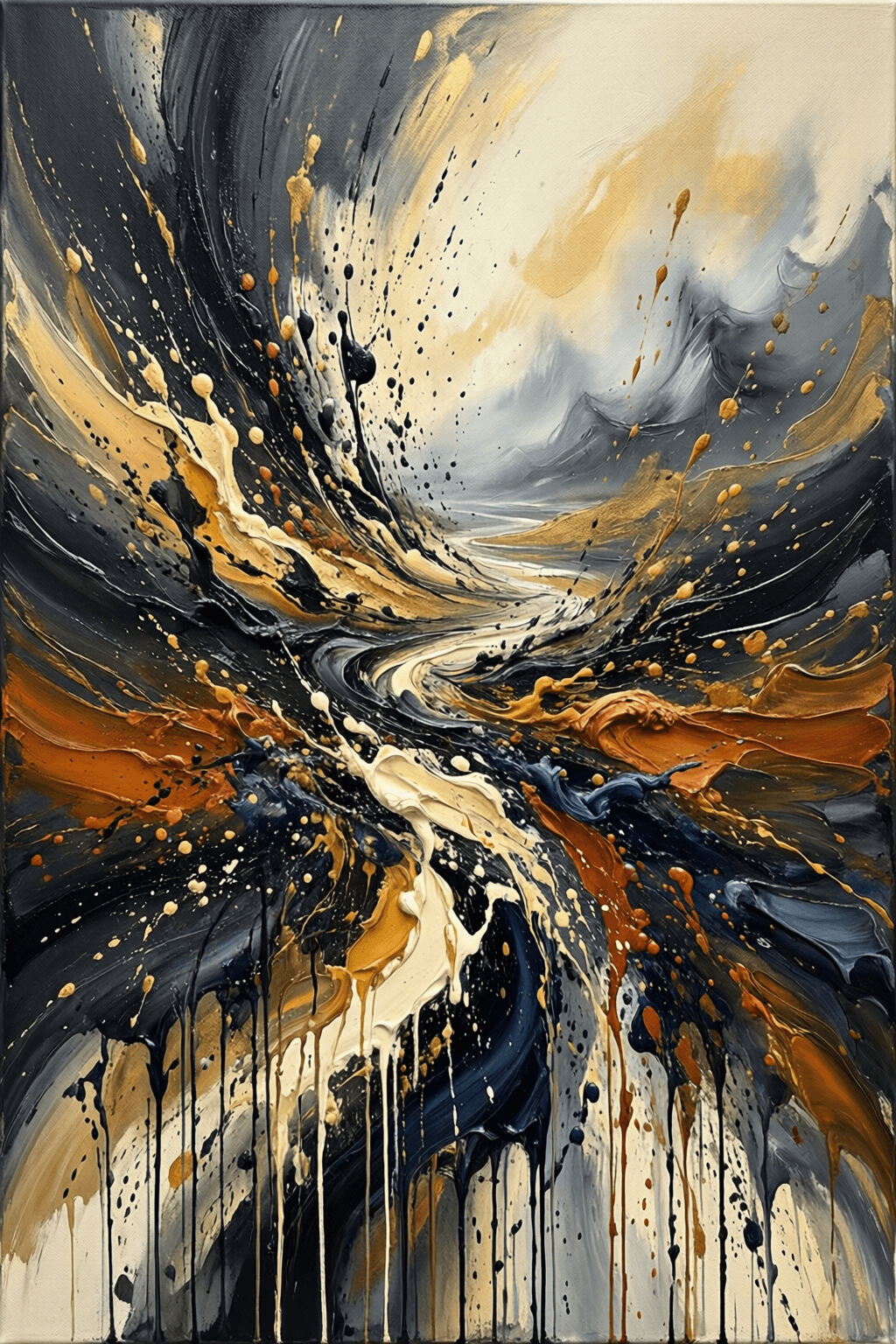
The painting has a life of its own. I try to let it come through. — Jackson Pollock
—What lingers after this line?
Art as a Living Presence
At first glance, Jackson Pollock’s remark gives the painting an almost independent existence, as though the canvas carries its own pulse before the artist fully understands it. Rather than describing painting as pure control or design, he suggests a collaboration in which the artist listens as much as he acts. In this view, the work is not manufactured like a machine-made object; it is uncovered, released, or allowed to emerge.
The Artist as Conduit
From there, Pollock’s phrase “I try to let it come through” shifts attention from mastery to receptivity. He does not claim to impose meaning by force; instead, he positions himself as a conduit for energies, impulses, and forms that arrive through the act of making. This idea aligns with many modernist accounts of creativity, where intuition matters as much as technique and where the artist’s task is to remain open to what the work wants to become.
Pollock’s Process in Motion
Seen in light of his famous drip paintings, the quote becomes even more revealing. Works such as Autumn Rhythm (Number 30) (1950) show Pollock moving around the canvas, pouring and flinging paint in a process that was physical, rhythmic, and responsive. As photographer Hans Namuth’s 1950 films documented, Pollock did not simply decorate a surface; he entered into a dynamic exchange with it, adjusting gesture after gesture as the painting developed its own internal logic.
Chance and Control Together
However, Pollock’s statement should not be mistaken for surrendering entirely to accident. The life of the painting emerges precisely through a tension between spontaneity and judgment: paint may fall unpredictably, yet the artist still decides when to continue, when to pause, and when the composition has found balance. In that sense, the painting’s “life” is not chaos, but an evolving order discovered through attentive risk.
A Broader Philosophy of Creativity
More broadly, the quote speaks to a creative philosophy that extends beyond painting. Writers, musicians, and dancers often describe moments when a work seems to lead them rather than obey them, as if form arises from deep intuition before conscious explanation catches up. Pollock gives this mysterious experience a vivid image: the artist succeeds not by dominating the work, but by making space for its hidden life to appear.
Why the Quote Still Resonates
Finally, Pollock’s words endure because they challenge the modern urge to explain everything through control, planning, and intention. They remind us that great art often contains something unforeseen, something that feels discovered rather than engineered. For viewers standing before an abstract canvas, that idea can be liberating: the painting is not merely a puzzle to decode, but a living encounter that continues to unfold each time it is seen.
Recommended Reading
As an Amazon Associate, we earn from qualifying purchases.
One-minute reflection
Where does this idea show up in your life right now?
Related Quotes
6 selectedThe creative process is not a straight line, but a labyrinth. To get lost in it is not a failure; it is the only way to find the hidden things worth saying. — M.C. Richards
M.C. Richards
At its core, M.C. Richards rejects the comforting myth that creative work unfolds through orderly steps.
Read full interpretation →To create something new, one must first learn to be comfortable with the mess of the process. — Yayoi Kusama
Yayoi Kusama
At first glance, Yayoi Kusama’s insight reframes creativity as something far less polished than people often imagine. To create something truly new, she suggests, one must stop fearing confusion, failed attempts, and unf...
Read full interpretation →The creative process is a sanctuary for healing, a space where resilience is transformed into art that speaks to our shared humanity. — Ben Okri
Ben Okri
At its heart, Ben Okri’s statement imagines the creative process as more than production; it becomes a refuge. A sanctuary is a place of shelter, and by choosing that word, Okri suggests that making art offers protection...
Read full interpretation →It is through the process of creating that we discover who we are, not by waiting for a finished masterpiece to tell us. — Twyla Tharp
Twyla Tharp
Twyla Tharp’s insight begins with a reversal of a common assumption: we often imagine that identity arrives fully formed and then expresses itself through art, work, or achievement. Instead, she argues that we come to kn...
Read full interpretation →The craft is not in holding tight, but in release: letting the work reveal its own nature. — Lloyd Alexander
Lloyd Alexander
At first glance, Lloyd Alexander’s line reframes craftsmanship in a surprising way: the maker’s skill does not lie in controlling every outcome, but in knowing when to loosen the grip. Rather than forcing a work into a p...
Read full interpretation →The creative process is a journey of 95 percent intuitive, seat-of-the-pants, at-the-moment decisions that you can't even explain. — George Saunders
George Saunders
George Saunders presents creativity not as a tidy formula but as a lived, improvisational act. At the heart of his claim is the idea that most artistic choices arise in motion, before the mind can neatly justify them.
Read full interpretation →More From Author
More from Jackson Pollock →