
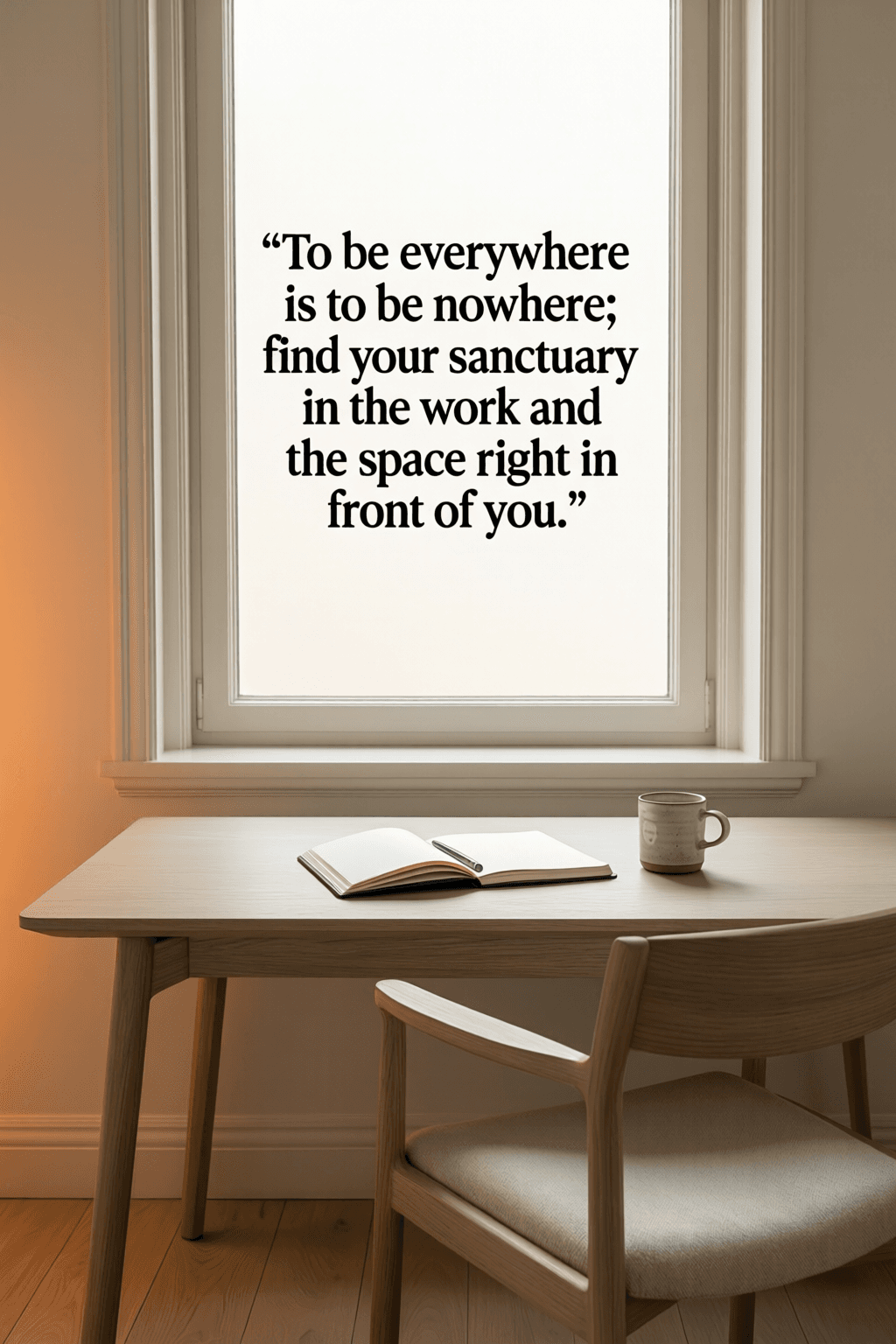
To be everywhere is to be nowhere; find your sanctuary in the work and the space right in front of you. — Seneca
—What lingers after this line?
The Warning Against Scattered Living
Seneca’s line begins with a sharp paradox: a person who tries to be everywhere ends up belonging nowhere. In a Stoic sense, this is not merely about physical movement but about mental dispersion—attention split across ambitions, anxieties, and distractions until nothing receives the depth it deserves. What appears to be freedom can quietly become a form of exile from one’s own life. From that starting point, the quote urges a reversal. Instead of chasing significance across countless places, Seneca directs us toward the immediate task and the immediate setting. The sanctuary he describes is not remote or mystical; it is discovered by fully inhabiting the moment already given.
A Stoic Practice of Attention
Seen through the lens of Stoic philosophy, this advice aligns with Seneca’s broader insistence on governing the mind rather than being governed by circumstance. In letters such as Seneca’s *Epistulae Morales ad Lucilium* (c. 65 AD), he repeatedly warns against restlessness, arguing that constant motion often disguises inner instability. One does not heal confusion by changing locations if the same unsettled mind travels along. Therefore, the quote becomes a practical discipline: attend to what is present, controllable, and necessary. By narrowing one’s concern to the work and space directly at hand, a person recovers agency. The world may remain vast and noisy, yet the self becomes steadier within it.
The Meaning of Sanctuary
Importantly, Seneca’s use of sanctuary suggests more than efficiency. A sanctuary is a place of refuge, order, and inward safety. Here, however, refuge is not found by withdrawing from reality but by entering it more completely. The desk, the room, the unfinished duty, the conversation before us—these ordinary things become protective when they gather our wandering mind into one coherent act. This idea has enduring force because modern life often treats attention as expendable. Yet Seneca implies the opposite: focused presence is a shelter for the soul. When we stop scattering ourselves, even a modest space can feel sufficient, and even difficult work can become grounding.
An Answer to Modern Distraction
In that sense, Seneca sounds strikingly contemporary. Digital life encourages a state of perpetual partial presence: messages interrupt tasks, news collapses distance, and the mind is pulled into many rooms without fully entering any of them. To be everywhere online, socially, and professionally can produce exactly the emptiness Seneca names—a life crowded with stimuli but thin in meaning. Consequently, his remedy feels almost radical. To focus on the work and space right in front of you is to reject the glamour of constant access. It is a decision to value depth over spread, substance over motion, and actual engagement over the performance of busyness.
Depth as a Form of Belonging
Once this principle is accepted, a deeper implication emerges: belonging is created through attention. We come to inhabit a place, a craft, or a relationship not by touching many of them lightly, but by remaining long enough to be changed by one. Plato’s *Republic* (c. 375 BC) associates justice with each part doing its proper work; similarly, Seneca suggests a life gains shape when the self is not perpetually diffused. An ordinary example makes the point clear. A craftsperson absorbed in a single bench, a teacher fully present to one classroom, or a parent listening without glancing away often experiences a quiet completeness. Their world is temporarily narrowed, yet their existence feels more grounded, not less.
A Practical Philosophy of Presence
Ultimately, the quote offers not just comfort but instruction. It asks us to stop searching for a better vantage point from which to live and instead to consecrate the one already before us. The next task, the present room, the reachable duty—these are not obstacles to meaning but its entry points. Thus Seneca leaves us with a disciplined form of peace. Sanctuary is not found by expanding endlessly outward; it is found by consenting to presence. When we give ourselves wholly to what is here, we are no longer nowhere. We begin, at last, to arrive.
One-minute reflection
Why might this line matter today, not tomorrow?
Related Quotes
6 selectedThe mind should not be kept continuously at the same pitch of concentration, but given amusing diversions. Our minds must relax: they will rise better and keener after a rest. — Seneca
Seneca
At first glance, Seneca’s advice sounds surprisingly modern: the mind cannot remain indefinitely strained without losing its edge. In his moral writings, especially the letters collected in Seneca’s Epistulae Morales (c.
Read full interpretation →Complexity means distracted effort. Simplicity means focused effort. — Edward De Bono
Edward de Bono
At its heart, Edward de Bono’s remark draws a sharp distinction between motion and direction. Complexity, in this sense, is not merely having many parts; rather, it is effort scattered across too many priorities, decisio...
Read full interpretation →The more you can increase your focus of time and attention, the more capable you will be of managing your world. — Esther Dyson
Esther Dyson
Esther Dyson’s quote begins with a simple but powerful premise: the quality of our lives is shaped by where we place our attention. The more deliberately we focus our time and mental energy, the less we are pushed around...
Read full interpretation →Stop trying to fix your life in a world that profits from you feeling broken. True strength is reclaiming your own focus. — Jessa Crispin
Jessa Crispin
At first glance, Jessa Crispin’s quote rejects the familiar command to endlessly improve oneself. Her point is not that growth is meaningless, but that a whole industry thrives by convincing people they are perpetually f...
Read full interpretation →Being overwhelmed means that your life or work is overpowering you. Regain control by clarifying your intentions and focusing on your next step. — Daphne Michaels
Daphne Michaels
At its core, Daphne Michaels’ quote defines overwhelm as a moment when the demands of life or work seem larger than our capacity to respond. The word itself suggests not mere busyness, but a loss of proportion: tasks blu...
Read full interpretation →To do one thing well is the only way to endure a world that demands we do everything at once. — Pico Iyer
Pico Iyer
At its core, Pico Iyer’s line argues that endurance now depends less on speed than on concentration. In a culture that praises multitasking, constant updates, and endless availability, he reframes survival as an act of d...
Read full interpretation →More From Author
More from Seneca →Quiet people are not empty; they are contained. Their power does not seek attention—it waits. — Seneca
At first glance, Seneca’s line overturns a common social assumption: that quietness signals absence, weakness, or lack of thought. Instead, he frames silence as containment, suggesting that some people hold their ideas,...
Read full interpretation →Our plans miscarry because they have no aim. When a man doesn't know what harbor he's making for, no wind is the right wind. — Seneca
Seneca’s remark begins with a simple but severe diagnosis: plans fail not merely from bad luck, but from the absence of a clear aim. In his view, activity alone is not progress.
Read full interpretation →We must take care to live not merely a long life, but a full one; for living a long life requires only good fortune, but living a full life requires character. — Seneca
Seneca begins by drawing a sharp distinction between duration and depth. A long life, he says, may depend largely on luck—health, safety, and circumstances beyond our control.
Read full interpretation →Society can only remain healthy through the mutual protection and love of its parts. — Seneca
At the heart of Seneca’s statement lies a simple but powerful image: society is not a loose collection of isolated individuals, but a living whole whose parts depend on one another. In his Letters and essays, Seneca repe...
Read full interpretation →