
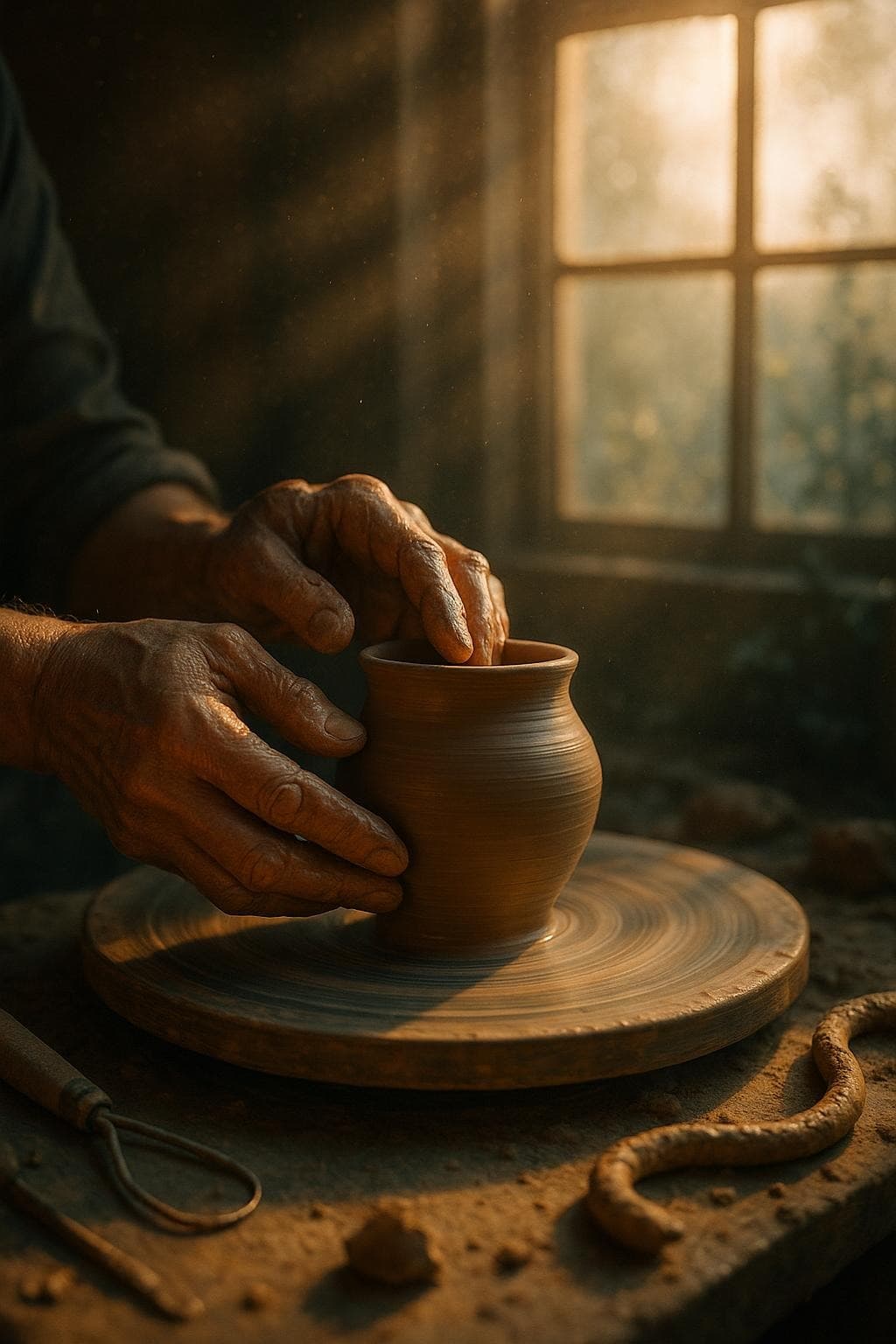
Turn your insight into practice; beauty needs a living hand. — Rabindranath Tagore
—What lingers after this line?
From Vision to Embodied Action
Tagore’s line urges a passage from contemplation to creation: insight is only fully itself when it finds form in deed. In Sadhana (1913), he describes realization not as withdrawal but as participation—truth ripens when it enters the rhythms of life. Thus, the beautiful is not a distant ideal; it is a lived encounter, shaped by touch, timing, and courage. Moving from idea to practice, then, is not a downgrade but a revelation. The “living hand” is where meaning becomes visible—whether in a line of verse, a bowl of bread, or a shelter raised for a neighbor. By insisting on life’s contact, Tagore frames beauty as a responsibility as well as an aspiration.
Why Beauty Requires a Human Touch
Moreover, beauty emerges through materials and gestures, not abstractions alone. John Dewey’s Art as Experience (1934) argues that art crystallizes felt experience through doing; the making is inseparable from the meaning. Likewise, Richard Sennett’s The Craftsman (2008) shows how careful work refines both the artifact and the maker, while Michael Polanyi’s The Tacit Dimension (1966) reminds us that crucial knowledge resides in practiced hands. Consequently, the “living hand” signals presence: attention tuned to grain, weight, and consequence. To handle clay, code, or a conversation is to accept feedback from the world, letting reality tutor intention. This is how insight matures—through the resistance and response of things and people.
Santiniketan: Schooling Insight with the Hands
Carrying this philosophy forward, Tagore founded a school at Santiniketan (1901) and later Visva-Bharati University (1921), where open-air learning intertwined arts, agriculture, and inquiry. Study moved beyond texts to workshops, gardens, and performances—cultivating perception alongside skill. In 1922, with Leonard Elmhirst, Tagore launched Sriniketan, an institute for rural reconstruction that paired education with practice. Students learned weaving and pottery as readily as literature, engaging local livelihoods. The classroom widened to the village, and knowledge gained a pulse. In this way, Tagore showed that the hand is not merely an implement; it is a pedagogy that links thought to community.
Beauty as Service to Community
Consequently, beauty—rightly understood—is communal: it reconciles self and other in shared flourishing. Tagore’s lectures in Nationalism (1917) warned against abstractions that ignore human dignity, urging creative work that heals rather than divides. At Sriniketan, this took shape in projects across agriculture, health, and cooperative crafts, where aesthetic care met practical need. Here, the living hand is ethical. To stitch a garment, restore a well, or stage a play for public dialogue is to declare that beauty belongs in daily life. The standard becomes not ornament but benefit—forms that serve, environments that uplift, and practices that dignify.
Modern Work: Prototypes, Code, and Care
Today, the same principle animates design labs, clinics, and studios. As Tim Brown notes in Change by Design (2009), rapid prototyping turns fuzzy ideas into testable realities, inviting users’ hands to refine the outcome. Nurses translate protocols into presence; open-source maintainers convert intent into tools used by thousands; urban gardeners braid ecology with neighborhood trust. Thus, across domains, a pattern repeats: insight gains authority through iteration in the world. When teams sketch, build, and listen, beauty appears as fitness to purpose, clarity of form, and kindness in impact. The living hand is collaboration made tangible.
A Simple Daily Praxis
To practice Tagore’s imperative, adopt a modest cycle: notice, make, share, learn. Begin by observing a friction in your day; then produce the smallest helpful thing—a two-sentence script, a paper mock-up, a clarified policy line. Share it with one real user. Finally, adjust based on what their hands and words reveal. Kept daily, this ritual converts aspiration into momentum. Over time, small embodiments accumulate into craft, and craft becomes character. Beauty, then, is not occasional inspiration but steady generosity shaped by practice.
The Ecological Hand
Finally, the living hand extends to the living world. Tagore inaugurated Briksharopan Utsav, a tree-planting festival at Santiniketan (1928), ritualizing care for the landscape as a communal art. Planting became poetry you could shade beneath—a stanza that grew leaves. In the same spirit, citizen science, habitat restoration, and low-waste design translate reverence into repair. By touching soil, counting birds, or redesigning packaging, we let insight take root. Beauty needs a living hand because the earth needs living helpers—and because our humanity blossoms in the tending.
Recommended Reading
As an Amazon Associate, we earn from qualifying purchases.
One-minute reflection
Where does this idea show up in your life right now?
Related Quotes
6 selectedLife is a continuous exercise in creative resilience. — Ai Weiwei
Ai Weiwei
The quote highlights that life is full of obstacles and difficulties, requiring us to persist and adapt constantly.
Read full interpretation →Genius is the ability to renew one's emotions in daily experience. — Paul Cezanne
Paul Cézanne
Paul Cezanne’s remark singles out genius not as a fixed trait or miraculous aptitude, but as an ongoing ability—the continual refreshing of one’s emotions through the ordinary events of life. By anchoring creative brilli...
Read full interpretation →Turn your everyday routine into an act of creation. — Frida Kahlo
Frida Kahlo
At the outset, Kahlo’s line reframes routine not as drudgery but as raw material. She urges us to treat repetition as a canvas—one that reveals its patterns only when seen with an artist’s attention.
Read full interpretation →Choose effort as an artist chooses a brush — with faith in the marks you will leave. — Paulo Coelho
Paulo Coelho
At the outset, Coelho’s injunction recasts effort not as burdensome grind but as a tool we elect to wield. Like an artist reaching for a sable brush instead of a bristle one, the act of choosing signals intention: we dec...
Read full interpretation →Let your life lightly dance on the edges of time like dew on the tip of a leaf. — Rabindranath Tagore
Rabindranath Tagore
Tagore's quote encourages embracing each moment with grace and presence, suggesting that one should not be weighed down by the past or future.
Read full interpretation →Adaptability is not imitation. It means power of resistance and assimilation. — Rabindranath Tagore
Rabindranath Tagore
At the heart of Tagore’s statement lies a careful distinction between changing and merely copying. Adaptability, he argues, is not the passive act of becoming like one’s surroundings; rather, it is an active power that a...
Read full interpretation →More From Author
More from Rabindranath Tagore →Adaptability is not imitation. It means power of resistance and assimilation. — Rabindranath Tagore
At the heart of Tagore’s statement lies a careful distinction between changing and merely copying. Adaptability, he argues, is not the passive act of becoming like one’s surroundings; rather, it is an active power that a...
Read full interpretation →It is not the speed of the work, but the intention behind it that grants it value. — Rabindranath Tagore
At first glance, Tagore’s statement challenges a modern habit of equating worth with speed. In many settings, quick results are praised as signs of competence, yet he redirects attention to the inner motive that shapes t...
Read full interpretation →When I stand before thee at the day's end, thou shalt see my scars and know that I had my wounds and also my healing. — Rabindranath Tagore
At its heart, Tagore imagines an ultimate moment of reckoning in which nothing essential can be hidden. To stand before another “at the day’s end” suggests the close of life, a spiritual homecoming, or simply the end of...
Read full interpretation →A home is not a mere transient shelter of brick and stone, but a place where hearts dwell and souls are nurtured. — Rabindranath Tagore
At its core, Tagore’s statement rejects the idea that a home can be defined by architecture alone. Walls, roofs, and doors may provide protection, yet they do not automatically create belonging.
Read full interpretation →