
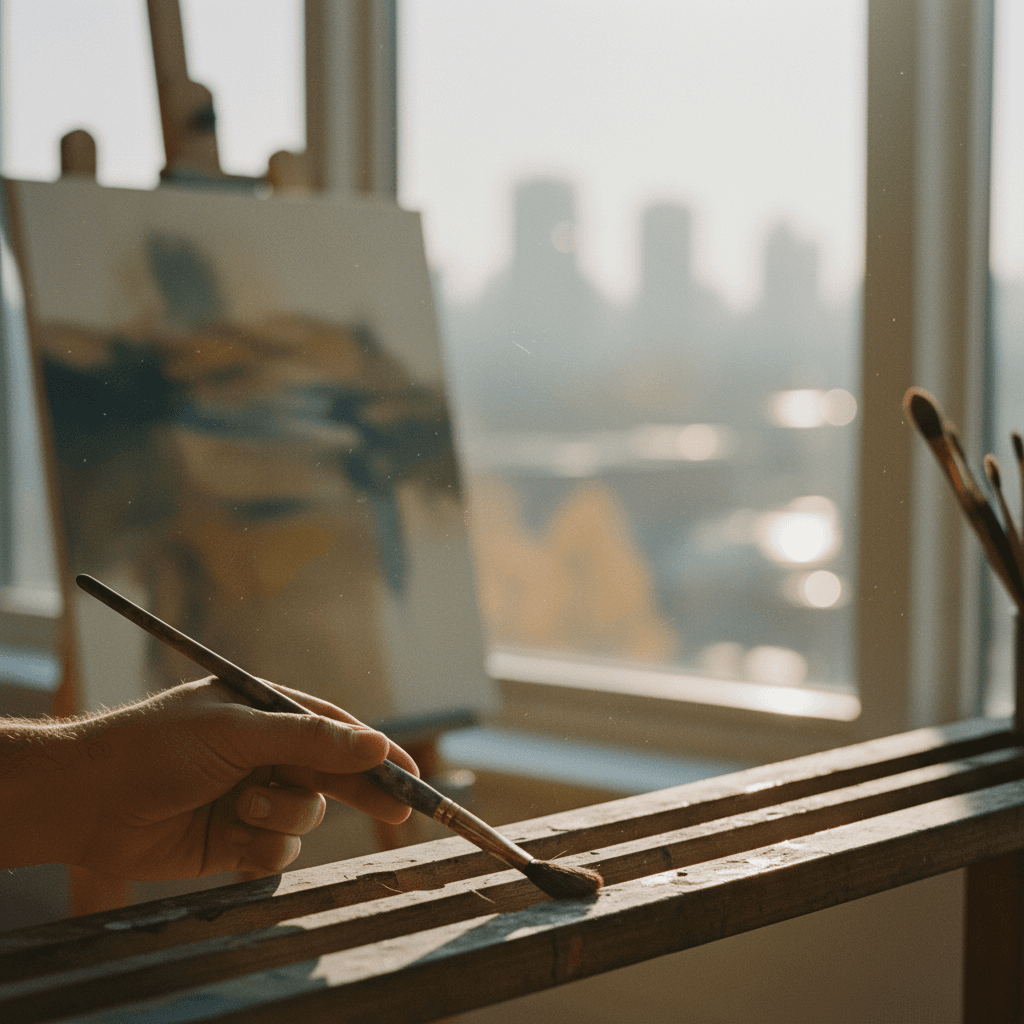
Choose effort as an artist chooses a brush — with faith in the marks you will leave. — Paulo Coelho
—What lingers after this line?
Effort as a Deliberate Instrument
At the outset, Coelho’s injunction recasts effort not as burdensome grind but as a tool we elect to wield. Like an artist reaching for a sable brush instead of a bristle one, the act of choosing signals intention: we decide what kind of work will best serve the image we hope to bring forth. In The Alchemist (1988), Coelho’s shepherd advances by trusting small, purposeful acts; similarly, choosing effort is an expression of faith that today’s stroke contributes to a larger picture we can only partly see.
Choosing With Purpose, Not Panic
From there, the metaphor deepens: artists do not grab the nearest brush in fear; they select with purpose. Hokusai, who signed himself “Old Man Crazy to Paint” (c. 1834), experimented across decades to find the stroke that matched his vision. Likewise, Agnes Martin’s quiet grids—articulated in her Writings (1992)—show how restrained, consistent marks can evoke spaciousness. In our work, choosing effort means aligning the quality of exertion to the effect we intend, rather than flailing under pressure.
Faith in Process Amid Uncertainty
Yet, a chosen brush still meets an empty canvas. Here faith bridges the gap between intention and result. Psychologist Mihaly Csikszentmihalyi’s Flow (1990) describes the absorption that comes when skill meets challenge, suggesting that trust grows as we keep moving our hand. Moreover, Carol Dweck’s growth mindset research (2006) shows how believing abilities can develop reframes mistakes as feedback. Thus the artist’s faith is not naive optimism; it is confidence that disciplined iteration will make the next mark wiser than the last.
The Ethics of the Marks We Leave
Consequently, the quote pushes beyond productivity toward responsibility. Marks remain—on canvases, communities, and colleagues. Michelangelo’s unfinished Prisoners, with their visible chisel tracks (c. 1525–1530), remind us that process leaves evidence. In civic terms, Antoni Gaudí’s Sagrada Família (begun 1882) demonstrates how intentional work can outlast its maker, shaping how others live and look. Choosing effort, then, is also choosing the kind of imprint we will accept as our legacy.
Evidence for Sustained, Skilled Effort
Moreover, research underscores that outcomes hinge on sustained, well-structured effort. Angela Duckworth’s Grit (2016) links long-term passion and perseverance with achievement, while Anders Ericsson’s Peak (2016) argues that deliberate practice—focused repetitions with feedback—produces expertise more reliably than talent alone. The lesson harmonizes with Coelho’s image: selecting the right ‘brush’ means designing the way we work, not merely working longer.
Making Today’s Stroke Count
Finally, the metaphor becomes practical. Artists think in sequences: underpainting, layers, varnish. Likewise, we can choose a manageable brush for today—a draft, a call, a prototype—and apply it with clean intention. Small, well-placed strokes compound; as James Clear’s Atomic Habits (2018) popularizes, tiny gains accumulate into visible change. By returning to the canvas daily with faith, we allow the picture to reveal itself—one deliberate mark at a time.
One-minute reflection
What's one small action this suggests?
Related Quotes
6 selectedMake each choice a brushstroke in the portrait of your future — Barack Obama
Barack Obama
Barack Obama’s line frames the future not as a fixed destination but as a canvas gradually filled in. By calling each choice a “brushstroke,” he suggests that even small decisions—what you practice, what you ignore, what...
Read full interpretation →The goal isn’t to live forever; the goal is to create something that will. — Chuck Palahniuk
Chuck Palahniuk
This quote highlights the idea that human life is finite, but the impact one leaves behind can endure indefinitely. Instead of striving for personal immortality, one should focus on creating something meaningful that las...
Read full interpretation →Life is a continuous exercise in creative resilience. — Ai Weiwei
Ai Weiwei
The quote highlights that life is full of obstacles and difficulties, requiring us to persist and adapt constantly.
Read full interpretation →Genius is the ability to renew one's emotions in daily experience. — Paul Cezanne
Paul Cézanne
Paul Cezanne’s remark singles out genius not as a fixed trait or miraculous aptitude, but as an ongoing ability—the continual refreshing of one’s emotions through the ordinary events of life. By anchoring creative brilli...
Read full interpretation →Turn your insight into practice; beauty needs a living hand. — Rabindranath Tagore
Rabindranath Tagore
Tagore’s line urges a passage from contemplation to creation: insight is only fully itself when it finds form in deed. In Sadhana (1913), he describes realization not as withdrawal but as participation—truth ripens when...
Read full interpretation →Turn your everyday routine into an act of creation. — Frida Kahlo
Frida Kahlo
At the outset, Kahlo’s line reframes routine not as drudgery but as raw material. She urges us to treat repetition as a canvas—one that reveals its patterns only when seen with an artist’s attention.
Read full interpretation →More From Author
More from Paulo Coelho →One doesn't get to be a master of one's own life by rushing. You have to learn the patience of a gardener who knows the harvest cannot be hurried. — Paulo Coelho
At its core, Paulo Coelho’s reflection challenges a modern obsession with speed. He argues that mastery over one’s life does not come from frantic action or constant acceleration, but from learning when to wait, observe,...
Read full interpretation →It is a good idea always to do something relaxing prior to making an important decision in your life. — Paulo Coelho
Paulo Coelho’s remark begins with a simple but powerful premise: important decisions are rarely improved by agitation. When the mind is tense, it tends to confuse urgency with clarity, pushing us toward choices made out...
Read full interpretation →Your 'yes' has no value until you learn to say 'no'. — Paulo Coelho
Paulo Coelho’s line hinges on a simple contrast: a “yes” only carries weight when an alternative is genuinely available. If you can’t—or won’t—say “no,” agreement becomes automatic rather than chosen, and it starts to re...
Read full interpretation →Dare to begin where fear says to stop; the first step redraws the map — Paulo Coelho
Paulo Coelho’s line treats fear less as a warning and more as a border we mistakenly accept as permanent. When fear says “stop,” it often isn’t pointing to actual danger; it’s signaling uncertainty, inexperience, or the...
Read full interpretation →