
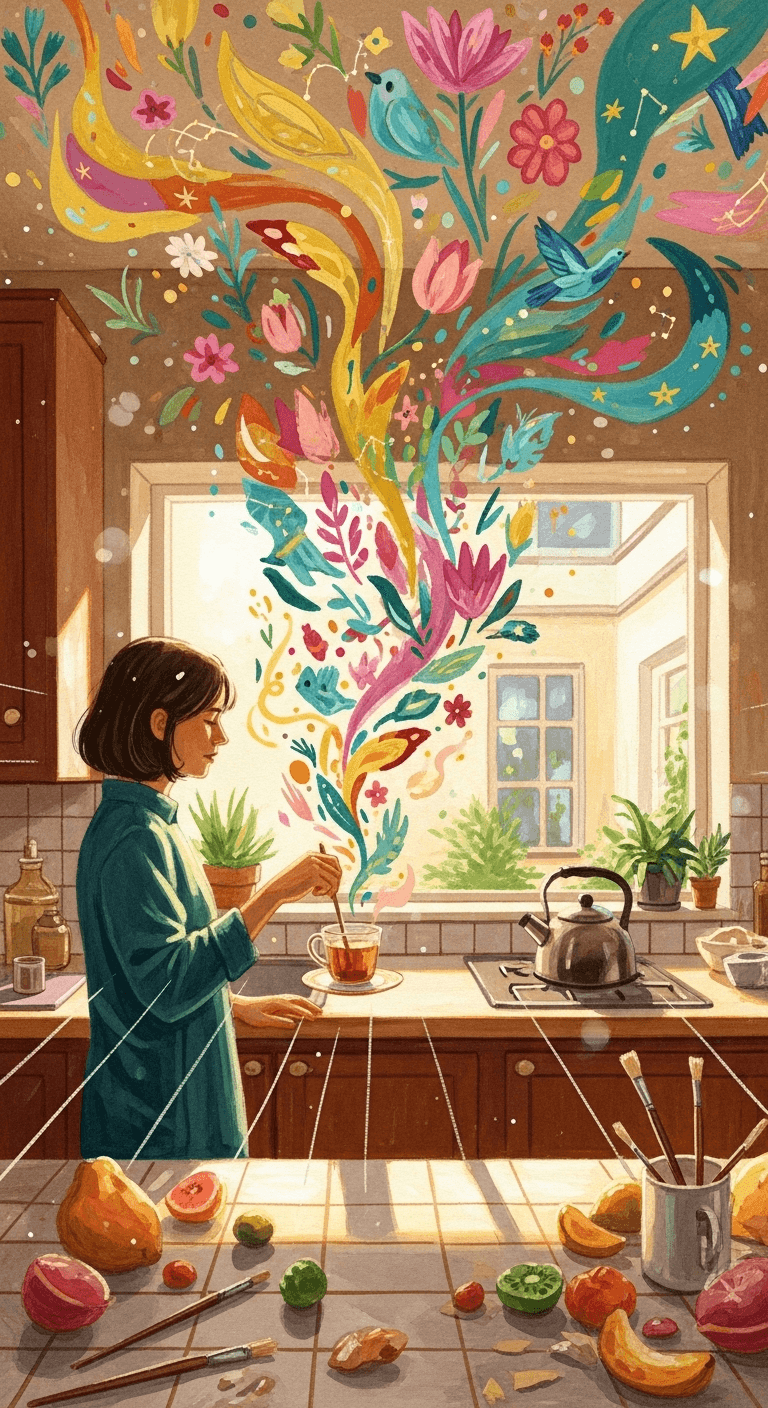
Turn your everyday routine into an act of creation. — Frida Kahlo
—What lingers after this line?
Kahlo’s Invitation to Reimagine the Ordinary
At the outset, Kahlo’s line reframes routine not as drudgery but as raw material. She urges us to treat repetition as a canvas—one that reveals its patterns only when seen with an artist’s attention. Living with chronic pain and working within the confines of Casa Azul, she converted constraints into motifs, proving that creation begins wherever you are. Carrying this forward, the maxim is less about making art objects than about adopting an artist’s stance toward daily acts. The shift is subtle yet radical: we don’t wait for inspiration; we infuse the mundane with intention.
Domestic Space as Studio
From there, Kahlo’s life offers a concrete model. After her 1925 accident, she painted from bed using a special easel and adorned her medical corsets with imagery—transforming instruments of limitation into surfaces of expression (Museo Frida Kahlo, Coyoacán). Nickolas Muray’s color photographs (1930s–40s) show her in Tehuana dress among vivid rooms and gardens, turning self-presentation and home into ongoing works. Thus the kitchen, mirror, and wardrobe became collaborative tools. By stylizing meals, garments, and rooms, she wove identity, politics, and care into the texture of the day, demonstrating that creativity can thrive inside ordinary tasks.
Philosophies That Sanctify the Everyday
In this light, philosophy and aesthetics clarify the path. John Dewey’s Art as Experience (1934) argues that art grows from the rhythms of lived activity; the boundary between life and art is porous. Likewise, Hannah Arendt’s The Human Condition (1958) distinguishes labor, work, and action, suggesting that making can shape a shared world rather than remain private routine. Similarly, Richard Sennett’s The Craftsman (2008) and Japanese notions of shokunin and the tea ceremony show how care, repetition, and form turn simple acts into meaning. The lesson is cumulative: cultivate form and attention, and routine ripens into creation.
Habits as Engines of Imagination
Moreover, psychology explains why rituals unlock originality. Mihaly Csikszentmihalyi’s Flow (1990) describes deep engagement that often emerges from structured, repeatable tasks. Teresa Amabile’s The Progress Principle (2011) shows that small daily wins boost intrinsic motivation, while Charles Duhigg’s The Power of Habit (2012) maps cue–routine–reward loops that sustain effort. Consequently, by designing tiny, pleasurable creative loops—stirring coffee while sketching a thumbnail, or ending email sessions by jotting one idea—you harness consistency to generate surprise. Regularity doesn’t dull the mind; it primes it.
Practical Rituals for Everyday Making
To make this concrete, embed form into actions you already do. Try Julia Cameron’s morning pages (The Artist’s Way, 1992) while the kettle boils, or shoot a one-minute phone film during your walk. Design constraint recipes—only five ingredients for dinner, only two colors in your outfit, only one sentence in your journal—to spark invention. Next, ritualize setup and teardown: practice mise en place in the studio as in the kitchen, laying out tools so making begins frictionlessly. Finally, curate micro-galleries: pin a daily sketch by the doorway, plate food with intentional color, or arrange a “thinking shelf” that rotates weekly. Small frames create big focus.
When Routine Becomes Collective Meaning
Beyond the self, the everyday can be political. Frida’s embrace of mexicanidad—indigenous motifs, textiles, and popular arts—folded cultural pride into daily life, linking craft and identity. In parallel, Mierle Laderman Ukeles’s Maintenance Art Manifesto (1969) and her “Touch Sanitation” performance (1978–80) recast cleaning and care as civic art, honoring undervalued labor. Accordingly, the creative routine becomes a social statement: who and what we attend to gains dignity. By elevating maintenance, dress, and shared meals, we expand art’s domain to include care, culture, and community.
Sustaining the Practice Over Time
Finally, sustainability matters more than intensity. Choose small prompts you can repeat under stress—one line, one photo, one stitch. Batch tools on Sundays, set visible cues, and celebrate completion rather than perfection. When life changes, let the form flex but keep the ritual alive. Circling back to Kahlo, creation is not a distant event; it is a daily posture. With intention, constraint, and care, the routine you already live becomes the art you mean to make.
Recommended Reading
As an Amazon Associate, we earn from qualifying purchases.
One-minute reflection
Where does this idea show up in your life right now?
Related Quotes
6 selectedScatter bold colors into routine moments; revolution often looks like art. — Nikos Kazantzakis
Nikos Kazantzakis
Kazantzakis’s line invites us to treat the dull edges of routine as a canvas, where a splash of boldness is not mere ornament but a spark of transformation. In Zorba the Greek (1946), a dance interrupts drudgery, turning...
Read full interpretation →Life is a continuous exercise in creative resilience. — Ai Weiwei
Ai Weiwei
The quote highlights that life is full of obstacles and difficulties, requiring us to persist and adapt constantly.
Read full interpretation →Genius is the ability to renew one's emotions in daily experience. — Paul Cezanne
Paul Cézanne
Paul Cezanne’s remark singles out genius not as a fixed trait or miraculous aptitude, but as an ongoing ability—the continual refreshing of one’s emotions through the ordinary events of life. By anchoring creative brilli...
Read full interpretation →Turn your insight into practice; beauty needs a living hand. — Rabindranath Tagore
Rabindranath Tagore
Tagore’s line urges a passage from contemplation to creation: insight is only fully itself when it finds form in deed. In Sadhana (1913), he describes realization not as withdrawal but as participation—truth ripens when...
Read full interpretation →Choose effort as an artist chooses a brush — with faith in the marks you will leave. — Paulo Coelho
Paulo Coelho
At the outset, Coelho’s injunction recasts effort not as burdensome grind but as a tool we elect to wield. Like an artist reaching for a sable brush instead of a bristle one, the act of choosing signals intention: we dec...
Read full interpretation →Sketch the life you crave, then build the courage to live inside that sketch. — Frida Kahlo
Frida Kahlo
Often attributed to Frida Kahlo, the exhortation begins with a deliberate act of imagination: sketch the life you crave. A sketch is not a final verdict but a guiding outline, much like Kahlo’s self-portraits that mapped...
Read full interpretation →More From Author
More from Frida Kahlo →I paint flowers so they will not die. — Frida Kahlo
Frida Kahlo’s line reads like a gentle spell: by painting flowers, she resists the most ordinary tragedy—things fading despite our care. A bouquet wilts, a season ends, a beloved moment slips away; the canvas, however, o...
Read full interpretation →I tried to drown my sorrows, but the bastards learned how to swim. — Frida Kahlo
Frida Kahlo’s line opens with the familiar promise of escape—“I tried to drown my sorrows”—and then snaps into a punchline that refuses sentimentality. The sudden insult, “the bastards,” is more than comic shock; it’s a...
Read full interpretation →I used to think I was the strangest person in the world, but there must be someone just like me who feels bizarre and flawed. — Frida Kahlo
Frida Kahlo’s reflection begins in a familiar loneliness: the belief that one’s inner life is uniquely strange, even irredeemably flawed. That kind of self-story can make ordinary differences feel like permanent exile.
Read full interpretation →Embrace risk as the price of progress; comfort keeps the clock of your life frozen. — Frida Kahlo
Frida Kahlo’s line frames progress as a purchase: you pay for it with risk. In that sense, “embrace” is not a motivational flourish but an instruction to stop treating uncertainty as an error and start treating it as a t...
Read full interpretation →