
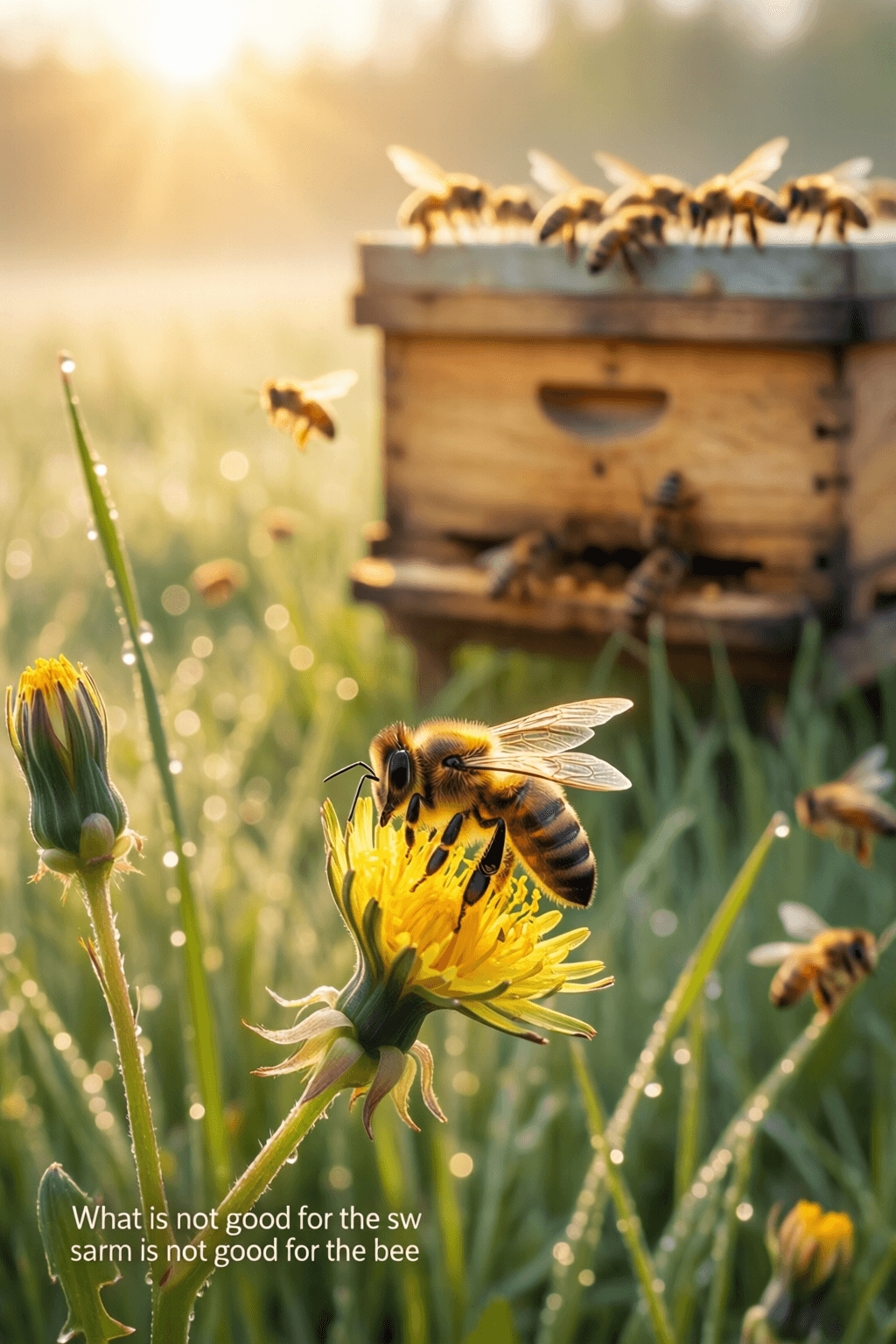
What is not good for the swarm is not good for the bee. — Marcus Aurelius
—What lingers after this line?
A Stoic Image of Interdependence
Marcus Aurelius’ line from the Stoic tradition turns a simple natural image into a moral principle: the individual cannot flourish apart from the community that sustains it. Just as a bee depends on the health of the hive for food, shelter, and survival, a person depends on family, city, institutions, and shared trust. From this starting point, the quote challenges the illusion of isolated self-interest. What harms the larger body eventually circles back to harm the individual, even if the damage is not immediate. In this way, Aurelius reframes ethics as enlightened belonging rather than self-denial.
The Stoic Idea of the Common Good
Moving from metaphor to philosophy, Stoicism taught that human beings are naturally social and rational creatures. Marcus Aurelius’ Meditations (c. AD 170–180) repeatedly insists that people are made ‘for cooperation,’ like hands, feet, and eyelids working together. The bee and swarm image belongs to this same moral universe. For Aurelius, virtue is not private perfection detached from others; it is right action within a shared order. Therefore, justice, patience, honesty, and public duty are not optional ornaments of character. They are the very conditions that allow both the person and the community to remain healthy.
Leadership and Civic Responsibility
This insight becomes especially powerful when we remember that Marcus Aurelius was not only a philosopher but also a Roman emperor. His words were not written from a quiet classroom but from the pressures of war, plague, and political administration. The Antonine Plague, which struck the empire in the second century, made communal welfare a matter of life and death. In that context, the quote reads as advice to anyone with responsibility: policies that weaken the many will eventually weaken the few who think themselves protected. A ruler, employer, or citizen who exploits the swarm may gain briefly, but the hive that supports that gain begins to collapse.
A Warning Against Narrow Self-Interest
Following this logic, Aurelius warns against the short-sightedness of selfish advantage. A person may profit from corruption, dishonesty, or neglect of public duties, but such actions erode the trust and stability that make private success possible. The bee cannot poison the hive and expect to keep making honey. This principle appears in many historical lessons. When financial systems are weakened by reckless speculation, as seen in the 2008 global financial crisis, individual gains can become collective losses that return to damage households, workers, and businesses alike. The swarm’s injury becomes the bee’s injury.
Modern Echoes in Ecology and Society
The quote also speaks naturally to ecological thinking. Bees themselves remind us that life depends on networks: pollination supports crops, ecosystems, and food chains. Modern environmental studies frequently note that declining bee populations threaten agriculture and biodiversity, showing in literal terms that the fate of one creature is tied to the fate of the whole. In society, the same pattern appears in public health, education, infrastructure, and climate policy. Clean air, safe roads, reliable schools, and disease prevention are not merely collective luxuries; they form the background of individual freedom. Aurelius’ ancient line therefore feels strikingly contemporary.
Balancing Individual and Community
Finally, the quote does not erase individuality; rather, it gives individuality a healthier setting. A bee still has its own work, movement, and role, but its meaning is inseparable from the swarm. Likewise, a person’s ambitions, talents, and choices matter most when they contribute to a livable shared world. Aurelius invites us to ask a practical moral question before acting: does this help or harm the larger whole on which I depend? If the answer is harm, then the benefit is probably false or temporary. In the end, the wisdom of the bee is that personal good and common good are not enemies but deeply connected forms of survival.
One-minute reflection
Where does this idea show up in your life right now?
Related Quotes
6 selectedWe are not born for ourselves alone; our country and our friends have a share in us. — Marcus Tullius Cicero
Marcus Tullius Cicero
At its core, Cicero’s line rejects the idea that a human life is a private possession. In works such as De Officiis (44 BC), he argues that each person is bound by obligations that extend outward to family, friends, and...
Read full interpretation →If you would live your life with ease, do what you ought, not what you please. — Epictetus
Epictetus
At its heart, Epictetus argues that a peaceful life does not come from indulging every passing preference, but from aligning action with obligation and principle. In other words, ease is not the same as comfort.
Read full interpretation →You are only entitled to the action, never to its fruits. — Bhagavad Gita
Bhagavad Gita
At its heart, this line from the Bhagavad Gita teaches that a person controls effort, not results. In the dialogue between Krishna and Arjuna in the Bhagavad Gita (c.
Read full interpretation →I long to accomplish a great and noble task; but it is my chief duty to accomplish small tasks as if they were great and noble. — Helen Keller
Helen Keller
Helen Keller’s words open with a familiar human desire: the longing to do something magnificent. Yet she immediately redirects that ambition toward duty, reminding us that life is rarely built from grand gestures alone.
Read full interpretation →The artist must elect to fight for the whole rather than for his own little piece of territory. — Ben Okri
Ben Okri
Ben Okri’s statement immediately shifts the artist’s role from private self-expression to public responsibility. Rather than defending a narrow identity, career, or niche, the artist is asked to serve something larger: t...
Read full interpretation →The Christian shoemaker does his duty not by putting little crosses on the shoes, but by making good shoes, because God is interested in good craftsmanship. — Martin Luther
Martin Luther
At first glance, Martin Luther’s remark redirects attention away from outward religious decoration and toward the moral weight of everyday work. The Christian shoemaker, in his view, serves God not through symbolic embel...
Read full interpretation →More From Author
More from Marcus Aurelius →No random actions, none not based on underlying principles. — Marcus Aurelius
Marcus Aurelius’ line urges a life in which action is never careless, impulsive, or merely reactive. For the Stoics, the worth of a person is revealed not by grand declarations but by the quiet discipline behind each cho...
Read full interpretation →A man's true delight is to do the things he was made for. — Marcus Aurelius
Marcus Aurelius points to a kind of happiness deeper than pleasure or convenience. In this line, he suggests that real delight arises when a person acts in harmony with his nature, talents, and responsibilities.
Read full interpretation →The shorter way to do many things is to only do one thing at a time. — Marcus Aurelius
Marcus Aurelius’ observation begins with a practical paradox: the fastest path through many tasks is not frantic multitasking, but focused attention. By doing one thing at a time, we reduce the waste created by shifting,...
Read full interpretation →Creativity is the tool we all possess that helps us fulfill this promise by being creative on purpose. — Marcus Aurelius
The quote begins with an empowering assumption: creativity is not reserved for artists, inventors, or exceptional minds. Instead, it presents creativity as a common human tool, something each person already carries.
Read full interpretation →