
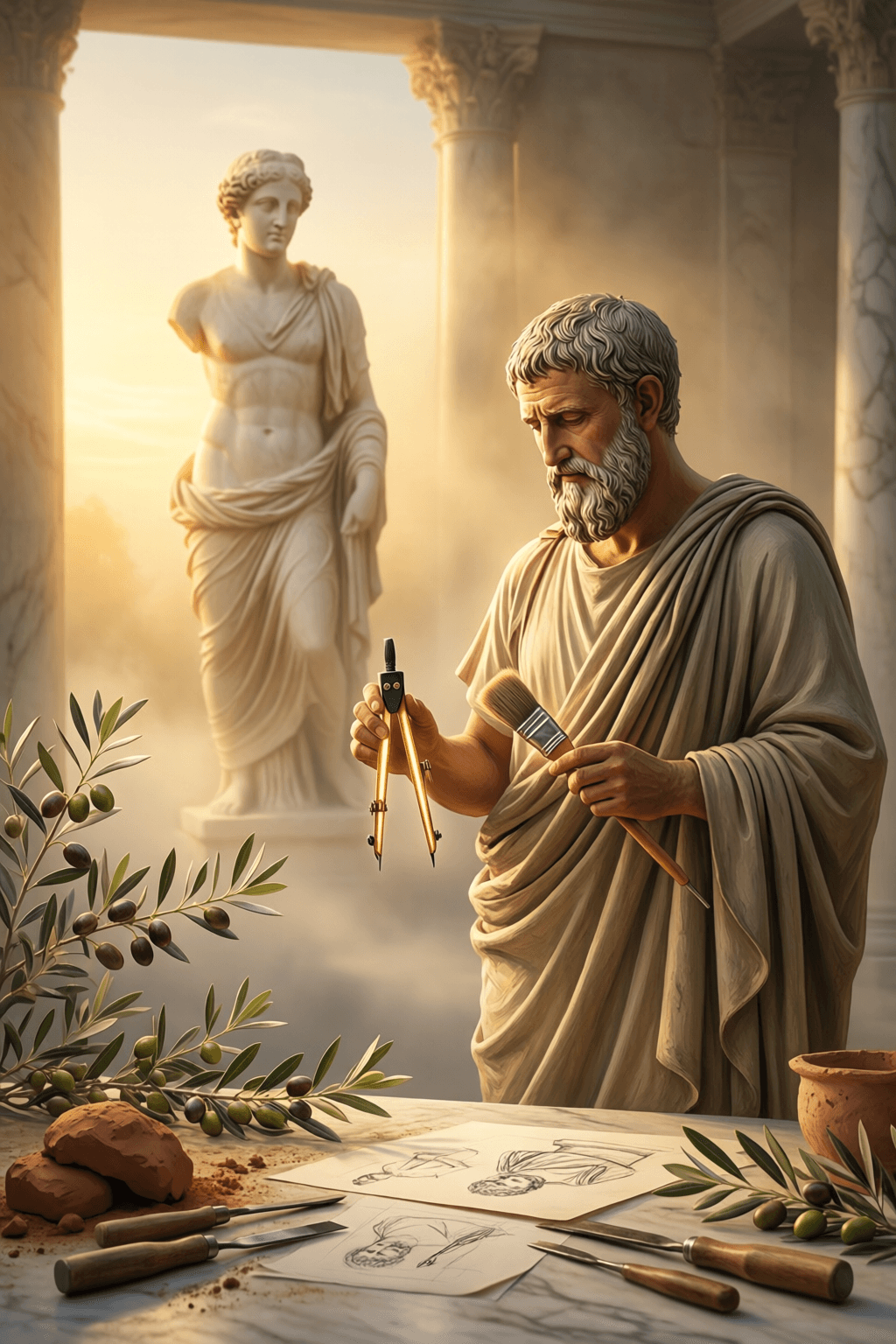
Creativity is the tool we all possess that helps us fulfill this promise by being creative on purpose. — Marcus Aurelius
—What lingers after this line?
Creativity as a Shared Capacity
The quote begins with an empowering assumption: creativity is not reserved for artists, inventors, or exceptional minds. Instead, it presents creativity as a common human tool, something each person already carries. In that sense, the “promise” it mentions is the possibility of becoming more fully useful, expressive, and intentional in the world.
The Meaning of Creating on Purpose
Moving from possession to practice, the phrase “being creative on purpose” suggests that creativity is not merely spontaneous inspiration. It can be chosen, disciplined, and directed. This idea fits well with the Stoic emphasis found in Marcus Aurelius’s Meditations (c. 170–180 AD), where attention, intention, and self-command shape a meaningful life.
A Stoic View of Human Potential
From a Stoic perspective, fulfilling a promise means living according to one’s nature and responsibilities. Creativity, then, is not just decoration or novelty; it becomes a way of responding wisely to circumstances. When obstacles arise, the creative person does not simply complain but searches for a constructive path forward.
Creativity Beyond the Arts
This broader understanding allows creativity to appear in ordinary life. A teacher redesigning a lesson, a parent calming conflict with humor, or a worker solving a practical problem all demonstrate purposeful creativity. Consequently, the quote invites us to see imagination not as escape from reality but as a practical method for engaging it more skillfully.
The Promise of Intentional Action
Finally, the quote ties creativity to fulfillment because ideas alone do not complete the promise. Purpose turns imagination into action. When people deliberately use their creative capacity, they participate in shaping their character, relationships, and communities, transforming creativity from a hidden talent into a daily ethical practice.
One-minute reflection
Why might this line matter today, not tomorrow?
Related Quotes
6 selectedAsk yourself at every moment, 'Is this necessary?' — Marcus Aurelius
Marcus Aurelius
Marcus Aurelius’ prompt—“Is this necessary?”—works like a mental pause button. Rather than condemning desire or action outright, it inserts a moment of scrutiny between impulse and behavior.
Read full interpretation →To be creative is to participate in the great process of creation — and participating in creativity is participating in life. — Rajneesh
Rajneesh
Rajneesh frames creativity not as a rare talent but as an act of joining something larger than oneself. At once, the quote shifts attention away from finished masterpieces and toward participation in an ongoing process o...
Read full interpretation →Order your thoughts, then set your feet in motion; intention finds its path through action. — Marcus Aurelius
Marcus Aurelius
Marcus Aurelius’ line begins with a simple sequence: first arrange the mind, then move the body. In Stoic terms, this reflects the idea that a well-ordered inner life—clear judgments, realistic expectations, and measured...
Read full interpretation →Creativity takes courage. — Henri Matisse
Henri Matisse
This quote highlights that being creative often involves exposing one's inner thoughts and feelings, which requires a significant amount of courage as it makes one vulnerable to criticism and judgment.
Read full interpretation →Shifting the mind into lower gear can bring better health, inner calm, enhanced concentration and the ability to think more creatively. — Carl Honoré
Carl Honoré
Carl Honoré’s insight begins with a simple but countercultural claim: the mind often works better when it stops racing. In a world that rewards speed, multitasking, and constant responsiveness, shifting into a “lower gea...
Read full interpretation →In order to be open to creativity, one must have the capacity for constructive use of solitude. One must overcome the fear of being alone. — Rollo May
Rollo May
Rollo May’s insight begins with a quiet but demanding premise: creativity requires the ability to stand apart from constant noise, approval, and distraction. To be open to new ideas, a person must first become comfortabl...
Read full interpretation →More From Author
More from Marcus Aurelius →Consistency is the sum that equals what we become. — Marcus Aurelius
Marcus Aurelius’ line frames becoming as a kind of moral mathematics: each repeated action adds to the total of a life. Rather than imagining identity as a single grand decision, the quote suggests that character is accu...
Read full interpretation →If anyone can refute me—show me I'm making a mistake or looking at things from the wrong perspective—I'll gladly change. — Marcus Aurelius
Marcus Aurelius begins from a position that appears modest but is actually deeply disciplined: he is willing to be corrected. Rather than treating disagreement as an insult, he frames it as an opportunity to see more cle...
Read full interpretation →The art of life is more like the wrestler's art than the dancer's; stand ready and firm to meet sudden and unexpected onsets. — Marcus Aurelius
Marcus Aurelius contrasts two arts to clarify what living well demands. A dancer suggests elegance, rhythm, and practiced beauty; a wrestler, by contrast, suggests balance under pressure, resistance, and constant readine...
Read full interpretation →How much time he gains who does not look to see what his neighbour says or does or thinks, but only at what he does himself, to make it just and holy. — Marcus Aurelius
Marcus Aurelius argues that a great deal of life is wasted in watching other people—what they say, what they do, and even what they might be thinking. Instead, he recommends a disciplined inward turn: focus on your own c...
Read full interpretation →