
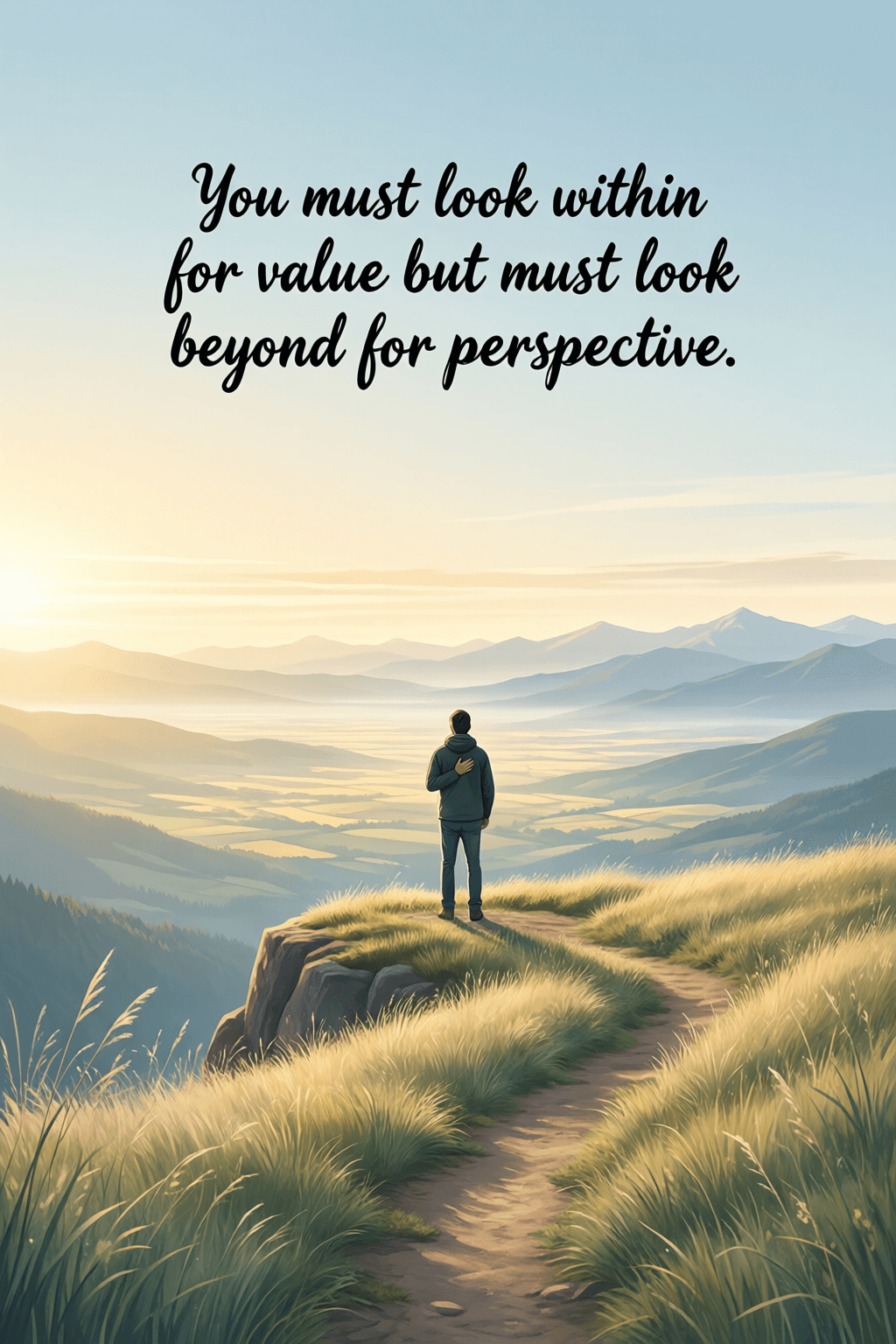
You must look within for value but must look beyond for perspective. — Denis Waitley
—What lingers after this line?
The Quote’s Core Balance
Denis Waitley’s line rests on a subtle but powerful balance: value is something we discover inwardly, while perspective is something we gain by looking outward. In other words, self-worth cannot be borrowed from applause, status, or comparison; it must be rooted in an honest understanding of who we are. At the same time, that inward grounding can become narrow or distorted if it never meets the wider world. For that reason, the quote does not praise isolation or constant self-reference. Instead, it proposes a rhythm between reflection and encounter. We begin by asking what we truly stand for, and then we test that understanding against other lives, other histories, and other realities. That movement from self-knowledge to broader awareness gives the saying its enduring practical wisdom.
Why Value Must Be Found Within
Looking within for value means recognizing that dignity is not the same as external success. A person may win admiration and still feel hollow, while another with little public recognition may possess deep integrity and steadiness. This idea echoes Stoic thought: Marcus Aurelius’ Meditations (c. AD 180) repeatedly return to the principle that character, not public opinion, anchors a life. Yet Waitley’s wording is careful. He does not say we should ignore the world; rather, he insists that worth should not depend entirely on it. Without that inward source, people become vulnerable to every criticism and addicted to every compliment. Inner value therefore becomes the stable center from which healthier choices, relationships, and ambitions can grow.
Why Perspective Requires Looking Beyond
Once inner worth is established, however, perspective demands an outward gaze. Left entirely alone, the self can mistake preference for truth and feeling for fact. By engaging with other people, cultures, and circumstances, we learn proportion: our problems may be real but not unique, our convictions may be sincere but not complete, and our experiences may be meaningful but not universal. This outward widening appears throughout literature and philosophy. Plato’s Republic (c. 375 BC) suggests that education is partly a turning of the soul toward a larger reality. In a more everyday sense, travel, conversation, history, and even service work can perform that same function. They remind us that wisdom grows not only from introspection, but also from contact with what lies beyond our own immediate frame.
The Danger of Imbalance
The force of the quote becomes even clearer when one side is missing. If people look only within, they may become self-enclosed, overconfident, or unable to correct their blind spots. What feels like authenticity can quietly harden into ego. Conversely, if they look only beyond, they may lose their center altogether, letting trends, expectations, or comparisons define their worth. Modern life often intensifies this second danger. Social media, for instance, offers endless perspective in one sense—countless glimpses into others’ lives—but often without the inner grounding needed to process them well. As a result, exposure becomes comparison rather than insight. Waitley’s aphorism therefore reads almost like a corrective for contemporary culture: know your worth privately, then seek perspective publicly.
A Practical Philosophy for Growth
Taken as advice, the quote offers a workable philosophy for personal development. First, one must cultivate inward habits such as reflection, journaling, prayer, or meditation—practices that help clarify values apart from noise. Then, just as importantly, one must move outward through listening, reading widely, meeting different people, and confronting realities that challenge comfort. Growth happens in the conversation between those two movements. A simple example makes the point. A young professional may believe inwardly that kindness and excellence matter more than prestige. Later, by working with colleagues from different backgrounds or volunteering in a struggling community, that belief gains perspective and depth. What began as a private conviction becomes informed, tested, and enlarged by the world.
Wisdom as an Ongoing Exchange
Ultimately, Waitley’s sentence describes wisdom not as a possession but as an ongoing exchange between the inner life and the outer world. We need the inward journey to avoid becoming shallow copies of public opinion, yet we need the outward journey to avoid becoming prisoners of our own limited viewpoint. One gives us grounding; the other gives us scale. That is why the quote feels both reassuring and demanding. It reassures us that value does not have to be earned through endless external validation. At the same time, it demands humility, because perspective always asks us to learn from what is beyond us. In that union of self-respect and openness, the saying sketches a mature and generous way to live.
Recommended Reading
As an Amazon Associate, we earn from qualifying purchases.
One-minute reflection
Where does this idea show up in your life right now?
Related Quotes
6 selectedWhen you honor your time, you honor your value. — Suze Orman
Suze Orman
At its core, Suze Orman’s statement links time to self-respect. To honor your time is not merely to stay busy or organized; rather, it is to recognize that your hours are a finite expression of your life itself.
Read full interpretation →Your worth is not a spreadsheet. You are not a project to be completed, but a life to be experienced. Stop measuring and start breathing. — Anne Lamott
Anne Lamott
Anne Lamott’s quote begins by confronting a habit many people barely notice: treating human value as if it could be tabulated. A spreadsheet symbolizes order, productivity, and comparison, yet it also reduces complexity...
Read full interpretation →If you want to move forward, you must first give yourself permission to stand still. Perspective is often the result of stopping long enough to actually see. — Alain de Botton
Alain de Botton
At first glance, Alain de Botton’s line seems contradictory: how can standing still help us move forward? Yet that tension is precisely his point.
Read full interpretation →Stop looking for the lens. Be the prism. — Shaan Puri
Shaan Puri
At first glance, Shaan Puri’s line overturns a common habit: waiting for the right lens through which to view the world. A lens implies borrowed perspective, something external that clarifies reality for us.
Read full interpretation →The most powerful relationship you will ever have is the relationship with yourself. — Nedra Glover Tawwab
Nedra Glover Tawwab
Nedra Glover Tawwab’s quote places self-relationship at the center of human life, suggesting that every other bond is filtered through the one we have with ourselves. In other words, the way we speak to ourselves, interp...
Read full interpretation →To the river, the stone is an obstacle; to the stone, the river is erosion. Perspective births both truth and conflict. — Monika Ajay Kaul
Monika Ajay Kaul
Monika Ajay Kaul’s image of the river and the stone immediately turns a simple natural scene into a meditation on perception. To the river, the stone interrupts motion; to the stone, the river slowly wears away form.
Read full interpretation →More From Author
More from Denis Waitley →When you are hit with life-disrupting events, you either cope or you crumble; you become better or bitter; you emerge stronger or weaker. — Denis Waitley
Denis Waitley frames disruption not merely as misfortune, but as a decisive turning point. When life is shaken by loss, failure, illness, or betrayal, ordinary habits no longer suffice, and character is tested in motion.
Read full interpretation →Chase your passion, not your pension. — Denis Waitley
This quote emphasizes the significance of pursuing what you truly love rather than focusing solely on financial security. It suggests that true happiness comes from following your passions.
Read full interpretation →You must welcome change as the rule but not as your ruler. — Denis Waitley
The quote suggests that change is a natural and inevitable part of life, and we should accept it as a constant force. Resistance can lead to stagnation, while openness to change allows for growth and progress.
Read full interpretation →The real risk is doing nothing. — Denis Waitley
This quote highlights that there is a greater risk in remaining inactive or stagnant than in taking action, even with the possibility of failure. By doing nothing, one may lose opportunities and fall behind.
Read full interpretation →