
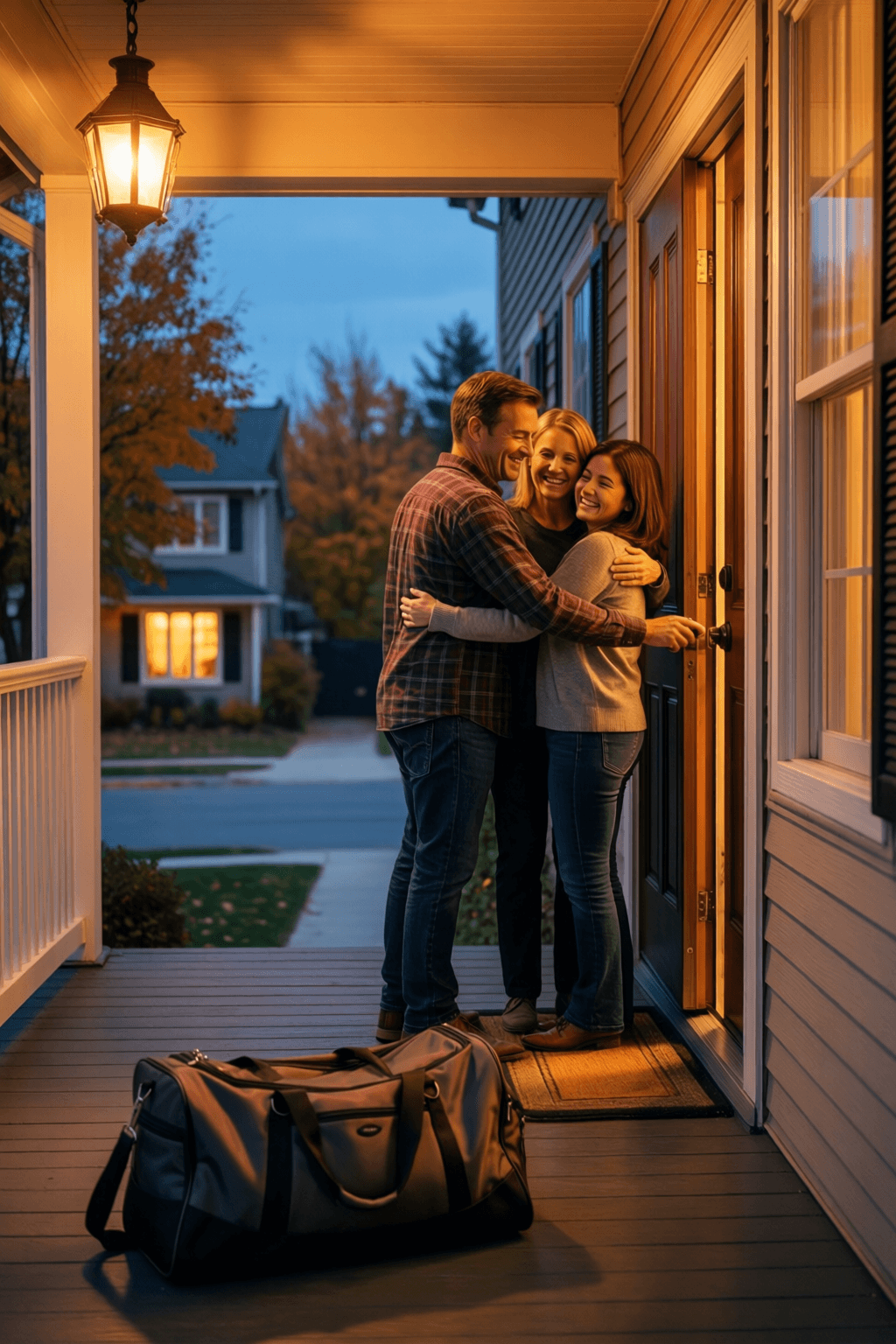
Home is the place where, when you have to go there, they have to take you in. — Robert Frost
—What lingers after this line?
The Unconditional Threshold
At first glance, Robert Frost’s line defines home not by warmth or beauty, but by obligation. In this view, home is the one place where necessity overrides ceremony: if you must arrive, the door must open. That subtle shift gives the quote its power, because it treats belonging less as a feeling than as a claim one can make in moments of vulnerability. In turn, Frost captures something many people recognize instinctively. Friendships may fade and institutions may judge, yet home, at least in its ideal form, remains bound by a deeper promise. The statement is both comforting and slightly stern, suggesting that real belonging includes duties as well as affection.
Belonging Beyond Sentiment
From there, the quote challenges sentimental pictures of home as merely cozy or nostalgic. Frost implies that home proves itself most clearly not during holidays or easy visits, but when life has gone wrong and one has nowhere else to stand. In that sense, home is tested by inconvenience; its truth appears when acceptance costs something. This perspective echoes Homer’s Odyssey, where Ithaca matters not because it is perfect, but because it remains Odysseus’s rightful place of return. Likewise, Frost’s idea suggests that home is less a mood than a durable bond, one that persists through failure, distance, and need.
A Quiet Social Contract
Moreover, Frost’s wording hints at an unwritten social contract within families and intimate communities. The phrase “they have to take you in” carries legal and moral weight, as though home operates by a code older than preference. Even when relationships are strained, the concept of home preserves a minimum duty of care. This is why the quote can sound both reassuring and bittersweet. It acknowledges that love inside a home may be imperfect, complicated, or even reluctant. Yet precisely because it leaves room for tension, Frost’s definition feels realistic: home is not always where one is most celebrated, but where one is still received.
The Pain Inside the Comfort
At the same time, the line is not naïve. By stressing obligation, Frost quietly admits that home can involve dependence, embarrassment, or return after disappointment. To have to go there may mean defeat, illness, poverty, or emotional exhaustion. Thus the quote contains a shadow: home is precious partly because people often seek it when they are least triumphant. This complexity recalls the emotional terrain of many American stories, including John Steinbeck’s The Grapes of Wrath (1939), where shelter and kinship are never abstract ideals but urgent necessities. Frost similarly suggests that home matters most when dignity is fragile and acceptance becomes a lifeline.
A Definition That Extends Beyond Houses
Finally, Frost’s insight reaches beyond any single building. Home may be a family, a grandparent’s table, a sibling’s spare room, or even a community that refuses to let someone disappear. What makes it home is not architecture but the certainty of being admitted when admission is most needed. Seen this way, the quote becomes a moral challenge as well as a definition. It asks whether we provide that kind of refuge for others and whether our closest bonds can bear the weight of obligation. In the end, Frost presents home as the last durable form of belonging: not flawless, not always tender, but steadfast when the world offers nowhere else to go.
One-minute reflection
Where does this idea show up in your life right now?
Related Quotes
6 selectedA home should be an anchor, a port in a storm, a refuge, a happy place in which to dwell. — Marvin J. Ashton
Marvin J. Ashton
Marvin J. Ashton’s statement presents home not merely as a physical structure but as a place of emotional and spiritual grounding.
Read full interpretation →Having a place to go is home. Having someone to love is family. Having both is a blessing. — Donna Hedges
Donna Hedges
This quote begins by defining 'home' not just as a physical space, but as any place of belonging or comfort—a refuge one can return to, offering safety and familiarity.
Read full interpretation →The most significant shift underway is not technological. It is relational. People are tired of being audiences. They want to belong. — Mariana F. Silva
Mariana F. Silva
At the heart of Mariana F. Silva’s observation is a subtle but powerful correction to the way modern change is usually described.
Read full interpretation →Home is where the heart is. — Pliny the Elder
Pliny the Elder
At its simplest, “Home is where the heart is” shifts the idea of home from a physical address to an emotional center. Pliny the Elder, the Roman naturalist associated with this saying, points toward a truth that outlasts...
Read full interpretation →In the embrace of family, we find our true home, where love wraps around us like a warm, familiar blanket. — Mitch Albom
Mitch Albom
At first glance, Mitch Albom’s reflection shifts the meaning of home away from walls, roofs, and addresses toward something more intimate: the emotional shelter created by family. In this view, home is not merely where w...
Read full interpretation →Stop walking through the world looking for confirmation that you don't belong. You will always find it because you've made that your mission. — Brené Brown
Brené Brown
Brené Brown’s statement begins with a striking image: moving through the world while searching for proof of exclusion. In other words, she suggests that many experiences of not belonging are filtered through an expectati...
Read full interpretation →More From Author
More from Robert Frost →The best way out is always through. — Robert Frost
This quote suggests that the most effective way to overcome difficulties is by confronting them directly, rather than avoiding or bypassing them.
Read full interpretation →Poetry is when an emotion has found its thought and the thought has found words. — Robert Frost
This quote highlights the poetic process, where emotions first need to be understood through clear thought, and only then can they be expressed through words. It emphasizes the intricate relationship between feelings and...
Read full interpretation →The woods are lovely, dark and deep, but I have promises to keep, and miles to go before I sleep. — Robert Frost
The 'woods' symbolize a tranquil and beautiful place, which tempts one to rest, pause, or even withdraw from obligations. The 'dark and deep' woods evoke a sense of mystery and allure that can be comforting yet dangerous...
Read full interpretation →To know what you can do, you must first find out what you can't do. — Robert Frost
This quote emphasizes the importance of self-awareness in personal growth. By understanding your limitations, you gain better clarity on your strengths and can make more informed decisions about what you're truly capable...
Read full interpretation →