
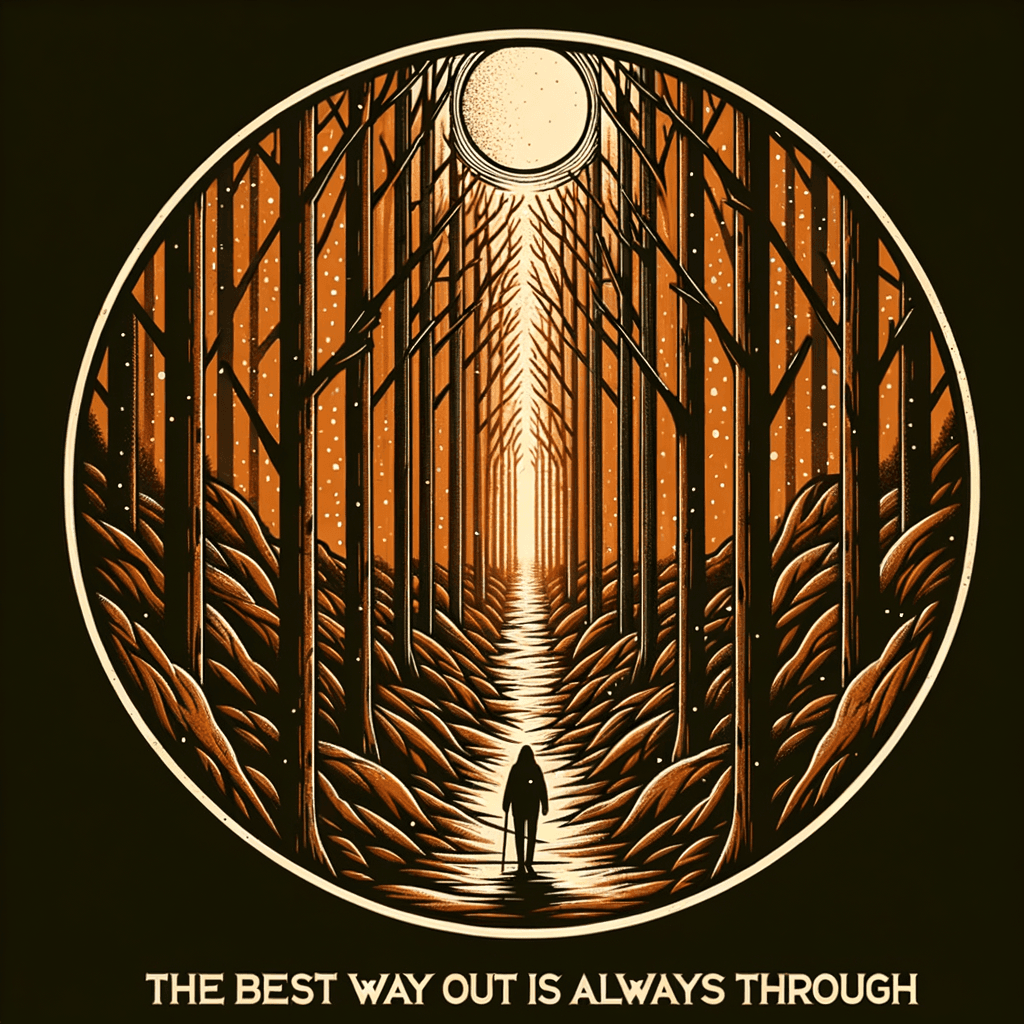
The best way out is always through. — Robert Frost
—What lingers after this line?
Facing Challenges Head-On
This quote suggests that the most effective way to overcome difficulties is by confronting them directly, rather than avoiding or bypassing them.
Building Resilience
Going through challenging experiences helps to build resilience and strength. It implies that enduring and navigating through tough times is crucial for personal growth.
Avoidance vs. Engagement
The quote contrasts avoidance with engagement, emphasizing that true resolution comes from action and persistence, not from evading problems.
Long-Term Solutions
It suggests that enduring the hardships and working through them provides a more lasting and meaningful solution compared to temporary escapism.
Psychological Perspective
From a psychological standpoint, facing fears and challenges can lead to a sense of accomplishment and empowerment, which is important for mental well-being.
Robert Frost's Philosophy
Robert Frost, an American poet known for his depictions of rural life and philosophical musings, often explored themes of human experience and the complexities of life. This quote reflects his belief in the importance of perseverance.
One-minute reflection
What feeling does this quote bring up for you?
Related Quotes
6 selectedWhen I hear somebody sigh, 'Life is hard,' I am always tempted to ask, 'Compared to what?' — Sydney J. Harris
Sydney J. Harris
Sydney J. Harris’s remark begins with an ordinary expression of fatigue: “Life is hard.” Yet his response, “Compared to what?” quietly turns complaint into inquiry.
Read full interpretation →If we are facing in the right direction, all we have to do is keep walking. — Thích Nhất Hạnh
Thich Nhat Hanh
Thích Nhất Hạnh’s words begin with a simple but profound premise: progress depends first on direction, not speed. If a person is turned toward compassion, clarity, healing, or truth, then each modest step becomes meaning...
Read full interpretation →Don't fight the challenges. Just find a new way to stand. — Germany Kent
Germany Kent
Germany Kent’s words begin with a quiet reversal of instinct: instead of treating every challenge as an enemy to defeat, she invites us to reconsider our posture toward difficulty. The emphasis is not on surrender, but o...
Read full interpretation →Do the best one can. Do it over again. Then still improve, even if ever so slightly, those retouches. — Marguerite Yourcenar
Marguerite Yourcenar
Yourcenar’s words begin with a simple demand: do the best one can. Yet she immediately refuses to let effort become an excuse for stopping.
Read full interpretation →Optimist: someone who figures that taking a step backward after taking a step forward is not a disaster, it's more like a cha-cha. — Robert Brault
Robert Brault
Robert Brault’s line begins with a witty redefinition: an optimist is not someone who denies backward motion, but someone who interprets it differently. Instead of treating a setback as proof of failure, the optimist see...
Read full interpretation →A mind grows by staying with difficulty long enough for the experience to change it. — Mary Catherine Bateson
Mary Catherine Bateson
Mary Catherine Bateson’s observation begins with a quiet but demanding truth: the mind does not grow merely by encountering difficulty, but by remaining with it. Challenge becomes transformative only when we resist the u...
Read full interpretation →More From Author
More from Robert Frost →Home is the place where, when you have to go there, they have to take you in. — Robert Frost
At first glance, Robert Frost’s line defines home not by warmth or beauty, but by obligation. In this view, home is the one place where necessity overrides ceremony: if you must arrive, the door must open.
Read full interpretation →Poetry is when an emotion has found its thought and the thought has found words. — Robert Frost
This quote highlights the poetic process, where emotions first need to be understood through clear thought, and only then can they be expressed through words. It emphasizes the intricate relationship between feelings and...
Read full interpretation →The woods are lovely, dark and deep, but I have promises to keep, and miles to go before I sleep. — Robert Frost
The 'woods' symbolize a tranquil and beautiful place, which tempts one to rest, pause, or even withdraw from obligations. The 'dark and deep' woods evoke a sense of mystery and allure that can be comforting yet dangerous...
Read full interpretation →To know what you can do, you must first find out what you can't do. — Robert Frost
This quote emphasizes the importance of self-awareness in personal growth. By understanding your limitations, you gain better clarity on your strengths and can make more informed decisions about what you're truly capable...
Read full interpretation →