
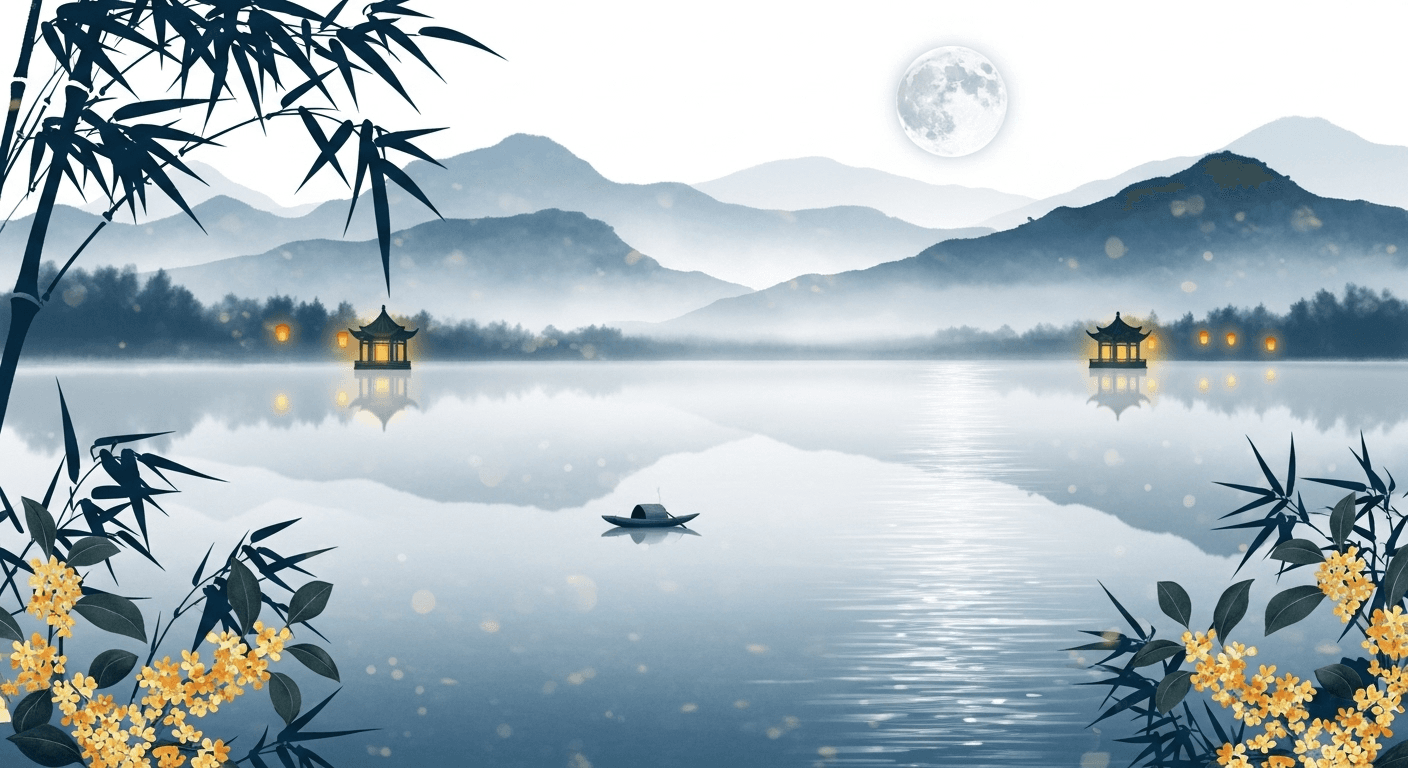
May we all be blessed with longevity, Though thousands of miles apart, We are still able to share the beauty of the moon together. - Su Shi (Su Dongpo)
—What lingers after this line?
A Blessing for Enduring Ties
Su Shi’s closing lines read like a raised cup across the night: may life be long enough that bonds endure, and may distance yield to a shared, luminous moment. Rather than deny separation, he dignifies it by offering a common point of reference—the moon—that gathers scattered lives into one horizon. The wish is tender but practical, recognizing that we cannot always choose nearness, yet we can still choose communion. Flowing from this blessing, the poem’s deeper layers unfold: acceptance of change, gratitude for continuity, and confidence that beauty can be mutual even when proximity is not. It is a compact philosophy of togetherness that prepares us for the historical and emotional context in which it was written.
A Mid-Autumn Night in 1076
To see why the blessing resonates, consider its origin. During the Mid-Autumn Festival of 1076, Su Shi (1037–1101) wrote “Shui Diao Ge Tou” in Mizhou, far from his brother, Su Zhe. His prefatory note records, “On the Mid-Autumn night of the bingchen year, I drank merrily until dawn and composed this piece, thinking of Ziyou” (Su Shi, Shui Diao Ge Tou, 1076). Thus the lyric rises from separation eased by festivity: a table lit by moonlight, wine softening grievance, and memory turning absence into presence. In that setting, the moon becomes both witness and courier, carrying affection across provinces.
The Moon as Shared Vessel
From this vantage, the moon functions as a shared vessel—one image poured into many cups. Because it is simultaneously seen by distant eyes, it sutures space without erasing it. Chinese poetry often grants the moon this mediating role; Li Bai’s “Quiet Night Thoughts” (c. 8th century) likewise lets moonlight summon family and home. Yet Su’s twist is communal: he invites not only nostalgia but co-experience, “to share the moon together,” as if the sky were a single table. Consequently, the image shifts from solitary yearning to synchronized looking, transforming private longing into a participatory rite.
Impermanence Turned Into Comfort
At the poem’s heart is a frank concession to change: “People have grief and joy, partings and reunions; the moon has phases of dimness and fullness—such things are hard to perfect.” By paralleling human fortunes with the moon’s cycles, Su Shi reframes instability as a natural rhythm rather than a personal failure. This acceptance, steeped in yin–yang sensibility, clears a path from lament to blessing. Because fullness cannot be permanent, the poet offers what can endure: the capacity to look up together. The wish for longevity thereby becomes a wish for recurring moments of shared light.
Ritual, Community, and Mooncakes
Moving from philosophy to practice, the Mid-Autumn Festival made Su’s insight tangible. Families gathered to admire the moon, exchange mooncakes, and recite poems—a custom that matured across Tang and Song courts and marketplaces alike. The ritual did not abolish distance; rather, it taught people how to inhabit it with grace. By coordinating attention—everyone gazing upward on the same night—community was enacted across rooftops and rivers. The festal script turned a celestial event into social glue, echoing Su’s call to share beauty even when miles intervene.
Translation Nuances of ‘婵娟’
The closing phrase “qian li gong chanjuan” is often rendered “share the beauty of the moon,” but chanjuan literally connotes graceful, feminine elegance. In classical usage it personifies the moon’s fair presence rather than a human beloved. Translators choose “beauty,” “lovely radiance,” or simply “the moon” to capture its delicate poise. This nuance matters: by addressing the moon as a refined companion, Su softens the distance between sky and viewer. The diction itself performs intimacy, making the act of looking feel like keeping company.
Living the Sentiment Today
Finally, the poem’s promise survives our era of flights and fiber-optic calls. Even when time zones refuse convenient reunions, the same lunar face crosses windows and phone screens, an ancient synchronization beyond bandwidth. Families apart can still schedule their gaze, letting shared light do quiet work. Thus the centuries fold into the present: a Song-dynasty toast becomes a modern practice of remembrance. Distance remains, but so does a simple remedy—one moon, many hearts, held together by looking.
Recommended Reading
As an Amazon Associate, we earn from qualifying purchases.
One-minute reflection
What's one small action this suggests?
Related Quotes
6 selected“A bright moon rises over the sea; though far apart, we share this moment together.” — Zhang Jiuling
Zhang Jiuling
Zhang Jiuling distills a paradox into a luminous image: the moon unites what the sea divides. In his “Looking at the Moon and Thinking of One Afar” (c.
Read full interpretation →I searched for him a thousand times in the crowd. Suddenly I turned my head, and there he was, at the dimly lit place where the lanterns were few. -- Xin Qiji
Xin Qiji
Xin Qiji frames love as a relentless act of looking: the speaker scans a crowd again and again, as if repetition might conjure the beloved into view. The exaggeration of “a thousand times” is less a statistic than a port...
Read full interpretation →Transform longing into art; the soul does its work through making. — Kahlil Gibran
Kahlil Gibran
Gibran frames longing not as a deficit to be cured but as a force that can be transmuted. The ache for someone, somewhere, or some meaning becomes raw material—an emotional pigment waiting to be mixed into form.
Read full interpretation →May we all be blessed with longevity, Though thousands of miles apart, We are still able to share the beauty of the moon together. - Su Shi (Su Dongpo)
Su Shi (Su Dongpo
Su Shi, the Song-dynasty poet-statesman, composed his lyric to the tune “Shui Diao Ge Tou” during the Mid-Autumn Festival (c. 1076).
Read full interpretation →Sing so your longing becomes fuel, then walk toward the light you name — Sappho
Sappho
Sappho’s line begins by treating longing not as a weakness to hide but as raw material to work with. Instead of letting desire pool into paralysis, she frames it as something already full of energy—an inner pressure seek...
Read full interpretation →Translate longing into craft, and the world will begin to answer. — Frida Kahlo
Frida Kahlo
Kahlo’s line treats longing not as a weakness to outgrow but as a potent substance—like pigment or clay—waiting to be shaped. Rather than asking us to suppress desire, grief, or yearning, she implies these feelings can b...
Read full interpretation →More From Author
More from Su Shi (Su Dongpo →May we all be blessed with longevity, Though thousands of miles apart, We are still able to share the beauty of the moon together. - Su Shi (Su Dongpo)
At the outset, Su Shi’s wish binds time, space, and affection into a single gesture: may we live long enough to keep sharing the same moon. Rather than lament distance, the lines convert it into a field of connection, wh...
Read full interpretation →May we all be blessed with longevity, Though thousands of miles apart, We are still able to share the beauty of the moon together. - Su Shi (Su Dongpo)
Su Shi, the Song-dynasty poet-statesman, composed his lyric to the tune “Shui Diao Ge Tou” during the Mid-Autumn Festival (c. 1076).
Read full interpretation →May we all be blessed with longevity, Though thousands of miles apart, We are still able to share the beauty of the moon together. - Su Shi (Su Dongpo)
Su Shi’s closing benediction—“May we all be blessed with longevity… we are still able to share the beauty of the moon”—distills a tender paradox: separation persists, yet communion endures. The moon becomes a mirror in t...
Read full interpretation →The endless Yangtze River flows eastward, Its waves have washed away all the gallant heroes of ages past. -- Yang Shen We are still able to share the beauty of the moon together. - Su Shi (Su Dongpo)
At the outset, Yang Shen’s image of the Yangtze sweeping east—its waves “washing away” fallen champions—offers a stark meditation on impermanence. History’s pageantry, he implies, dissolves into foam, as fame proves no m...
Read full interpretation →