
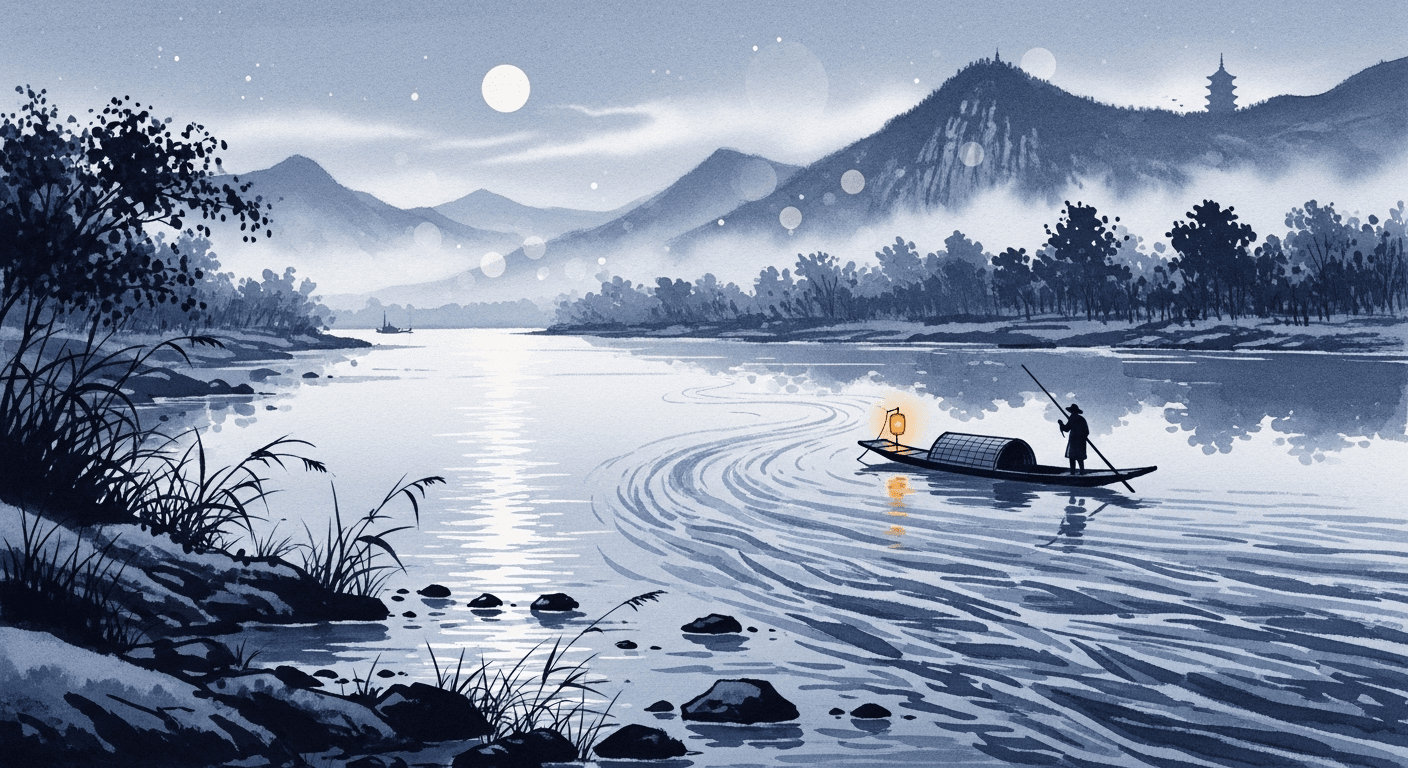
The endless Yangtze River flows eastward, Its waves have washed away all the gallant heroes of ages past. -- Yang Shen We are still able to share the beauty of the moon together. - Su Shi (Su Dongpo)
—What lingers after this line?
The River That Forgets Heroes
At the outset, Yang Shen’s image of the Yangtze sweeping east—its waves “washing away” fallen champions—offers a stark meditation on impermanence. History’s pageantry, he implies, dissolves into foam, as fame proves no match for time’s current. Popularly placed at the opening of Romance of the Three Kingdoms and traced to Yang Shen’s ci poem Linjiangxian (Ming, c. 16th century), the couplet compresses entire dynasties into a single watery gesture. The river, ever-moving, becomes history’s impartial editor: it preserves the landscape yet erases names. Thus the scene is not merely elegiac; it is diagnostic, urging humility before the ceaseless motion that outlives all triumphs.
A Moon That Unites the Distant
Meanwhile, Su Shi shifts the gaze upward, transforming the moon into a compassionate bridge. In his Shui diao ge tou (Mid-Autumn, 1076), written while separated from his brother Ziyou, he resolves distance with a wish: “May we live long, and share the moon’s beauty across a thousand miles.” Where the river enacts loss, the moon enacts communion, synchronizing dispersed hearts under a single luminous clock. Even when circumstances scatter people, the cyclical orb returns, promising reunion by rhythm if not by road. Su Shi thus reframes impermanence as an invitation to cherish what recurs.
Flux and Fellowship: A Unified Vision
Taken together, the river and the moon sketch a double wisdom: accept transience, and cultivate togetherness. The Yangtze’s sweep clears illusions of permanence; the moon’s recurrence sustains bonds that outlast events. As the river teaches humility, the moon teaches fidelity. One strips away the vanities of “gallant heroes,” the other restores meaning through shared contemplation. The movement from water to sky becomes a moral arc: first, let go of the myth of lasting acclaim; then, hold fast to the practice of shared wonder.
Voices Tempered by Exile and Return
Historically, both voices were shaped by political turbulence. Yang Shen (1488–1559), a brilliant Ming scholar-official, suffered demotion to Yunnan; his Linjiangxian distills the sobriety of a man who watched courts change like riverbanks. Su Shi (1037–1101), repeatedly exiled, wrote Shui diao ge tou after a period of hardship, transforming personal separation into universal solace. Their biographies clarify the poems’ temper: resignation without despair, clarity without coldness. Far from abstract musings, these lines are field notes from lives weathered by power’s tides and healed by recurring light.
Echoes Across Philosophies and Literatures
In parallel, the river recalls Heraclitus’s dictum, “You cannot step into the same river twice” (fr. B12 DK), while the moon’s shared gaze evokes classical Chinese meditations on cosmic kinship—Zhuangzi’s transformations and the Tang poet Zhang Jiuling’s “The moon grows and wanes; so do people’s fortunes” (c. 8th century). Even Du Fu’s Mid-Autumn poems (756) bind distant family through moonlight, demonstrating how recurrence consoles change. These echoes do not dilute the two lines; they amplify them, revealing a perennial pattern: movement humbles us, recurrence gathers us.
Contemporary Bearings: What To Remember
Today, the lesson travels easily. Careers crest and subside like wakes on a busy river, yet families separated by cities or oceans still look up at the same moon—during the Mid-Autumn Festival or an ordinary evening video call. The poems counsel a posture: measure one’s worth not by the silt of reputation but by the constancy of shared rituals. Let the river loosen our grip on applause; let the moon tighten our hold on one another. In practicing both, we find a durable grace amid relentless change.
One-minute reflection
What feeling does this quote bring up for you?
Related Quotes
6 selectedTime is like a river that swiftly carries away all that is born. - Marcus Aurelius
Marcus Aurelius
This quote likens time to a relentless, flowing river, emphasizing its unstoppable and ever-moving nature. Just as a river carries everything in its path towards an inevitable destination, time continuously progresses an...
Read full interpretation →If we don't have each other, we go crazy with loneliness. When we do, we go crazy with togetherness. — Stephen King
Stephen King
Stephen King’s line captures a sharp paradox at the center of human life: isolation can drive us inward until loneliness becomes unbearable, yet intimacy can overwhelm us with its demands. In other words, we are not buil...
Read full interpretation →Consistency is contrary to nature, contrary to life. The only completely consistent people are the dead. — Aldous Huxley
Aldous Huxley
At its core, Huxley’s remark argues that life is inseparable from movement, revision, and contradiction. A living person responds to new experiences, changing relationships, and shifting knowledge; therefore, complete co...
Read full interpretation →The best moments in life are made better by sharing them with family. — Anita Krizzan
Anita Krizzan
At its heart, Anita Krizzan’s quote suggests that happiness is rarely complete in isolation. A beautiful meal, a personal milestone, or even an ordinary sunset often feels more vivid when loved ones are present to witnes...
Read full interpretation →True togetherness is the art of sitting with one another in the silence, acknowledging that being present is the highest form of support we can offer. — Henri Nouwen
Henri Nouwen
Henri Nouwen’s reflection begins by redefining togetherness not as constant conversation, but as a quiet, attentive communion. In this view, silence is not emptiness; rather, it becomes a space where two people recognize...
Read full interpretation →Together in our house, in the firelight, we are the world made small. — Jennifer Donnelly
Jennifer Donnelly
At its heart, Jennifer Donnelly’s line turns a private domestic scene into something vast: a house lit by fire becomes a miniature version of the world itself. The phrase “made small” does not diminish life’s importance;...
Read full interpretation →More From Author
More from Su Shi (Su Dongpo →May we all be blessed with longevity, Though thousands of miles apart, We are still able to share the beauty of the moon together. - Su Shi (Su Dongpo)
At the outset, Su Shi’s wish binds time, space, and affection into a single gesture: may we live long enough to keep sharing the same moon. Rather than lament distance, the lines convert it into a field of connection, wh...
Read full interpretation →May we all be blessed with longevity, Though thousands of miles apart, We are still able to share the beauty of the moon together. - Su Shi (Su Dongpo)
Su Shi, the Song-dynasty poet-statesman, composed his lyric to the tune “Shui Diao Ge Tou” during the Mid-Autumn Festival (c. 1076).
Read full interpretation →May we all be blessed with longevity, Though thousands of miles apart, We are still able to share the beauty of the moon together. - Su Shi (Su Dongpo)
Su Shi’s closing lines read like a raised cup across the night: may life be long enough that bonds endure, and may distance yield to a shared, luminous moment. Rather than deny separation, he dignifies it by offering a c...
Read full interpretation →May we all be blessed with longevity, Though thousands of miles apart, We are still able to share the beauty of the moon together. - Su Shi (Su Dongpo)
Su Shi’s closing benediction—“May we all be blessed with longevity… we are still able to share the beauty of the moon”—distills a tender paradox: separation persists, yet communion endures. The moon becomes a mirror in t...
Read full interpretation →