
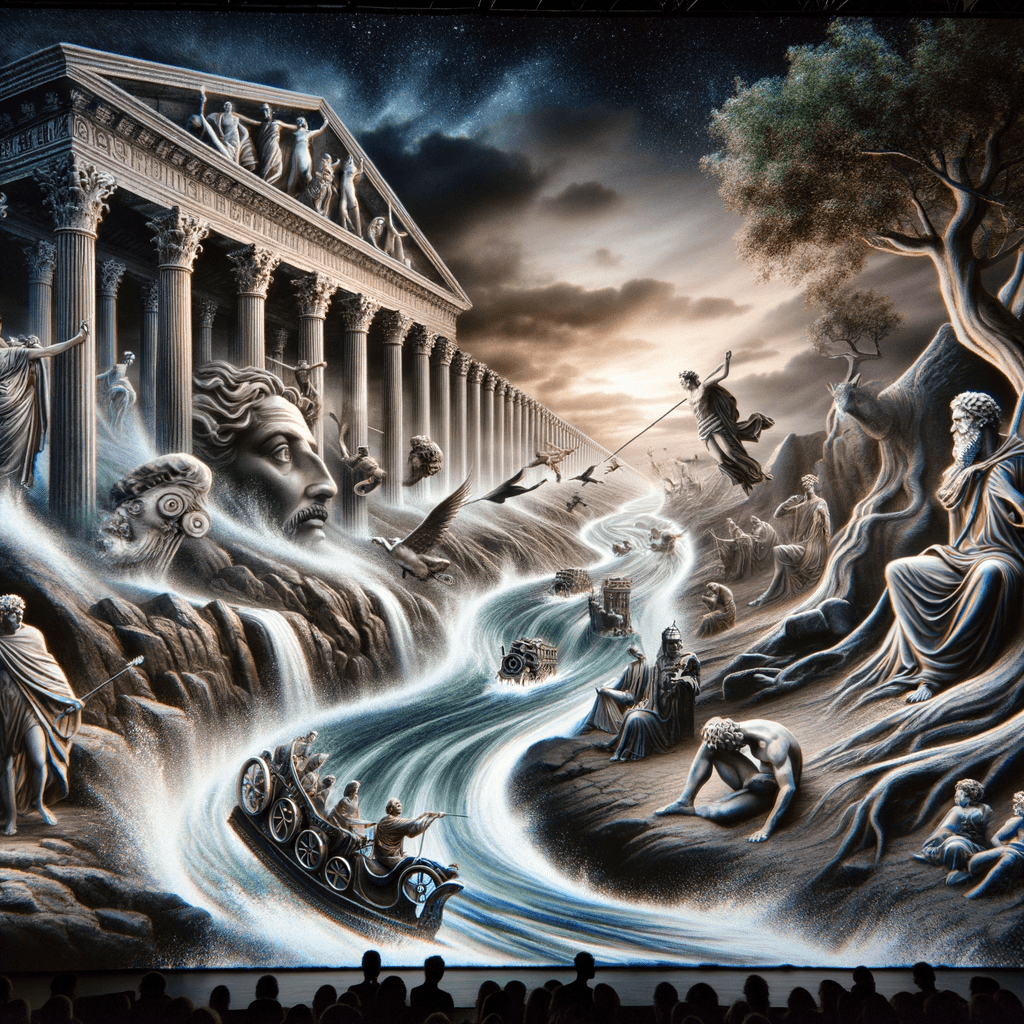
Time is like a river that swiftly carries away all that is born. - Marcus Aurelius
—What lingers after this line?
Nature of Time
This quote likens time to a relentless, flowing river, emphasizing its unstoppable and ever-moving nature. Just as a river carries everything in its path towards an inevitable destination, time continuously progresses and never halts.
Impermanence
It illustrates the concept of impermanence, highlighting that everything born or created is eventually taken away by the passage of time. This emphasizes the transient nature of life and existence.
Philosophical Reflection
Marcus Aurelius, a Stoic philosopher, often reflected on the fleeting nature of human life and the importance of living in accordance with virtue. This quote urges contemplation on the brevity and preciousness of life.
Inevitability of Change
The analogy of a river underscores the inevitable changes and events that occur over time. Just as a river shapes the landscape, time shapes our lives through experiences, growth, and loss.
Encouragement for Mindfulness
By understanding the swift passage of time, there is an encouragement to live mindfully and with intention. Recognizing that time carries everything away can inspire individuals to make meaningful choices and cherish moments.
Historical Context
Marcus Aurelius was a Roman Emperor and a key figure in Stoic philosophy. His writings, particularly in 'Meditations,' reflect his thoughts on life, time, and the human condition, offering insights that remain relevant across centuries.
One-minute reflection
What feeling does this quote bring up for you?
Related Quotes
6 selectedYou could leave life right now. Let that determine what you do, say, and think. — Marcus Aurelius
Marcus Aurelius
Marcus Aurelius compresses an entire philosophy into a single jolt: you could die at any moment, so let that fact govern your actions, words, and thoughts. In his Meditations (c.
Read full interpretation →There is a limit to the time assigned you, and if you don't use it to free yourself it will be gone and never return. — Marcus Aurelius
Marcus Aurelius
Marcus Aurelius frames time not as a neutral backdrop but as a finite allotment, quietly counting down whether we notice it or not. The sting in his line is practical: the hours are assigned, not earned, and their expira...
Read full interpretation →Time does not wait, the seasons flow like a stream.
Unknown
This statement emphasizes that time is relentless and unstoppable. It moves forward without waiting for anyone, much like the continuous flow of water in a stream.
Read full interpretation →The act of dying is one of the acts of life. — Marcus Aurelius
Marcus Aurelius
This quote highlights the inevitability of death as a natural part of life, suggesting that death itself is not separate from life but an essential and unavoidable phase within it.
Read full interpretation →Loss is nothing else but change, and change is Nature's delight. — Marcus Aurelius
Marcus Aurelius
This quote reframes loss as a natural and inevitable process of change, which is an integral part of life. It suggests that instead of resisting loss, one should view it as a transformation necessary for growth.
Read full interpretation →Consistency is contrary to nature, contrary to life. The only completely consistent people are the dead. — Aldous Huxley
Aldous Huxley
At its core, Huxley’s remark argues that life is inseparable from movement, revision, and contradiction. A living person responds to new experiences, changing relationships, and shifting knowledge; therefore, complete co...
Read full interpretation →More From Author
More from Marcus Aurelius →Consistency is the sum that equals what we become. — Marcus Aurelius
Marcus Aurelius’ line frames becoming as a kind of moral mathematics: each repeated action adds to the total of a life. Rather than imagining identity as a single grand decision, the quote suggests that character is accu...
Read full interpretation →If anyone can refute me—show me I'm making a mistake or looking at things from the wrong perspective—I'll gladly change. — Marcus Aurelius
Marcus Aurelius begins from a position that appears modest but is actually deeply disciplined: he is willing to be corrected. Rather than treating disagreement as an insult, he frames it as an opportunity to see more cle...
Read full interpretation →The art of life is more like the wrestler's art than the dancer's; stand ready and firm to meet sudden and unexpected onsets. — Marcus Aurelius
Marcus Aurelius contrasts two arts to clarify what living well demands. A dancer suggests elegance, rhythm, and practiced beauty; a wrestler, by contrast, suggests balance under pressure, resistance, and constant readine...
Read full interpretation →How much time he gains who does not look to see what his neighbour says or does or thinks, but only at what he does himself, to make it just and holy. — Marcus Aurelius
Marcus Aurelius argues that a great deal of life is wasted in watching other people—what they say, what they do, and even what they might be thinking. Instead, he recommends a disciplined inward turn: focus on your own c...
Read full interpretation →