
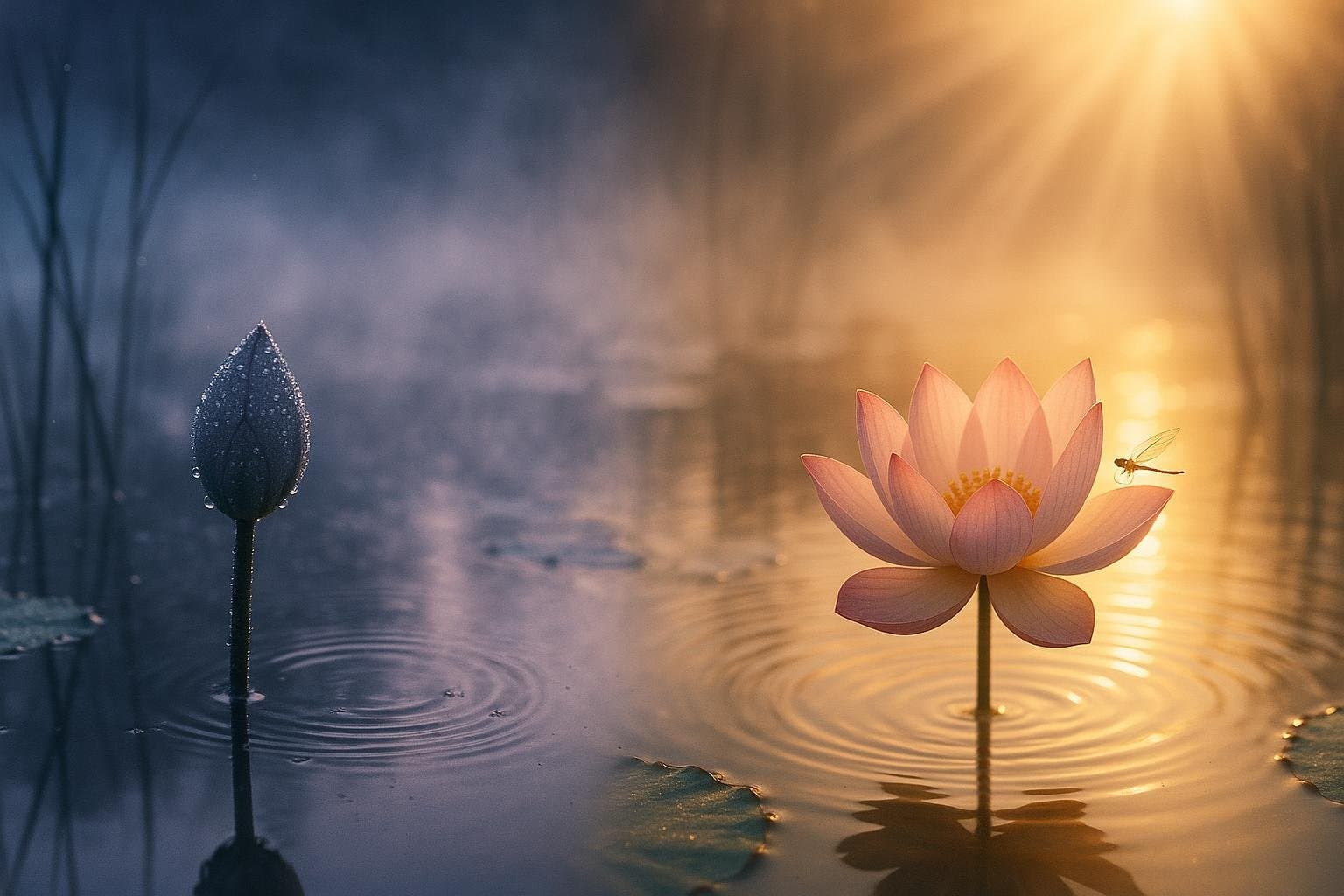
Breathing in, I calm my body. Breathing out, I smile. — Thich Nhat Hanh
—What lingers after this line?
A One-Breath Doorway to Presence
Thich Nhat Hanh distills mindfulness into two gestures: soothing the body and softening the face. In this short gatha—a mindful verse used in Plum Village—breath becomes an anchor, and the smile a gentle signal of friendliness toward the present moment. Rather than forcing change, it invites a shift from reactivity to receptivity. Beginning with the body acknowledges that emotion lives in muscles, breath, and heartbeat. As calm arrives, the outward smile reflects an inward readiness to meet life as it is. Peace Is Every Step (1991) shows how such brief pauses can interrupt stress spirals. Thus, with one inhalation and one exhalation, we practice arriving—fully, kindly, here.
How Breathing Physically Settles the Body
Physiologically, slow diaphragmatic breathing tilts the nervous system toward parasympathetic balance. Lengthening the exhale stimulates the vagus nerve and increases heart rate variability, a marker of resilience. Stephen Porges’s polyvagal perspective (2011) explains how cues of safety—like steady breath—downshift threat responses and relax musculature. Furthermore, paced respiration around six breaths per minute has been linked to improved autonomic regulation and emotional stability (Lehrer & Gevirtz, International Journal of Psychophysiology, 2014). In this light, ‘Breathing in, I calm my body’ is both poetic and biological: the inhale gathers awareness; the measured exhale signals the body to soften its guard.
Smiling as an Act of Kindness
The soft smile here is not performance but permission: it tells the nervous system, and the people around us, that we are safe enough to be open. Psychology’s facial feedback hypothesis, traced to William James, suggests expressions can nudge feelings. Strack, Martin, and Stepper (1988) reported mood shifts from induced smiling; later replications were mixed, yet a meta-analysis indicates a small, reliable effect (Coles et al., Psychological Bulletin, 2019). More importantly, the smile frames attention as caring rather than critical. By pairing exhale with a hint of warmth, we encourage benevolence toward our own experience—an echo of loving-kindness practice—so acceptance, not avoidance, becomes our default stance.
Roots in Early Buddhist Breath Training
Historically, this instruction aligns with the Anapanasati Sutta (MN 118), where practitioners train to ‘breathe in calming bodily formations’ and ‘breathe out experiencing joy.’ The Satipatthana framework then integrates breath with body, feeling, mind, and phenomena, weaving calm into insight. Thich Nhat Hanh’s wording adapts these classics into everyday language. By locating serenity in the body first, the tradition recognizes that clarity of mind follows ease of physiology. The smile completes the arc: from settling to gladdening, which in turn sustains attention without strain. Thus, ancient guidance becomes a portable tool for modern moments—at the sink, in traffic, or between meetings.
From Inner Calm to Compassionate Action
Calming and smiling are not retreats from the world; they are preparations to meet it wisely. Thich Nhat Hanh’s engaged Buddhism insisted that inner peace and social care are interdependent. During the Vietnam War, he advocated nonviolence and reconciliation, a stance that led Martin Luther King Jr. to nominate him for the Nobel Peace Prize in 1967. Consequently, the practice scales from breath to behavior: when the body is settled, we listen better, speak more gently, and act with steadier courage. This linkage reframes mindfulness as public ethics—personal regulation in service of collective wellbeing.
Weaving the Practice Into Daily Life
To make it stick, pair the gatha with existing routines. After you touch a door handle, inhale and calm; as you cross the threshold, exhale and smile. When your phone lights up, inhale; as you answer, exhale and smile before speaking. This ‘habit stacking’ approach is supported by behavior design research (BJ Fogg, Tiny Habits, 2019; James Clear, Atomic Habits, 2018). Small, frequent reps beat occasional marathons. Three mindful breaths before sending an email can shift tone; one at a red light can reset your afternoon. In this way, practice stops being a separate chore and becomes the texture of an ordinary day.
A Gentle, Trauma-Sensitive Approach
For some, focusing on the breath can be activating. If agitation rises, widen attention: feel your feet on the ground, keep eyes open, orient to three sounds, or place a hand where contact feels steady. Exhales can be longer than inhales without forcing pace. If discomfort persists, pause the exercise. Trauma-Sensitive Mindfulness (David Treleaven, 2018) recommends offering choices and emphasizing present-moment safety rather than rigid techniques. The spirit of Thich Nhat Hanh’s guidance remains: meet yourself with kindness. Calm and a true smile are invitations—not demands.
One-minute reflection
Where does this idea show up in your life right now?
Related Quotes
6 selectedConscious breathing is my anchor in the windy sky of feelings. — Thich Nhat Hanh
Thich Nhat Hanh
Thich Nhat Hanh frames emotion as weather—changeable, gusting, and often beyond our immediate control—while presenting conscious breathing as the steady point we can choose. The image of an “anchor” matters because it su...
Read full interpretation →Breathing in, I calm my body. Breathing out, I smile. — Thich Nhat Hanh
Thich Nhat Hanh
Thich Nhat Hanh’s two-line verse is a gatha—a short, memorable poem used to anchor attention in the here and now. By pairing inhalation with calming and exhalation with smiling, he offers a complete loop: body and mind m...
Read full interpretation →Breathing in, I calm my body. Breathing out, I smile. — Thich Nhat Hanh
Thich Nhat Hanh
Thich Nhat Hanh distills mindfulness into a single cycle of air: an in-breath that soothes and an out-breath that softens the face into a smile. The simplicity is deliberate; by narrowing attention to what is already hap...
Read full interpretation →Inhale courage, exhale fear. — Unknown, often attributed to Thich Nhat Hanh (distinct phrasing)
Unknown, often attributed to Thich Nhat Hanh (distinct phrasing
The phrase 'Inhale courage, exhale fear' distills the profound link between mindfulness and emotional transformation. With each breath, we are invited to mindfully draw in strength and release anxiety—a practice echoed t...
Read full interpretation →Peace is not found by controlling the storm—it's found by learning to breathe through it. — Jon Kabat-Zinn
Zinn
Jon Kabat-Zinn’s insight begins by challenging a common human instinct: the urge to control discomfort before allowing ourselves to feel calm. Storms, whether emotional, relational, or physical, often arrive without our...
Read full interpretation →Let your thoughts pass like clouds, and remember — you are the sky, not the storm. — Keshava Francis
Keshava Francis
At its core, Keshava Francis’s line invites a gentle shift in identity: instead of treating every thought or emotion as the whole self, it asks us to see consciousness as something larger and steadier. Thoughts may darke...
Read full interpretation →More From Author
More from Thich Nhat Hanh →If we are facing in the right direction, all we have to do is keep walking. — Thích Nhất Hạnh
Thích Nhất Hạnh’s words begin with a simple but profound premise: progress depends first on direction, not speed. If a person is turned toward compassion, clarity, healing, or truth, then each modest step becomes meaning...
Read full interpretation →You must love in such a way that the person you love feels free. — Thich Nhat Hanh
At its core, Thich Nhat Hanh’s statement redefines love as an act of care that does not confine. To love someone so that they feel free means offering affection without turning it into control, guilt, or dependence.
Read full interpretation →We are not islands; we are threads in a tapestry. To pull away from the weave is to lose the very texture that makes life hold together. — Thich Nhat Hanh
At its core, Thich Nhat Hanh’s image of threads in a tapestry rejects the fantasy of total self-sufficiency. A single thread may exist on its own, yet it gains meaning, strength, and beauty only through its relation to o...
Read full interpretation →When you learn how to suffer, you suffer far less. Resilience is not about avoiding the fire; it is about becoming fireproof. — Thich Nhat Hanh
At first glance, Thich Nhat Hanh’s quote appears paradoxical: how could learning to suffer make suffering lighter? Yet his point is that pain intensifies when we resist it, fear it, or treat it as a personal failure.
Read full interpretation →