
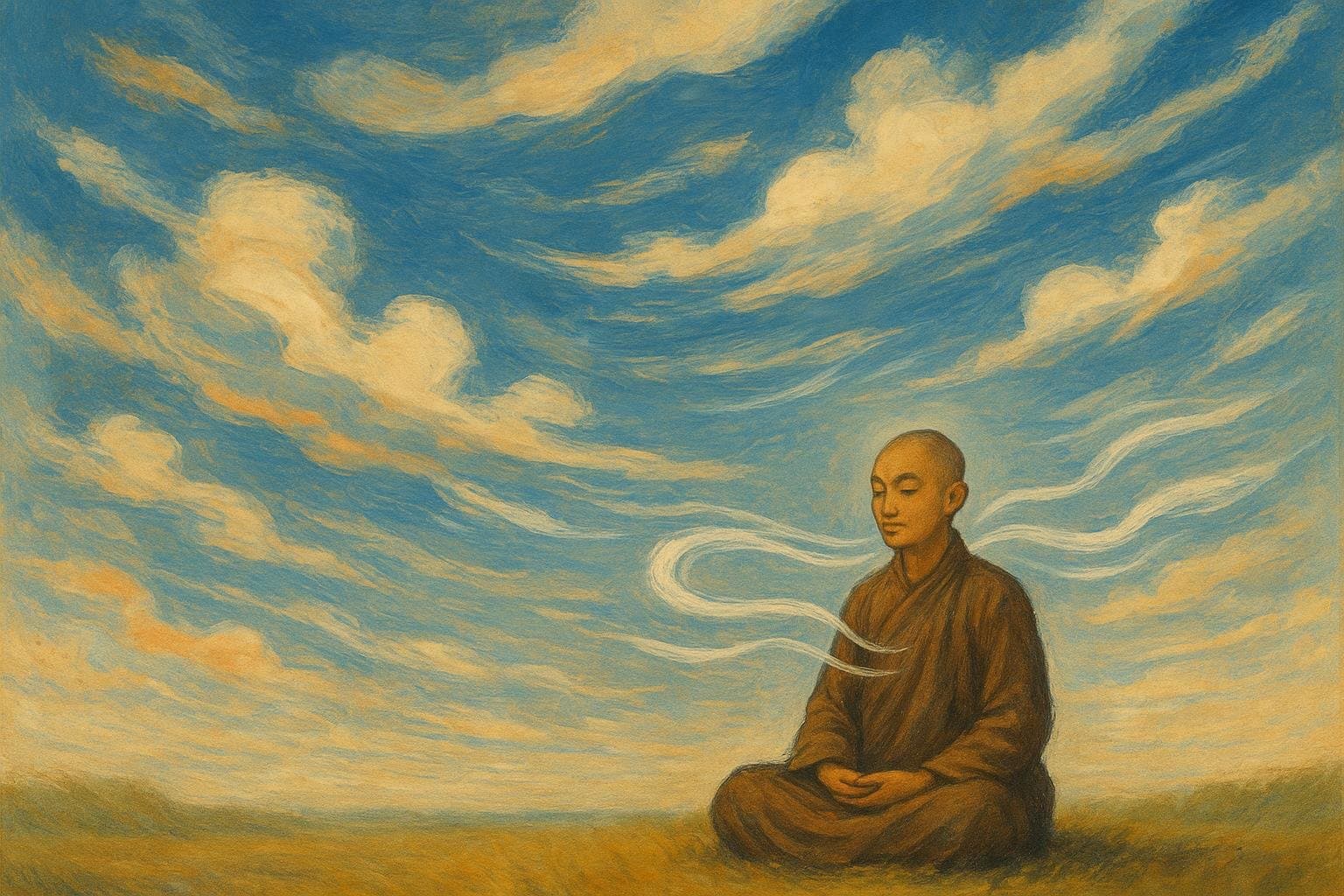
Feelings come and go like clouds in a windy sky. Conscious breathing is my anchor. — Thích Nhất Hạnh
—What lingers after this line?
The Ephemeral Nature of Feelings
Thích Nhất Hạnh’s metaphor likens feelings to clouds—shifting, insubstantial, and constantly changing under the influence of life’s winds. This imagery powerfully reminds us that emotional states, whether pleasant or painful, are inherently transient. Just as clouds never linger in one form, our emotions cannot be pinned down indefinitely. Accepting this impermanence reduces the tendency to identify too closely with passing moods, allowing us to navigate difficulties with greater ease.
Breath as a Mindful Foundation
In contrast to the unpredictability of feelings, conscious breathing offers a steady point of focus—an anchor in Nhất Hạnh’s words. By returning attention to the breath, we connect with a bodily rhythm that, unlike emotions, remains reliably present. This technique finds roots in Buddhist mindfulness practices, which emphasize the breath as a refuge, helping individuals remain centered amid inner storms (see Thích Nhất Hạnh's 'The Miracle of Mindfulness', 1975).
Mindfulness in Everyday Life
Building upon conscious breathing, mindfulness teaches us to observe thoughts and sensations without judgment. Whether we confront joy or sorrow, acknowledging these experiences with gentle awareness enables us to respond rather than react impulsively. In daily life, this perspective can transform routine moments—waiting in line, hearing unsettling news—into opportunities for reflection and composure. Jon Kabat-Zinn’s development of Mindfulness-Based Stress Reduction (MBSR) in the 1970s demonstrates how breath-centric mindfulness can effectively manage anxiety and stress.
Scientific Support for Conscious Breathing
Research in psychology and neuroscience underscores the calming effect of deliberate breathwork. Studies, such as those by Dr. Emma Seppälä (2014), show that slow, deep breaths activate the parasympathetic nervous system, promoting relaxation and emotional regulation. Thus, Thích Nhất Hạnh’s simple practice is not merely spiritual—it is reinforced by evidence demonstrating tangible benefits for mental well-being.
Integrating Practice Into Modern Living
Given the fast-paced, unpredictable nature of modern life, cultivating an anchor becomes all the more essential. Practicing conscious breathing during moments of emotional upheaval—like before a difficult conversation or after an unexpected event—equips us with resilience. As we learn to witness feelings come and go like clouds, anchored by calm, intentional breathing, we foster a sense of stability that endures regardless of our external circumstances.
One-minute reflection
Where does this idea show up in your life right now?
Related Quotes
6 selectedFeelings come and go like clouds in a windy sky. Conscious breathing is my anchor. — Thich Nhat Hanh
Thich Nhat Hanh
Thich Nhat Hanh frames feelings as something transient: they “come and go like clouds in a windy sky.” In other words, emotions are real, but they are not permanent fixtures and they don’t define who we are. This image g...
Read full interpretation →A single steady heartbeat can calm a thousand doubts. — Thich Nhat Hanh
Thich Nhat Hanh
Thich Nhat Hanh’s line begins with something almost ordinary—a heartbeat—yet treats it as a profound teacher. A single, steady beat implies continuity: life is here, now, and moving forward.
Read full interpretation →Keep a quiet steadiness; storms pass and the ground still needs tending. — Thich Nhat Hanh
Thich Nhat Hanh
Thich Nhat Hanh’s line frames life as a field and our responsibilities as ongoing tending of the ground. The storms represent crises, conflicts, or emotional upheavals that feel all-consuming in the moment.
Read full interpretation →In the quiet of your own mind, you hold the power to reclaim your attention from the chaos of the world. — Thich Nhat Hanh
Thich Nhat Hanh
Thich Nhat Hanh’s words begin with a gentle but radical claim: the mind contains a quiet space that cannot be fully colonized by the world’s noise. Rather than portraying attention as something stolen forever by distract...
Read full interpretation →To find peace, you must stop trying to solve every problem at once. Sometimes the most productive thing you can do is simply breathe and be present. — Thich Nhat Hanh
Thich Nhat Hanh
At first glance, Thich Nhat Hanh’s insight challenges a habit many people mistake for responsibility: the need to solve every problem immediately. When the mind races from one worry to the next, it often creates more str...
Read full interpretation →The goal is not to be good at everything, but to be present for the things that matter most. — Thich Nhat Hanh
Thich Nhat Hanh
Thich Nhat Hanh’s quote gently redirects ambition. Rather than chasing excellence in every possible area, he suggests that a meaningful life depends on discernment: knowing what deserves our energy and then meeting it wi...
Read full interpretation →More From Author
More from Thich Nhat Hanh →You must love in such a way that the person you love feels free. — Thich Nhat Hanh
At its core, Thich Nhat Hanh’s statement redefines love as an act of care that does not confine. To love someone so that they feel free means offering affection without turning it into control, guilt, or dependence.
Read full interpretation →We are not islands; we are threads in a tapestry. To pull away from the weave is to lose the very texture that makes life hold together. — Thich Nhat Hanh
At its core, Thich Nhat Hanh’s image of threads in a tapestry rejects the fantasy of total self-sufficiency. A single thread may exist on its own, yet it gains meaning, strength, and beauty only through its relation to o...
Read full interpretation →When you learn how to suffer, you suffer far less. Resilience is not about avoiding the fire; it is about becoming fireproof. — Thich Nhat Hanh
At first glance, Thich Nhat Hanh’s quote appears paradoxical: how could learning to suffer make suffering lighter? Yet his point is that pain intensifies when we resist it, fear it, or treat it as a personal failure.
Read full interpretation →Slow down, and you will find that the rhythm of your own heart becomes the master of your work. — Thich Nhat Hanh
At first glance, Thich Nhat Hanh’s words seem to offer simple advice about working more slowly, yet they point to something deeper: a different relationship with time itself. To slow down is not merely to reduce speed, b...
Read full interpretation →