
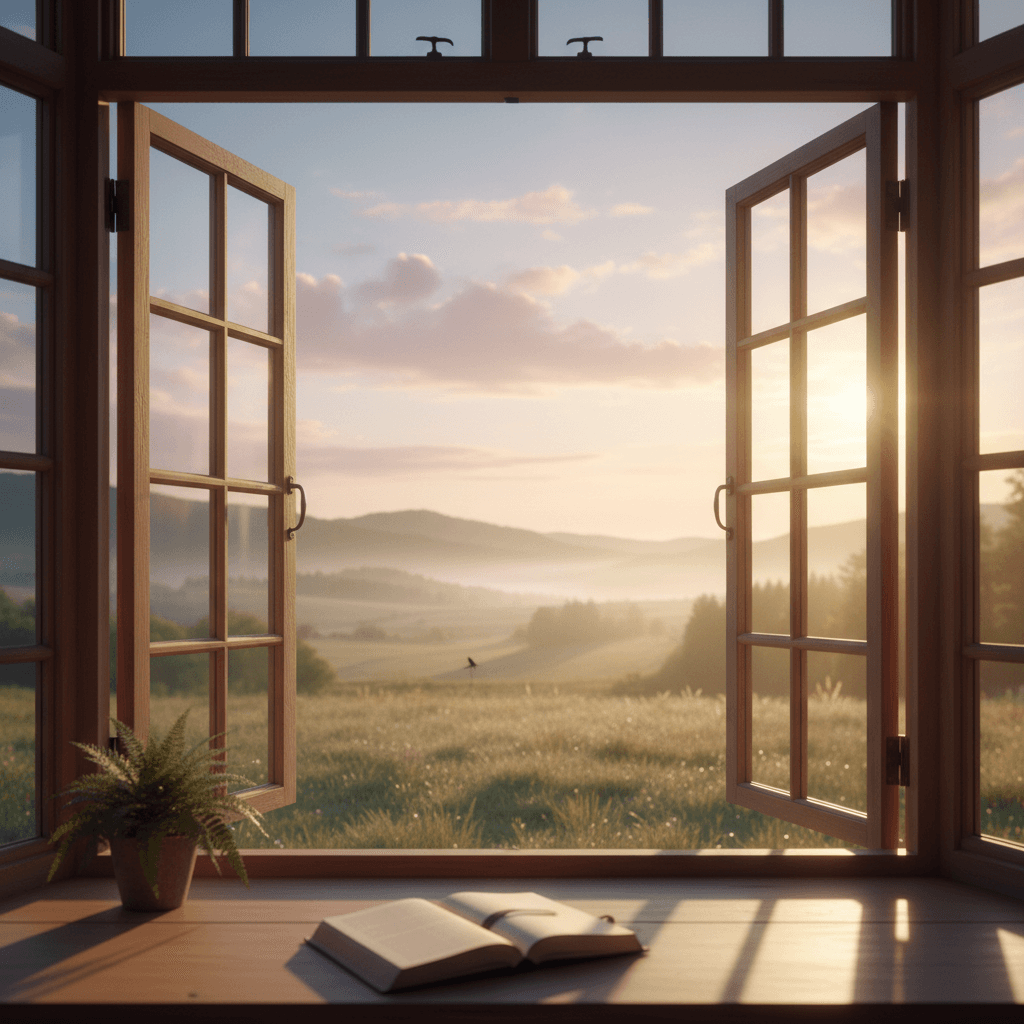
Open your life like a window—let fresh aims and wild light in. — Thich Nhat Hanh
—What lingers after this line?
A Window, Not a Wall
Thich Nhat Hanh’s image invites us to replace self-protective walls with a window that breathes. In Peace Is Every Step (1991), he teaches that mindful breathing opens a “door to the present,” and this quote extends the gesture: let life circulate. Rather than armoring ourselves against uncertainty, we can choose permeability—allowing experience to move through us, while we remain gently aware. With that small shift, stagnation gives way to circulation, and possibility begins to draft the room.
Setting Fresh Aims with Soft Hands
If the window stands open, aims supply direction. Yet in the Buddhist tradition, intention is not a clenched-fist goal but a compass—Right Intention on the Noble Eightfold Path shapes how we move, not just where we land. Fresh aims are living questions: What would kindness do next? What would curiosity learn here? By holding aims softly, we invite progress without self-punishment, making the journey itself a teacher rather than a tribunal.
Welcoming the Wild Light
Next comes the “wild light”—the unpredictable radiance of insight, beauty, and change. Wild does not mean reckless; it means un-domesticated by our preconceptions. Artists and naturalists court this brightness by attention. Mary Oliver’s Red Bird (2008) distills the practice: “Pay attention. Be astonished. Tell about it.” When we allow astonishment in, creative energy reframes old problems and illuminates new paths we could not have plotted in advance.
Clearing the Pane: Letting Go
Of course, a window clouded by old residue admits little light. Letting go—of stale stories, unhelpful comparisons, and anxious rehearsals—cleans the glass. In The Miracle of Mindfulness (1975), Thich Nhat Hanh shows how simple presence loosens mental knots; in The Heart of Understanding (1988), his teaching on “interbeing” reframes identity as relational, not rigid. As we release what no longer serves, the room brightens without our forcing a single sunbeam.
Practical Hinges: Habits That Open
To keep the window usable, we need sturdy hinges—small, repeatable practices that make openness a default. Implementation intentions (“If it’s 7 a.m., then I breathe for two minutes”) reliably convert aims into action (Peter Gollwitzer, 1999). Likewise, habit stacking—tucking a new practice onto an existing one—lowers friction (James Clear, Atomic Habits, 2018). These quiet mechanics protect inspiration from evaporating into someday.
Filters, Not Fortresses
Openness thrives with discernment. A screen lets air and light in while keeping pests out; in the same way, boundaries protect attention without closing the heart. Thich Nhat Hanh’s No Mud, No Lotus (2014) teaches that suffering is compost for understanding—yet he couples that tenderness with practices of mindful breathing and compassionate limits. We can decline what depletes us and still remain hospitable to what nourishes.
Shared Windows: The Strength of Sangha
Finally, windows are easier to open together. In Plum Village, bells of mindfulness invite collective pauses so the whole community inhales the same bright moment. Thich Nhat Hanh often taught that “the next Buddha may be a sangha” (see Lion’s Roar profiles of his teachings), suggesting awakening is collaborative. In supportive company, fresh aims stay fresh, and wild light finds many panes to enter—spreading warmth room by room.
One-minute reflection
What feeling does this quote bring up for you?
Related Quotes
6 selectedThe soul should always stand ajar, ready to welcome the roving experience. — Emily Dickinson
Emily Dickinson
Emily Dickinson’s image of the soul standing “ajar” transforms inner life into a threshold rather than a fortress. Instead of sealing ourselves against surprise, she suggests that wisdom begins with a kind of deliberate...
Read full interpretation →There is no true joy in a life lived closed up in the little shell of the self. When you take one step to reach out to people, when you meet with others and share their thoughts, you expand your world. — Desmond Tutu
Desmond Tutu
Desmond Tutu begins with a striking image: the self as a little shell, enclosed and protected yet ultimately cramped. In that metaphor, he suggests that a life organized entirely around private comfort and self-concern m...
Read full interpretation →Open your hands and the world will learn how to fit in them. — Toni Morrison
Toni Morrison
Toni Morrison’s line sounds gentle, yet it carries a bracing claim: the way you hold yourself teaches the world how to approach you. “Open your hands” evokes release—of tight control, fear, and the reflex to clutch what...
Read full interpretation →Question limits loudly until they answer with openings — bell hooks
bell hooks
In “Question limits loudly until they answer with openings,” bell hooks compresses an entire practice of liberation into one sentence: identify a boundary, challenge it audibly, and keep pressing until something gives wa...
Read full interpretation →Choose light over gloom; even small lamps banish a dark room. — Fyodor Dostoevsky
Fyodor Dostoevsky
Dostoevsky’s line frames hope as an active decision rather than a lucky mood: “Choose light over gloom.” The phrasing implies agency—an inner vote cast even when circumstances feel fixed. In that sense, light is not only...
Read full interpretation →Make the blank space a doorway, not a wall — Rumi
Rumi
Rumi’s line, “Make the blank space a doorway, not a wall,” urges a radical shift in how we interpret emptiness and interruption. What first appears as a dead end—a pause in conversation, a failed plan, a season of uncert...
Read full interpretation →More From Author
More from Thich Nhat Hanh →You must love in such a way that the person you love feels free. — Thich Nhat Hanh
At its core, Thich Nhat Hanh’s statement redefines love as an act of care that does not confine. To love someone so that they feel free means offering affection without turning it into control, guilt, or dependence.
Read full interpretation →We are not islands; we are threads in a tapestry. To pull away from the weave is to lose the very texture that makes life hold together. — Thich Nhat Hanh
At its core, Thich Nhat Hanh’s image of threads in a tapestry rejects the fantasy of total self-sufficiency. A single thread may exist on its own, yet it gains meaning, strength, and beauty only through its relation to o...
Read full interpretation →When you learn how to suffer, you suffer far less. Resilience is not about avoiding the fire; it is about becoming fireproof. — Thich Nhat Hanh
At first glance, Thich Nhat Hanh’s quote appears paradoxical: how could learning to suffer make suffering lighter? Yet his point is that pain intensifies when we resist it, fear it, or treat it as a personal failure.
Read full interpretation →Slow down, and you will find that the rhythm of your own heart becomes the master of your work. — Thich Nhat Hanh
At first glance, Thich Nhat Hanh’s words seem to offer simple advice about working more slowly, yet they point to something deeper: a different relationship with time itself. To slow down is not merely to reduce speed, b...
Read full interpretation →