
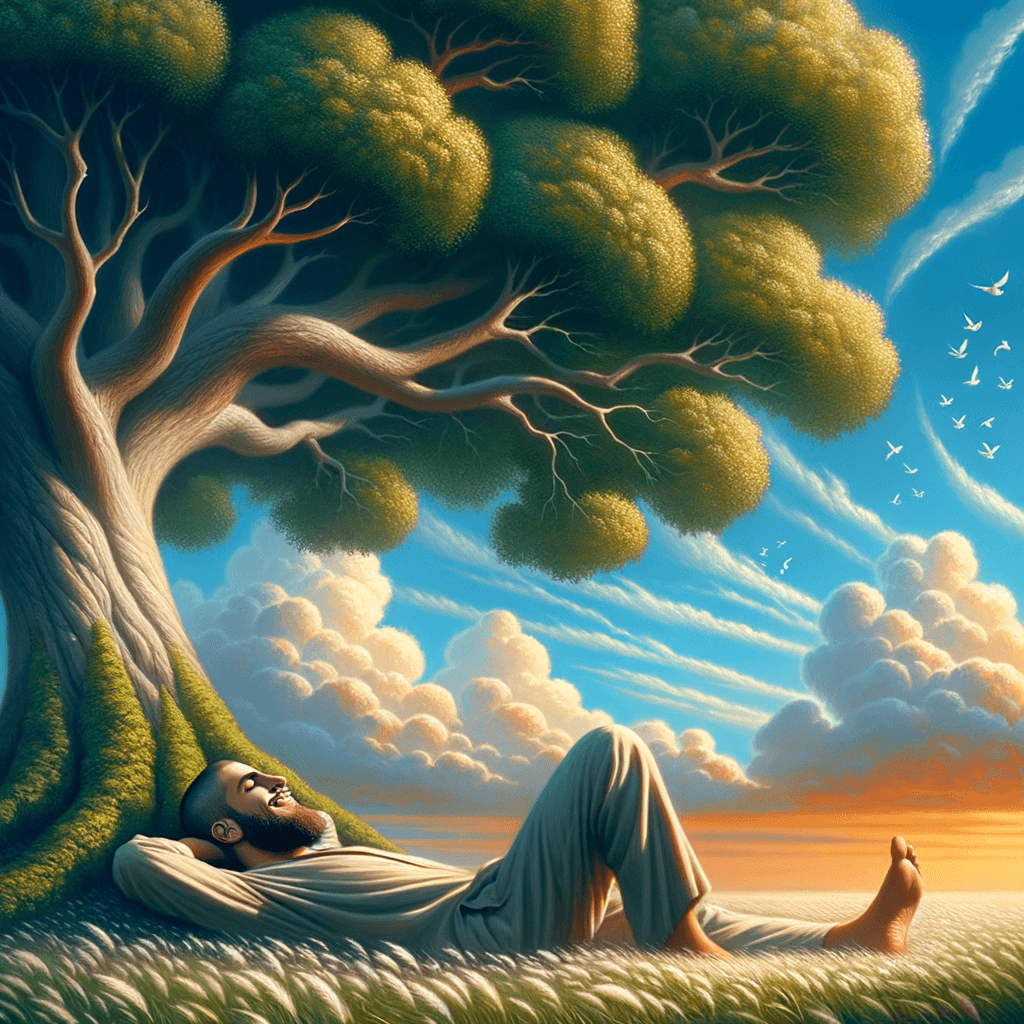
Keep your worries for another day. — Proverb
—What lingers after this line?
Living in the Present
This proverb encourages focusing on the present moment instead of dwelling on future uncertainties. It reminds us to enjoy today without letting anxiety about tomorrow overshadow it.
Managing Stress
The saying suggests postponing concerns and worries, implying that stressing out about things prematurely doesn’t solve problems. Instead, relaxing and staying calm might lead to clearer thinking and better solutions.
Finding Peace of Mind
It advocates for a more peaceful mindset by practicing patience and not allowing future challenges or hypothetical problems to disturb one’s current peace.
Optimism and Hope
By implying that worries can be dealt with later, this proverb also supports awakening feelings of optimism, trusting that the future will sort itself out and that there’s still time to handle things.
Spiritual and Cultural Significance
This type of wisdom echoes cultural and spiritual traditions, such as mindfulness and stoicism, which focus on embracing the present and not letting fear of the future dominate your life.
Recommended Reading
As an Amazon Associate, we earn from qualifying purchases.
One-minute reflection
What feeling does this quote bring up for you?
Related Quotes
6 selectedDo not seek for everything to happen as you wish it would, but rather wish that everything happens as it actually will — then your life will be serene. — Epictetus
Epictetus
At its heart, Epictetus urges a reversal of ordinary desire. Instead of demanding that reality conform to personal wishes, he advises shaping one’s wishes to fit reality itself.
Read full interpretation →Do your work, then step back. The only path to serenity. — Lao Tzu
Lao Tzu
At first glance, the saying seems contradictory: it asks us both to act and to withdraw. Yet that tension is precisely its wisdom.
Read full interpretation →Stress is the trash of modern life. If you don't dispose of it properly, it will pile up. — Danzae Pace
Danzae Pace
Danzae Pace frames stress as “trash,” an image that immediately shifts stress from something mysterious and personal to something ordinary, inevitable, and manageable. Just as daily living produces waste, modern life pro...
Read full interpretation →What I dream of is an art of balance, of purity and serenity. — Henri Matisse
Henri Matisse
Henri Matisse’s line crystallizes a lifelong pursuit: art as equilibrium and calm. In Notes of a Painter (1908), he imagined art that soothes “like a good armchair” after fatigue, not as escape but as restoration.
Read full interpretation →In every dawn, there is a poem of hope, and at dusk, a melody of serenity.
Unknown
Dawn represents new beginnings, possibilities, and hope. The imagery of a 'poem of hope' suggests that each morning brings a fresh start filled with optimism and potential.
Read full interpretation →At the break of dawn by the lakeside, a fisherman quietly casts his net, and the water gently ripples. He silently recites in his heart, Keep the heart as calm as the water, and the net will be fully laden. Each ray of sunlight scattered on the lake's surface seems like a seed of hope, waiting for the moment of harvest.
Unknown
The fisherman's inner mantra highlights the importance of maintaining a calm and composed heart. Just as tranquil water leads to a successful catch, inner peace and patience are essential for achieving one's goals.
Read full interpretation →More From Author
More from Proverb →Your nervous system is a landscape, not a machine; it requires the soft rain of rest, not the constant lightning of urgency. — Proverb
The proverb begins by rejecting the idea that the nervous system is a simple machine with replaceable parts and predictable outputs. Instead, it frames the body as a landscape—complex, interconnected, and shaped over tim...
Read full interpretation →If you bring forth what is within you, what you bring forth will save you. If you do not, it will destroy you. — Proverb
The proverb frames self-expression as a decisive fork in the road: what lies within us is not neutral, and it will shape our fate one way or another. In this view, inner fears, desires, convictions, and gifts resemble a...
Read full interpretation →The world will provide you with a label if you are too lazy to define yourself. Pick your own name before someone else names you their tool. — Proverb
The proverb begins with a blunt warning: if you don’t articulate who you are, other people will do it for you. In everyday life, that labeling can be subtle—“quiet,” “difficult,” “gifted,” “unreliable”—but once applied,...
Read full interpretation →I am allowed to have limits. My needs matter too. I deserve moments of rest. — Proverb
The proverb begins with a simple but radical permission: you are allowed to have limits. In many families, workplaces, or cultures, saying “no” can be treated as selfishness, yet limits are often the very structure that...
Read full interpretation →