
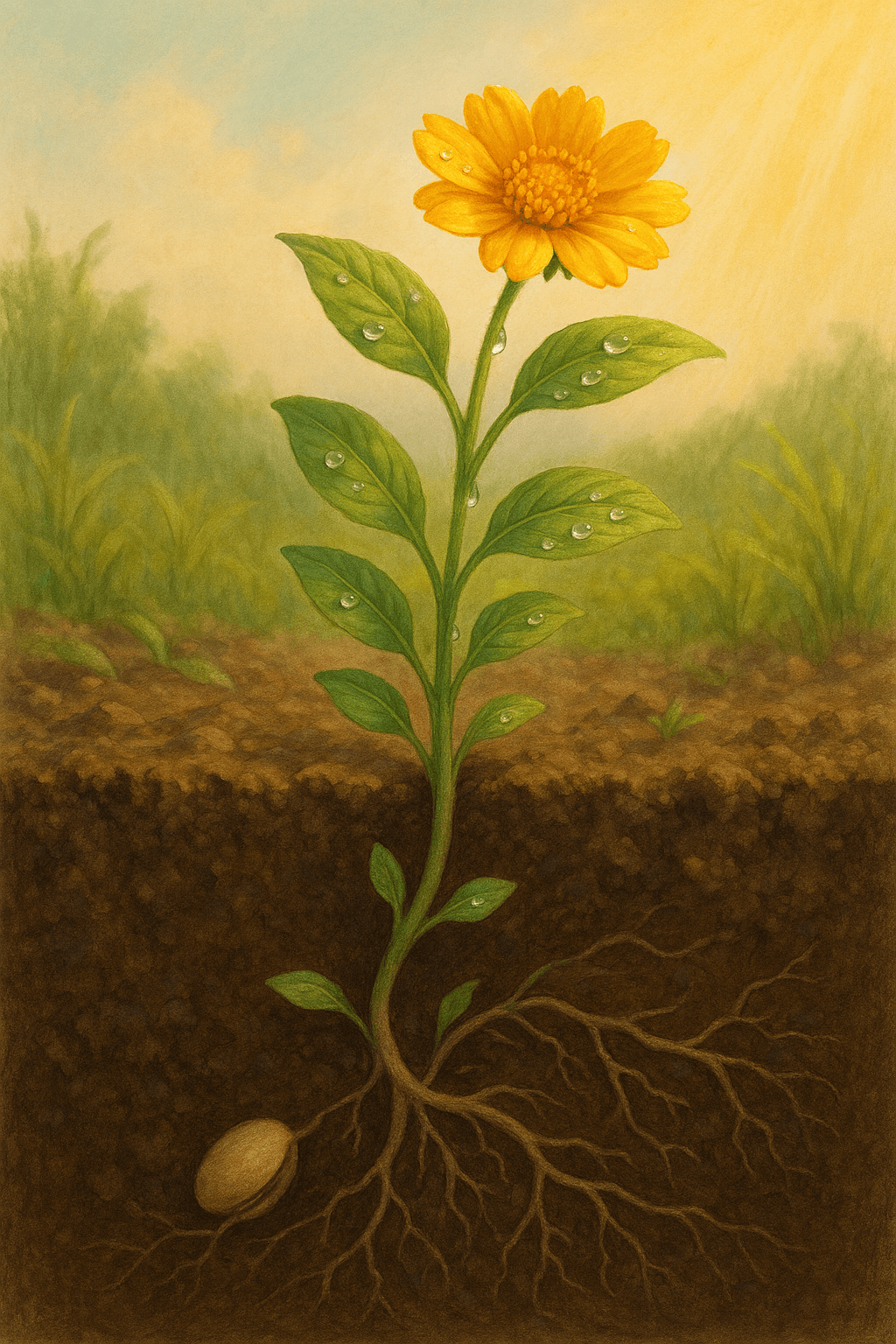
Patience plants the seed; persistence brings the flower. — Sadhguru
—What lingers after this line?
The Essence of Sadhguru’s Metaphor
Sadhguru’s eloquent metaphor presents patience and persistence as two interconnected forces in the journey of personal and professional achievement. The act of planting a seed symbolizes initial efforts—often quiet and undramatic—while the blossoming flower represents visible success. To fully grasp this wisdom, it’s essential to explore how these stages build upon each other.
Patience: The Silent Power of Waiting
Beginning with patience, we recognize the silent yet profound commitment required at the outset of any venture. Think of a gardener who sows seeds; immediate gratification isn’t expected. Rather, there is trust in the process and the environment, allowing growth to occur unseen. Similarly, history is rich with examples, such as Thomas Edison’s early experiments, where patience was as vital as innovation, as he calmly accepted each failure as part of the process.
Persistence: Transforming Waiting into Action
While patience is about enduring and trusting, persistence brings momentum: it’s the daily effort, the watering and tending of the seed, that catalyzes transformation. As we transition from waiting to doing, persistence prevents stagnation. In sports, for instance, athletes like Serena Williams persist through challenging training regimes—her relentless work ethic fuels her continual success, showing that resilience bridges the gap between beginning and blooming.
The Synergy Between Patience and Persistence
Importantly, patience without persistence leaves potential unrealized, just as persistence without patience devolves into frustration. The two must work in tandem, as Sadhguru’s analogy prescribes. This synergy is mirrored in stories like J.K. Rowling’s journey to publish ‘Harry Potter,’ where long periods of rejection required patience, yet her persistent submission to new publishers ultimately bore fruit.
Applying the Wisdom: Lessons for Everyday Life
In daily pursuits, this lesson guides us to approach challenges with a balanced mindset. Whether learning a new skill, nurturing relationships, or building a business, recognizing when to patiently wait and when to persistently act can determine the outcome. Echoing Sadhguru’s wisdom, by blending patience with persistence, anyone can transform humble beginnings into a full bloom of achievement.
Recommended Reading
As an Amazon Associate, we earn from qualifying purchases.
One-minute reflection
What does this quote ask you to notice today?
Related Quotes
6 selectedPatience is not passive waiting; it is the courage to stand in the middle of a process and trust that the bloom is coming. — Mary Oliver
Mary Oliver
At first glance, patience is often mistaken for mere delay or resignation, yet Mary Oliver overturns that assumption immediately. In her view, patience is not passive waiting but an active inner stance: a decision to rem...
Read full interpretation →There will come a time when you believe everything is finished. That will be the beginning. — Louis L'Amour
Louis L'Amour
At first glance, Louis L'Amour’s line sounds bleak, as though it pauses at the very edge of defeat. Yet the sentence pivots on its final promise: the moment we believe everything is over may actually mark the threshold o...
Read full interpretation →Beautiful things aren't rushed. A garden, a book, a work of art… they grow with time, care, and heart. — Angelika Regossi
Angelika Regossi
At its core, Angelika Regossi’s reflection challenges the modern obsession with speed. By saying that beautiful things are not rushed, she reminds us that what truly matters often emerges slowly, through patience rather...
Read full interpretation →You plant, then you cultivate, and finally you harvest. In today's world, everyone wants to go directly from plant to harvest. — Jeff Olson
Jeff Olson
Jeff Olson’s quote turns to agriculture to explain a wider truth about achievement: nothing meaningful moves straight from beginning to reward. First comes planting, which is the act of starting; then cultivation, which...
Read full interpretation →Energy returns slowly, like light entering a room at dawn. — Talk2Tessa
Talk2Tessa
At first glance, Talk2Tessa’s line frames returning energy not as a sudden surge but as a gradual illumination. By comparing it to dawn light entering a room, the quote replaces pressure with patience, suggesting that re...
Read full interpretation →Humility is attentive patience. — Simone Weil
Simone Weil
At first glance, Simone Weil’s remark seems to redefine humility altogether. Rather than treating it as self-deprecation or mere politeness, she presents it as a disciplined way of being: patient, watchful, and receptive...
Read full interpretation →More From Author
More from Sadhguru →If you do not take charge of your own mind, someone else will. — Sadhguru
Sadhguru’s line frames the mind as a powerful instrument that will not remain neutral for long. If you don’t direct it with intention, it tends to be directed by external forces—advertising, social pressure, fear-driven...
Read full interpretation →There is no such thing as work-life balance. It is all life. The balance has to be within you. — Sadhguru
Sadhguru’s claim begins by challenging a popular assumption: that “work” and “life” are separate realms competing for limited space. By saying it is all life, he reframes work as one expression of living rather than an i...
Read full interpretation →Spirituality does not come from religion. It comes from our soul. — Sadhguru
This quote draws a distinction between spirituality and organized religion. While religion often encompasses rituals, doctrines, and communal practices, Sadhguru suggests that true spirituality is a deeply personal and i...
Read full interpretation →Act with a purpose, and your future will offer you opportunities. — Sadhguru
Sadhguru emphasizes the importance of acting with deliberate intention. When actions are purposeful, they lay the foundation for a future full of opportunities.
Read full interpretation →