
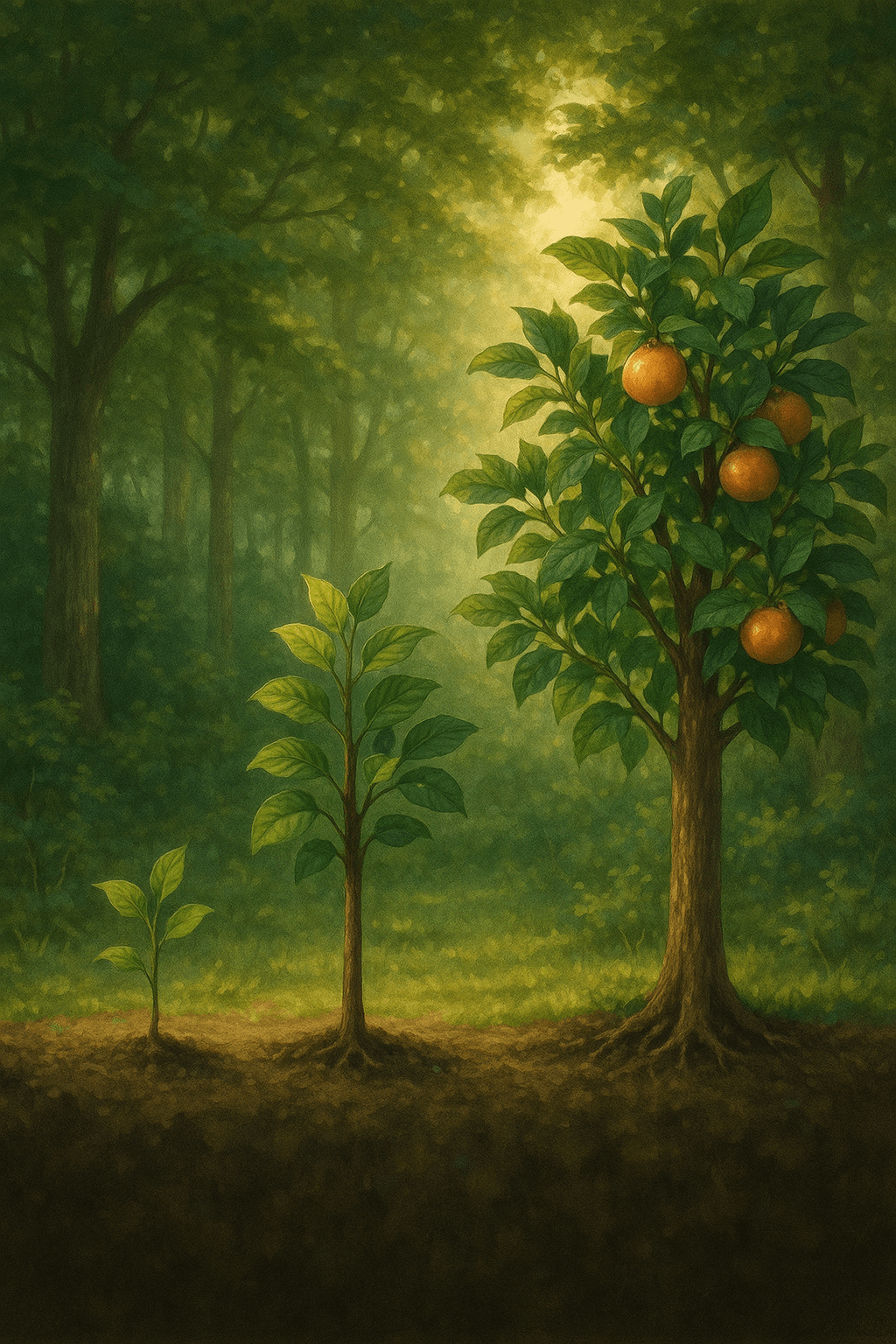
Trees that are slow to grow bear the best fruit. — Molière
—What lingers after this line?
Molière’s Metaphor of Maturity
Molière’s aphorism, likening slow-growing trees to those that yield the finest fruit, serves as a powerful metaphor for the value of patience in human endeavors. It suggests that the most worthwhile achievements often require time, care, and resilience to come to fruition. Rather than rushing the process, Molière calls us to appreciate gradual progress as an essential precondition for excellence.
Examples from Nature and Agriculture
This wisdom is vividly illustrated in the world of horticulture, where trees like the oak or the apple require years before they mature enough to produce their most robust yields. Farmers and gardeners recognize that rushing growth with artificial means often leads to shallow roots or tasteless fruit. Such natural cycles underline the importance of letting development take its course, reinforcing Molière’s analogy.
Historical Reflections on Patience and Success
History abounds with stories that echo this principle. For example, Michelangelo spent four years painstakingly painting the Sistine Chapel ceiling, insisting that mastery cannot be coaxed in haste. Similarly, in Winston Churchill’s long and often frustrating rise to British leadership, his eventual success embodied the rewards of perseverance over immediate gratification.
Psychological Insights into Delayed Gratification
Modern psychology has explored the concept of delayed gratification, most famously in the 1972 Stanford marshmallow experiment led by Walter Mischel. Children who resisted an immediate reward in favor of a larger, delayed one often experienced greater success later in life. This research mirrors Molière’s principle, emphasizing that the ability to wait and invest in long-term goals fosters stronger, more enduring outcomes.
Applying Patience in Personal Growth
Extending this to our own lives, investing time in developing skills, nurturing relationships, or building careers often yields the richest 'fruit.' Rather than seeking shortcuts, embracing patience allows us to cultivate depth and resilience. In this way, Molière’s insight remains as relevant today as ever—reminding us that the best results come to those willing to grow slowly, but surely.
One-minute reflection
Where does this idea show up in your life right now?
Related Quotes
6 selectedThe trees that are slow to grow bear the best fruit. — Molière
Molière
Molière’s image begins with a simple reversal of modern impatience: what takes longer is often worth more. A tree that grows slowly must endure seasons of scarcity, storms, and repeated cycles of strain, and that enduran...
Read full interpretation →Anything worth having is worth waiting for, and everything worth doing is worth doing with patience. — Confucius
Confucius
At its core, this saying ties value to delay. Confucius suggests that truly meaningful things do not arrive instantly; instead, they ask us to endure uncertainty, effort, and time.
Read full interpretation →Patience is not passive waiting; it is the courage to stand in the middle of a process and trust that the bloom is coming. — Mary Oliver
Mary Oliver
At first glance, patience is often mistaken for mere delay or resignation, yet Mary Oliver overturns that assumption immediately. In her view, patience is not passive waiting but an active inner stance: a decision to rem...
Read full interpretation →Patience is not passive waiting. Patience is active acceptance of the process required to attain your goals and dreams. — Ray Davis
Ray Davis
Ray Davis’s words begin by correcting a common misunderstanding: patience is not the same as doing nothing. Passive waiting suggests resignation, as if time alone will deliver success.
Read full interpretation →Slow progress today is often stable progress tomorrow. Fast growth collapses easily. Slow growth holds. — Timeless Type
Timeless Type
At first glance, slow progress can feel discouraging, especially in a culture that praises speed, sudden breakthroughs, and visible success. Yet the quote reminds us that what seems unimpressive today may become the foun...
Read full interpretation →Sometimes you have to slow down to go fast. — Jeff Olson
Jeff Olson
Jeff Olson’s line begins with a practical paradox: speed is not always created by rushing. Sometimes the quickest path forward requires pausing long enough to see the road clearly, correct mistakes early, and choose acti...
Read full interpretation →More From Author
More from Molière →To be courageous is to act with the heart. — Molière
Molière’s line suggests that courage is not merely the absence of fear, but the decision to move despite it. By connecting courage with the heart, he frames bravery as an emotional and moral act rather than a simple disp...
Read full interpretation →The trees that are slow to grow bear the best fruit. — Molière
Molière’s image begins with a simple reversal of modern impatience: what takes longer is often worth more. A tree that grows slowly must endure seasons of scarcity, storms, and repeated cycles of strain, and that enduran...
Read full interpretation →It is not what we do, but also what we do not do, for which we are accountable. — Molière
The quote highlights that people are not just responsible for their actions, but also for what they choose not to do.
Read full interpretation →