
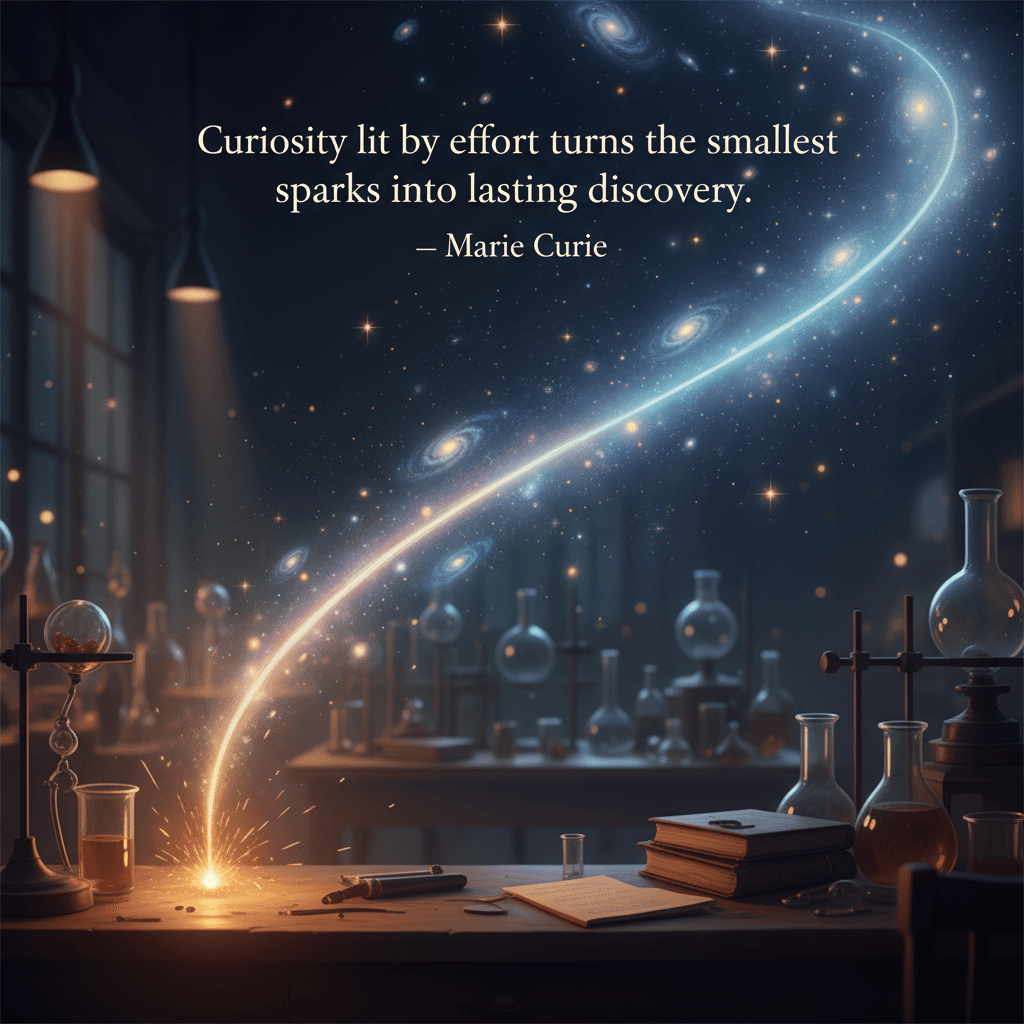
Curiosity lit by effort turns the smallest sparks into lasting discovery. — Marie Curie
—What lingers after this line?
From Spark to Sustained Flame
Curie’s line captures a simple engine of progress: curiosity ignites, but effort keeps the fire. A question alone flickers; repeated trials, careful notes, and patient refinement transform wonder into knowledge that lasts. This pairing reframes discovery not as sudden brilliance but as a long combustion of attention. Moreover, it places agency with the learner—any small spark can grow, provided it is tended. In this light, discovery becomes less a stroke of fate and more a habit, a rhythm of returning to a problem with better tools and sharper questions, until the transient becomes durable.
Curie’s Pitchblende Crucibles
To see this principle in action, consider Curie’s shed-like lab where she processed tons of pitchblende to isolate new elements. She stirred heavy cauldrons for years, repeatedly concentrating residues until faint signals strengthened enough to name: polonium and radium (Curie & Curie, Comptes Rendus, 1898). The work was grueling, yet cumulative, turning trace radioactivity into stable knowledge and a new branch of physics. Even today, her lab notebooks remain so radioactive they are stored in lead-lined boxes at the Bibliothèque nationale de France—an eerie testament to how disciplined effort can make the smallest signals endure as history.
The Discipline Behind Curiosity
Beneath these dramatic images lay mundane craft: calibrated instruments, routine controls, and relentless record-keeping. Pierre Curie’s sensitive electrometer enabled Marie to quantify tiny currents, transforming hunches into data with reproducible bite. This is curiosity domesticated by method, echoing her reminder that “the way of progress was neither swift nor easy.” Modern research on grit supports the point: perseverance toward long goals predicts achievement beyond talent alone (Duckworth et al., Psychological Science, 2007). Thus, curiosity sets the aim, but disciplined practice aligns each shot, gradually thickening fragile insights into reliable findings.
Prepared Minds and Productive Serendipity
Moreover, effort does not squash serendipity; it enables it. Becquerel’s fogged plates in 1896 suggested a mysterious emission, yet only prepared investigators could pursue the anomaly. The Curies’ trained attention, instruments, and routines converted that clue into the architecture of radioactivity. Pasteur’s dictum—“chance favors the prepared mind” (Lille lectures, 1854)—fits neatly here, as does Steven Johnson’s “slow hunch” model, where ideas mature through iterative encounters (Where Good Ideas Come From, 2010). In short, preparation turns lucky sparks into pathways, making discovery feel less like lightning and more like weather you can read.
From Lab Bench to Human Benefit
Consequently, the flame Curie tended did not remain confined to glassware. During World War I, she organized mobile X‑ray units—the “petites Curies”—bringing imaging to battlefield medicine and reducing needless amputations (Curie, Radiology in War, 1919). Later, radium advanced cancer therapy, even as its dangers became clear; Curie herself died in 1934 from aplastic anemia, a somber reminder that discovery carries obligations. Yet the enduring legacy—nuclear medicine, advanced imaging, radiation safety—shows how effort, guided by humane curiosity, can convert ephemeral glimmers into lasting public good.
Practices to Turn Sparks Into Discoveries
Today, we can emulate this engine at any scale. Start with small, testable questions; keep a dated logbook; run short, low-cost experiments; and refine based on evidence. Treat attention as a muscle—schedule brief, regular sessions that protect depth from distraction. Share provisional results early to invite correction, an approach echoed in preprints and open lab notebooks. Finally, translate learning into use by building simple prototypes and measuring real outcomes (Ries, The Lean Startup, 2011). Through such habits, curiosity is not a momentary thrill but a reliable pipeline—where sparks, tended by effort, become discoveries that last.
One-minute reflection
Where does this idea show up in your life right now?
Related Quotes
6 selectedPursue truth with tireless hands; discovery rewards the patient and the brave. — Marie Curie
Marie Curie
Curie’s injunction to pursue truth with “tireless hands” foregrounds science as a craft before it is a revelation. Truth emerges not from one grand epiphany but from many careful gestures—calibrating instruments, logging...
Read full interpretation →If we are facing in the right direction, all we have to do is keep walking. — Thích Nhất Hạnh
Thich Nhat Hanh
Thích Nhất Hạnh’s words begin with a simple but profound premise: progress depends first on direction, not speed. If a person is turned toward compassion, clarity, healing, or truth, then each modest step becomes meaning...
Read full interpretation →Do the best one can. Do it over again. Then still improve, even if ever so slightly, those retouches. — Marguerite Yourcenar
Marguerite Yourcenar
Yourcenar’s words begin with a simple demand: do the best one can. Yet she immediately refuses to let effort become an excuse for stopping.
Read full interpretation →A good-enough novel violently written now is better than a perfect novel meticulously written never. — Elizabeth Gilbert
Elizabeth Gilbert
Elizabeth Gilbert’s line immediately shifts the argument from artistic purity to artistic existence. A “good-enough” novel, even one “violently written,” has entered the world and can move, provoke, or comfort someone; b...
Read full interpretation →There is no road too long to the man who advances deliberately and without undue haste; there are no honors too distant to the man who prepares himself for them with patience. — Jean de La Bruyère
Jean de La Bruyère
At its core, La Bruyère’s line praises steady movement over restless speed. A long road feels intimidating only when seen all at once; once it is broken into deliberate steps, distance loses much of its power.
Read full interpretation →There are no soft grounds in life. Just places to water and plough. — Athésia
Athésia
At first glance, Athésia’s line dismisses the hope that life might eventually deliver a permanently gentle terrain. There are, in this view, no naturally soft grounds waiting for us—no stage where effort disappears and g...
Read full interpretation →More From Author
More from Marie Curie →Plant ideas like seeds and tend them with action until forests of change grow — Marie Curie
Marie Curie’s metaphor treats ideas not as static thoughts but as living seeds—small, vulnerable, and full of latent potential. A seed contains an entire future, yet it remains invisible until it meets the right conditio...
Read full interpretation →Measure progress by the bridges you build, not by the walls you avoid. — Marie Curie
The quote asks for a different yardstick: instead of treating success as the absence of conflict, it frames progress as the presence of connection. Avoiding “walls” can look like prudence—staying silent, steering clear o...
Read full interpretation →Measure your worth by the compassion you practice, not by the trophies you collect. — Marie Curie
Marie Curie’s line asks us to swap a familiar scoreboard for a quieter one. Instead of counting trophies—awards, titles, status symbols—she points to compassion as the real unit of measure, because it reflects how our li...
Read full interpretation →Risk a sincere attempt; the world rewards the brave. — Marie Curie
Marie Curie’s exhortation to “risk a sincere attempt” begins with a challenge to our habitual caution. Rather than waiting for perfect conditions or guaranteed success, she urges us to act with genuine intent, even when...
Read full interpretation →