
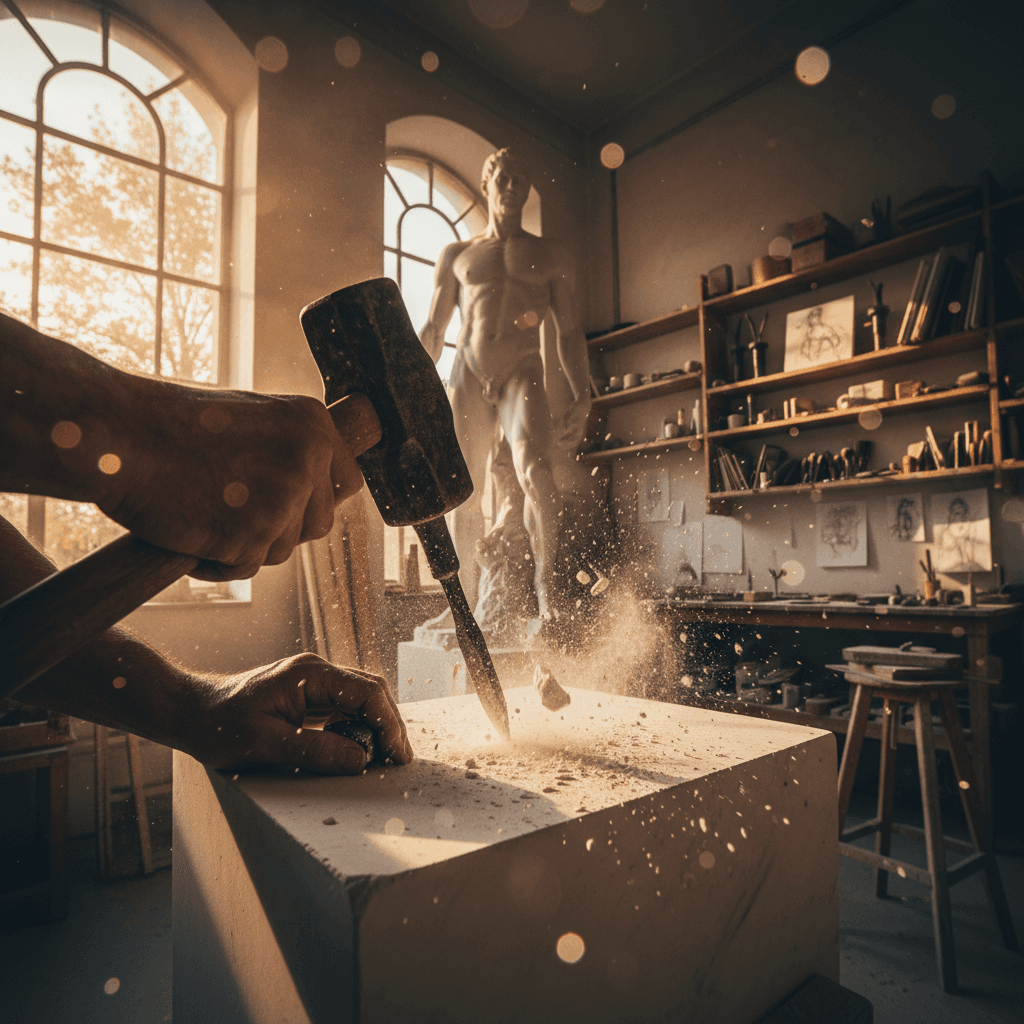
Forge beauty from effort; the sculpture of your life is made one strike at a time. — Auguste Rodin
—What lingers after this line?
The Studio as a Life Metaphor
Rodin’s workshop was a place of deliberate marks: plaster studies, maquettes, and chisels meeting stone with rhythmic intent. The aphorism imagines life the same way—formed not by a single flourish but by successive, mindful strikes. Rough surfaces were not always polished away; Rodin often left facets visible so the light could tell the story of labor, as in the textured planes of The Thinker (1904). Those marks become meaning. Thus, the phrase one strike at a time is less about violence and more about cadence. Each effort is a contour line, defining shape while accepting that clarity emerges gradually. We learn to see the form by sculpting toward it.
Incremental Strikes and Compound Change
A sculptor removes grams of marble to reveal tons of intention. Likewise, small, repeated efforts accrue into outsized transformation. The mathematics of habit—popularized by James Clear in Atomic Habits (2018)—shows how 1% improvements compound into significant change over time, much like fine chiseling teases out a figure. Neuroscience provides a complementary lens: repetition strengthens neural pathways through myelination, making skill more fluid with each pass (Daniel Coyle, The Talent Code, 2009). In this view, every careful strike is not just shaping stone; it is shaping the hand that wields the tool.
Working With Resistance, Not Against It
Stone has a grain, and so does life. Sculptors learn to read the block—veins, fissures, and the direction that welcomes or rejects force—then orient their strikes accordingly. The oft-quoted, possibly apocryphal Michelangelo line about freeing the angel from marble captures this posture: the artist collaborates with constraints rather than bulldozing them. Similarly, setbacks can become structure. The practice of kintsugi in 15th-century Japan repaired broken pottery with lacquer and gold, making the fracture the feature. By honoring resistance and repair, we convert obstacles into lines of composition.
Tools, Rituals, and Deliberate Practice
Progress accelerates when strikes are guided by systems. In studios, work begins with blocking-in, proceeds through measurement and correction, and only then invites detail. Anders Ericsson’s research on deliberate practice emphasizes targeted feedback loops and stretch goals as the engine of mastery (Ericsson et al., 1993). Translating this beyond art, rituals—timeboxed sessions, a prepared workspace, and immediate review—reduce friction and protect focus. Goals tell you where the statue might stand; systems swing the chisel today (Clear, 2018).
Patience, Pauses, and Perspective
Sculptors are taught to step back—literally—to see what proximity conceals. Changing the light or viewing the work in a mirror reintroduces objectivity. The Renaissance tradition of non finito, visible in Michelangelo’s Prisoners (c. 1520s), reminds us that incompletion can be a stage of truth, not a flaw. Likewise, rest is active craft. Sleep consolidates learning, and short pauses prevent overcutting—both in marble and in decision-making. Patience is not delay; it is preservation of form.
Leaving the Toolmarks: Authenticity as Aesthetic
Rodin’s surfaces often retain chisel chatter, signaling presence rather than perfectionism. Those marks catch light with honesty, suggesting that the process itself is part of the art. In a parallel spirit, wabi-sabi honors the irregular as an index of life lived. When we allow our efforts—and even our corrections—to remain visible, we build trust with ourselves and others. The signature is not only the finished silhouette; it is the pattern of our strikes.
Translating Craft into Daily Practice
To sculpt a life, begin where the stone permits. Define the smallest meaningful strike—a paragraph drafted, a scale practiced, a call made—and complete it under conditions you can repeat tomorrow. Then, like a sculptor circling the block, review from a distance and choose the next facet. Over weeks, your form emerges: guided by systems, tempered by patience, and enriched by the grain of real constraints. The beauty you forge is not an accident; it is the luminous residue of every deliberate blow.
One-minute reflection
What does this quote ask you to notice today?
Related Quotes
6 selectedThe beauty of craftsmanship is that it is a dialogue with time, a slow resistance against the rush of the world. — Richard Sennett
Richard Sennett
At its core, Richard Sennett’s line presents craftsmanship as more than skilled labor; it becomes a moral and temporal stance. To make something carefully is to refuse the culture of haste, where speed is often mistaken...
Read full interpretation →The craft of life is not in the final product, but in the slow, intentional turning of the hands and the quiet cultivation of the soul. — William Morris
William Morris
At its heart, this reflection shifts attention away from finished achievements and toward the manner in which a life is shaped. William Morris suggests that meaning does not reside chiefly in what we produce, display, or...
Read full interpretation →Trust the slow crafting of your life; steady hands build enduring shapes. — Rumi
Rumi
Rumi’s line invites a radical shift in tempo: away from the frantic pace of modern expectations toward the quieter rhythm of genuine growth. Rather than demanding quick resolutions, he suggests we “trust” a process we ca...
Read full interpretation →Do the best one can. Do it over again. Then still improve, even if ever so slightly, those retouches. — Marguerite Yourcenar
Marguerite Yourcenar
Yourcenar’s words begin with a simple demand: do the best one can. Yet she immediately refuses to let effort become an excuse for stopping.
Read full interpretation →In the end, you win through superior craftsmanship, not marketing. — Robert Greene
Robert Greene
Robert Greene’s statement cuts through the glamour of promotion by placing true advantage in the work itself. Marketing may attract attention, but craftsmanship earns trust, loyalty, and endurance.
Read full interpretation →The beauty of a finely worked object points to the beauty of the craftsmanship. — Paul Klee
Paul Klee
Paul Klee’s statement begins with a simple but powerful observation: a beautiful object does not merely please the eye; it points beyond itself to the intelligence, patience, and skill that shaped it. The object becomes...
Read full interpretation →More From Author
More from Auguste Rodin →The main thing is to be moved, to love, to hope, to tremble, to live. — Auguste Rodin
Rodin’s statement begins with a striking priority: “the main thing” is not to possess, achieve, or control, but to feel deeply. To be moved suggests openness to beauty, sorrow, wonder, and human connection.
Read full interpretation →Nothing is a waste of time if you use the experience wisely. — Auguste Rodin
This quote suggests that all experiences, even those that seem unproductive, have value if we learn from them. Time is never truly wasted if we use what we have gained to improve ourselves.
Read full interpretation →