
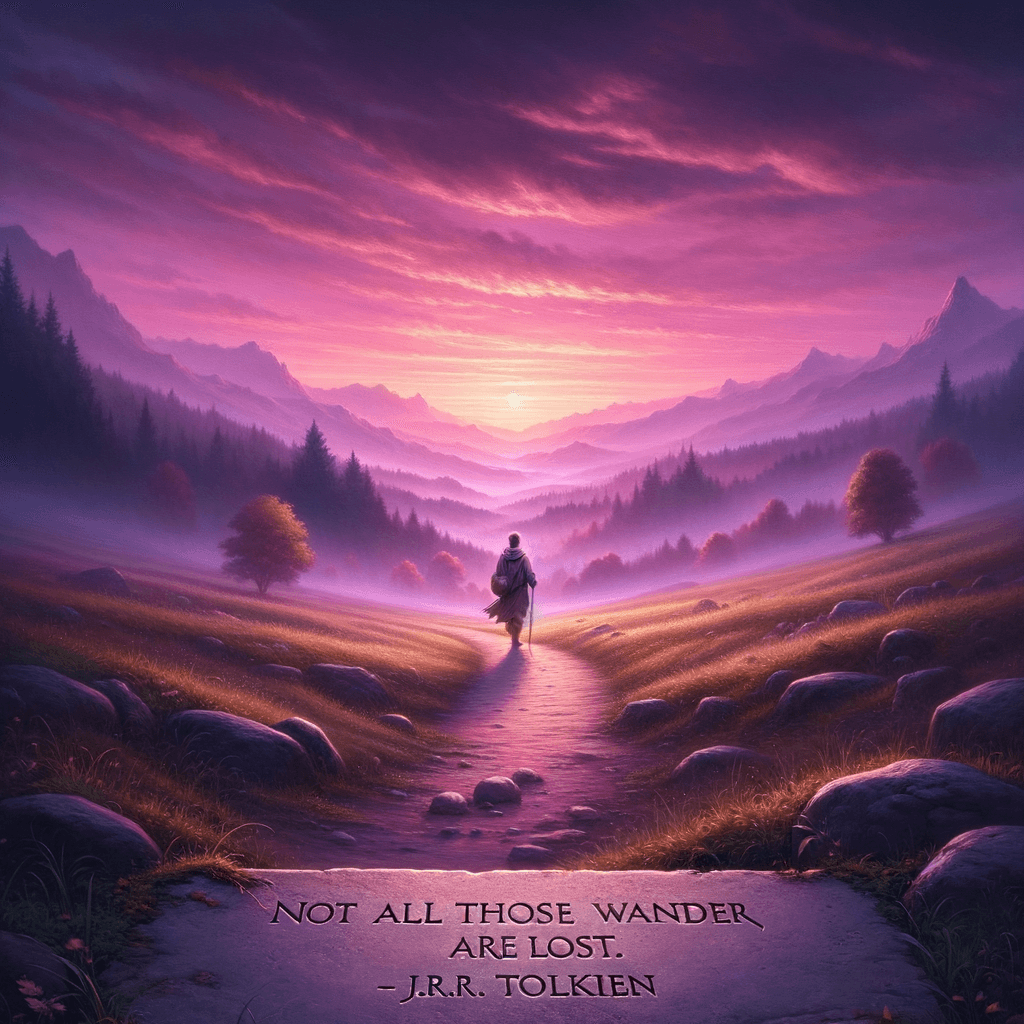
Not all those who wander are lost. - J.R.R. Tolkien
—What lingers after this line?
Freedom and Exploration
This quote suggests that wandering, or exploring without a set destination, is not inherently directionless or purposeless. It highlights the value of the journey and the exploration of the unknown.
Self-Discovery
The act of wandering can be a means of self-discovery and personal growth. It implies that those who wander may be seeking knowledge, experiences, or understanding, rather than being aimlessly adrift.
Non-Conformity
Tolkien's words celebrate non-conformity and the idea that individuals who take unconventional paths are not necessarily lost but may be following their unique calling or destiny.
Adventure and Curiosity
This quote inspires a sense of adventure and curiosity. It suggests that exploring the world and venturing into unknown territories can lead to meaningful experiences and knowledge.
Literary Context
J.R.R. Tolkien, an English writer, is best known for 'The Hobbit' and 'The Lord of the Rings.' This quote, originating from his poem 'All that is gold does not glitter,' encapsulates themes of heroism, journey, and the deeper wisdom found in his works.
One-minute reflection
What does this quote ask you to notice today?
Related Quotes
6 selectedNot all those who wander are lost. - J.R.R. Tolkien
J.R.R. Tolkien
This quote points out that wandering or taking an unconventional path doesn’t necessarily mean a person is directionless or lacks purpose. It celebrates the idea of seeking one's unique path in life.
Read full interpretation →Not all those who wander are lost. - J.R.R. Tolkien
J.R.R. Tolkien
This quote suggests that wandering, or exploring, is a valuable process that doesn't imply aimlessness. It highlights the idea that exploration can lead to self-discovery and personal growth.
Read full interpretation →Not all those who wander are lost. - J.R.R. Tolkien
J.R.R. Tolkien
This quote implies that wandering, or exploring, does not necessarily mean one lacks direction or purpose. Some individuals wander to discover, learn, and grow, rather than because they are lost.
Read full interpretation →Draw a map with your hands, then step into the landscape you imagine. — J.R.R. Tolkien
J.R.R. Tolkien
The line urges a sequence: make something tangible, then inhabit it. By telling us to draw a map “with your hands,” it foregrounds craft and embodiment before vision.
Read full interpretation →I am a part of all that I have met. — Alfred Lord Tennyson
Alfred Lord Tennyson
Tennyson’s line suggests that identity is not sealed within us from birth; rather, it is gradually formed by every person, place, hardship, and joy we encounter. Each meeting leaves a trace, sometimes obvious and sometim...
Read full interpretation →I am not a glitch in the system; I am the system evolving. — Octavia Butler
Octavia Butler
At first glance, Octavia Butler’s line transforms a defensive statement into a declaration of power. To say “I am not a glitch in the system” rejects the idea of being an error, an anomaly, or an inconvenience to the est...
Read full interpretation →More From Author
More from J.R.R. Tolkien →Courage is found in unlikely places. — J. R. R. Tolkien
Tolkien’s line gently overturns the usual image of courage as something reserved for warriors, rulers, or legendary heroes. Instead, it suggests that bravery often appears in ordinary people and modest settings, where no...
Read full interpretation →It is not our part here to take thought only for a season, or for a few lives of men, or for a passing age of the world. — J.R.R. Tolkien
At its core, Tolkien’s line rejects narrow, short-term thinking. He urges us to look beyond a single season, a generation, or even an era, and to measure our actions against a far larger horizon.
Read full interpretation →Faithless is he that says farewell when the road darkens. — J.R.R. Tolkien
Tolkien’s line draws a sharp boundary between affection that is convenient and fidelity that is real. Saying farewell “when the road darkens” suggests abandoning a person, cause, or duty precisely at the moment it demand...
Read full interpretation →Forge ahead where maps end; the brave craft new paths as they go. — J.R.R. Tolkien
Tolkien’s line evokes the moment when the comfort of the known world runs out—when the map quite literally ends. At such boundaries, most people turn back, trusting only what has been charted before.
Read full interpretation →