
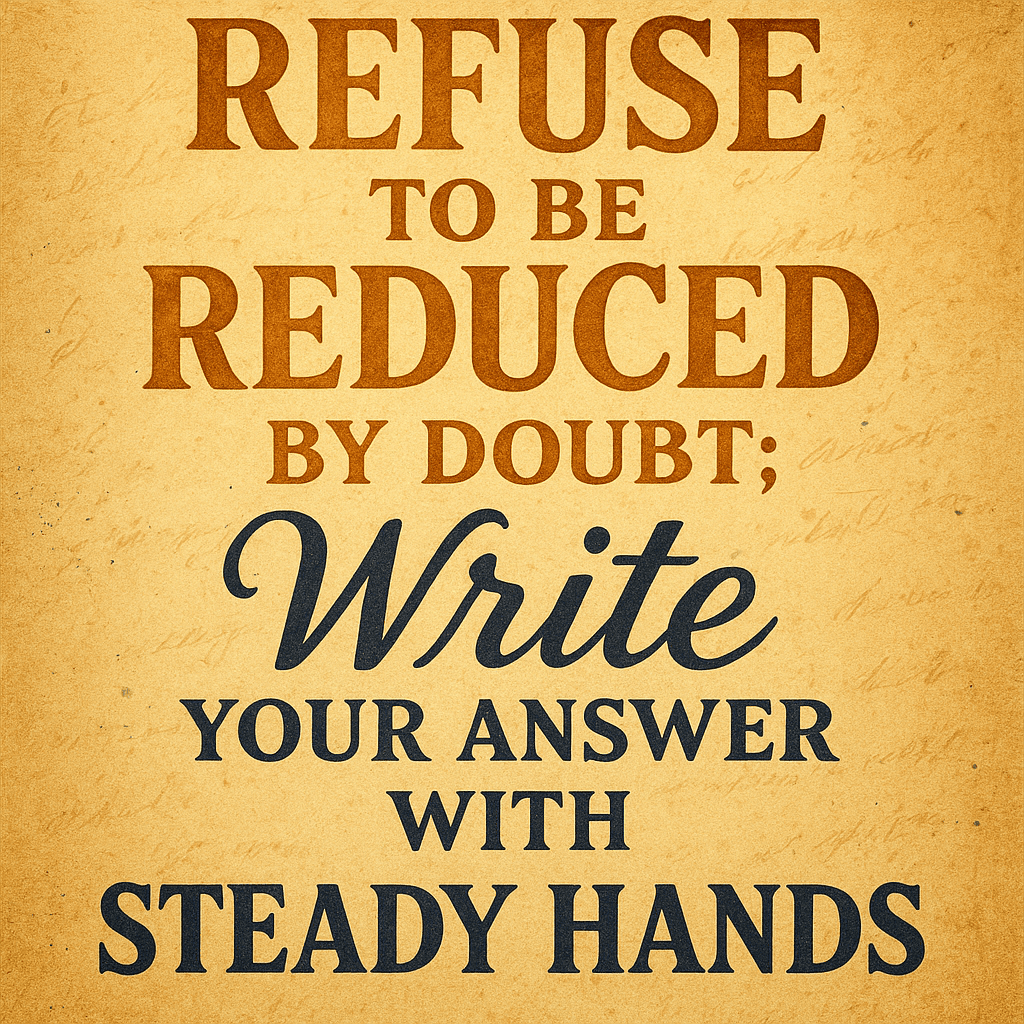
Refuse to be reduced by doubt; write your answer with steady hands. — Toni Morrison
—What lingers after this line?
The Call to Resist Inner Erosion
Toni Morrison’s line, “Refuse to be reduced by doubt; write your answer with steady hands,” begins as a quiet defiance against an invisible force. Doubt, in her framing, does not merely slow us down; it actively tries to shrink our sense of possibility and worth. To “refuse to be reduced” is therefore an act of self-preservation as much as courage. It asks us to recognize that while uncertainty is inevitable, surrendering our identity and purpose to it is not. In this light, the quote becomes less about eliminating doubt and more about denying it the power to define who we are or what we can do.
Doubt as a Shaping but Not Defining Force
Moving deeper, Morrison’s phrasing acknowledges that doubt will always be present at critical moments—before a decision, a creation, or a confrontation. Philosophers from Descartes onward have used doubt as a tool to clarify truth, showing that uncertainty can illuminate what truly matters. Yet Morrison warns against allowing that tool to become a cage. Doubt can refine our choices, but it must not compress our identity or silence our voice. Thus, the challenge is to let doubt pose questions without letting it write the answers for us.
“Write Your Answer” as a Creative Act
When Morrison urges us to “write your answer,” she shifts the metaphor from passive endurance to active authorship. The answer she refers to is not a test solution but the ongoing story of who we are and what we stand for. Much like in her novel *Beloved* (1987), where characters struggle to claim their own narratives against dehumanizing histories, this line invites us to become writers of our fate rather than mere respondents to external judgment. We do not simply react to doubt; we compose a deliberate response that reflects our values, experiences, and aspirations.
The Symbolism of Steady Hands
The image of “steady hands” adds a physical dimension to this inner work. Steadiness does not imply the absence of fear or trembling emotions; instead, it suggests discipline amid turbulence. A surgeon’s hand may hold tension and concern, yet it must remain controlled to heal. Likewise, a writer’s hand may hover over the page, unsure, but must still move across it. Morrison’s metaphor implies that courage is carried in the body: in our posture, our breath, and our willingness to keep going even when uncertainty presses in. Steady hands, then, signify a practiced refusal to let doubt dictate our movements.
From Private Resolve to Collective Strength
Finally, this refusal to be reduced is never only personal in Morrison’s world. Her essays in *Playing in the Dark* (1992) examine how social narratives try to reduce marginalized people through doubt about their intellect, beauty, or belonging. To resist reduction, therefore, becomes a communal stance: each person who writes their answer with steady hands widens the space for others to do the same. In this way, the quote points beyond individual resilience toward a shared ethic of affirmation, where confronting doubt in ourselves also challenges the systems that profit from keeping us small.
One-minute reflection
Why might this line matter today, not tomorrow?
Related Quotes
6 selectedThe ability to endure is the discipline of the soul. — Toni Morrison
Toni Morrison
Toni Morrison’s line shifts endurance from a mere survival trait into a deliberate inner practice: a discipline cultivated in the soul. Rather than glorifying pain for its own sake, she suggests that the capacity to cont...
Read full interpretation →Don't fight the challenges. Just find a new way to stand. — Germany Kent
Germany Kent
Germany Kent’s words begin with a quiet reversal of instinct: instead of treating every challenge as an enemy to defeat, she invites us to reconsider our posture toward difficulty. The emphasis is not on surrender, but o...
Read full interpretation →Optimist: someone who figures that taking a step backward after taking a step forward is not a disaster, it's more like a cha-cha. — Robert Brault
Robert Brault
Robert Brault’s line begins with a witty redefinition: an optimist is not someone who denies backward motion, but someone who interprets it differently. Instead of treating a setback as proof of failure, the optimist see...
Read full interpretation →A mind grows by staying with difficulty long enough for the experience to change it. — Mary Catherine Bateson
Mary Catherine Bateson
Mary Catherine Bateson’s observation begins with a quiet but demanding truth: the mind does not grow merely by encountering difficulty, but by remaining with it. Challenge becomes transformative only when we resist the u...
Read full interpretation →When you are friends with your storm, you dance, instead of getting blown away. — Michael Bassey Johnson
Michael Bassey Johnson
Michael Bassey Johnson’s line begins with a striking reversal: the storm is not merely an enemy to survive, but a force one can learn to understand. In this sense, the storm may represent grief, fear, conflict, uncertain...
Read full interpretation →Just because your light flickers does not mean it is about to go out. — Yohancé Salimu
Yohancé Salimu
At first glance, Yohancé Salimu’s line separates appearance from reality. A flicker suggests instability, fatigue, or interruption, yet it does not automatically signal extinction.
Read full interpretation →More From Author
More from Toni Morrison →The building of the architecture of a novel - the craft of it - is something I never tire of. — Toni Morrison
At its core, Toni Morrison’s remark celebrates not merely storytelling, but the deliberate construction behind it. By speaking of the “architecture of a novel,” she shifts attention from inspiration alone to design, sugg...
Read full interpretation →The role of art has never been to escape reality, but to help us understand it. — Toni Morrison
At first glance, art is often treated as a refuge from hardship, a private world where pain can be softened or forgotten. Toni Morrison overturns that expectation by arguing that art’s deeper purpose is not avoidance but...
Read full interpretation →The ability to endure is the discipline of the soul. — Toni Morrison
Toni Morrison’s line shifts endurance from a mere survival trait into a deliberate inner practice: a discipline cultivated in the soul. Rather than glorifying pain for its own sake, she suggests that the capacity to cont...
Read full interpretation →You are your best thing. — Toni Morrison
Toni Morrison’s line, “You are your best thing,” quietly overturns a common habit: looking outward for proof of worth. Instead of treating love, status, or achievement as the final measure, the quote plants value inside...
Read full interpretation →