
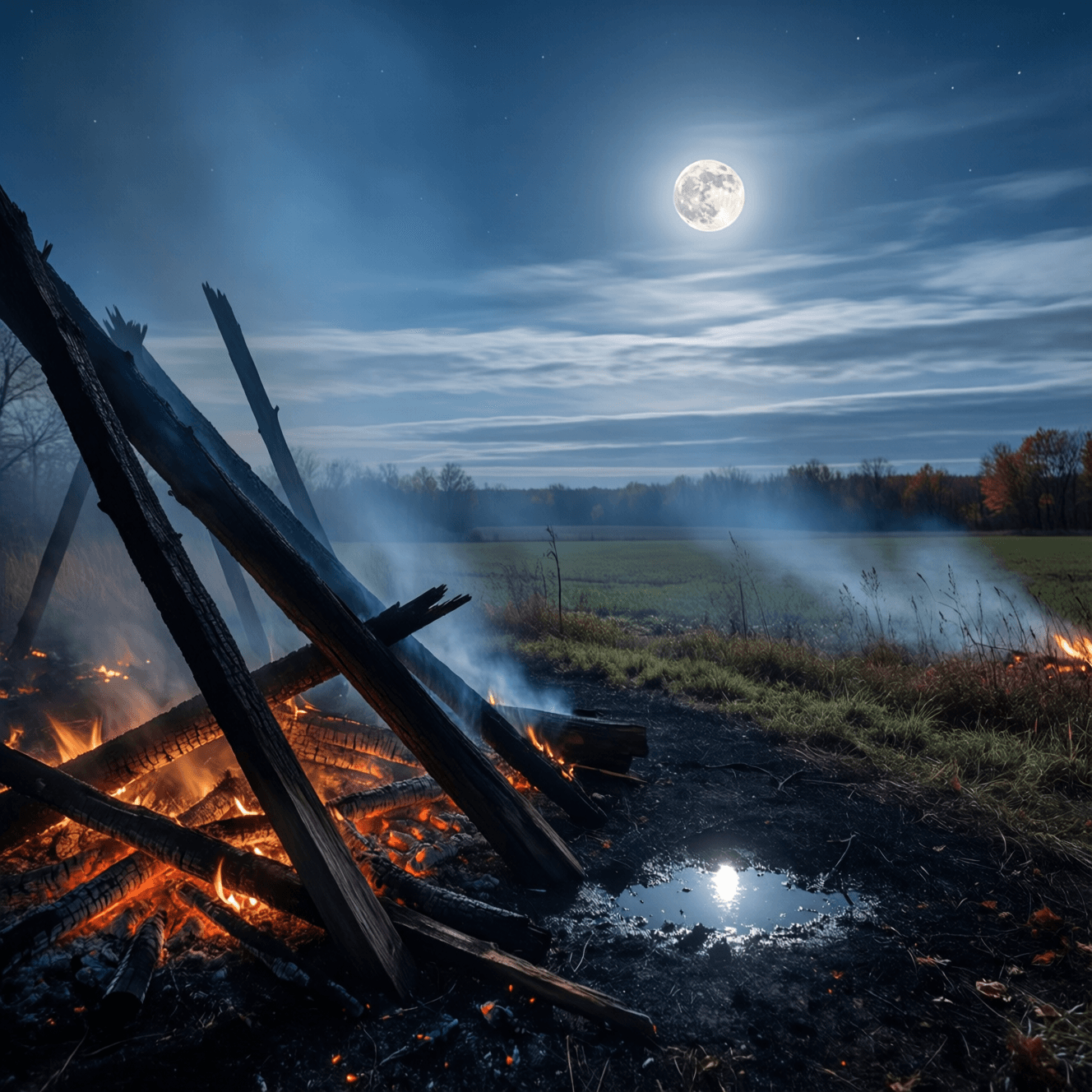
My barn having burned down, I can now see the moon. — Mizuta Masahide
—What lingers after this line?
A Spare Image With a Sudden Turn
Mizuta Masahide’s line begins with blunt damage—“My barn having burned down”—and then pivots to a quiet gift: “I can now see the moon.” The sentence structure itself creates the emotional motion, moving from catastrophe to clarity in a single breath. That turn is not an attempt to sweeten tragedy, but to register how reality can change when what once blocked our view is gone. Because the image is so plain—a barn, a fire, a moon—it invites readers to supply their own equivalents. What matters is not the specific building, but the way an absence can unexpectedly widen the world.
Impermanence as a Lens, Not a Slogan
The quote resonates with a long tradition in Japanese poetry and Buddhist thought in which impermanence is not merely tolerated but studied as a fundamental condition of life. Rather than presenting permanence as the default and loss as an exception, the line treats change as the situation we are always in, even when we pretend otherwise. Seen this way, the burned barn is less a moral lesson than a lens: it forces a recognition that what we build—homes, plans, identities—can vanish quickly. Yet the moon’s continued presence suggests another truth running alongside impermanence: something vast remains, even when familiar structures do not.
Perspective: When Obstruction Disappears
Moving from philosophy to perception, the poem hinges on a simple optical fact: a barn can block the sky. Loss therefore becomes a literal clearing of the view, and that concreteness keeps the insight from turning into abstraction. The moon was always there, but the speaker could not see it from where he stood. In everyday life, the same mechanism appears when a demanding job ends and someone notices how quiet mornings feel, or when a relationship dissolves and a person rediscovers neglected friendships. The point is not that the loss was “good,” but that altered circumstances can reveal what was previously hidden behind routine and attachment.
Grief Without Denial, Meaning Without Sugarcoating
Importantly, Masahide does not erase the fire. The barn is gone, and the statement does not claim the moon replaces it. This balance allows the line to hold grief and meaning in the same hand: the speaker can acknowledge damage while also admitting to a new kind of seeing. That emotional honesty is what makes the poem ethically persuasive. It avoids the cruelty of insisting that suffering is automatically beneficial, while still allowing for the possibility that, after the shock, a person may notice beauty that was inaccessible before. In this sense, the moon is not compensation but awareness.
Simplicity as an Aesthetic of Attention
The poem’s strength lies in its restraint, a hallmark of haiku-related sensibilities that favor precise observation over explanation. By leaving out commentary—no moralizing, no declared lesson—the line trains attention on the shift itself: from possession to openness, from enclosure to sky. That simplicity also mirrors how insight often arrives. It is rarely a grand conclusion; it is the sudden noticing of something obvious that was, somehow, overlooked. The moon becomes a symbol not because it is exotic, but because it is common—available to anyone who is not blocked from seeing it.
A Gentle Invitation to Rebuild Differently
Finally, the quote can be read as a quiet prompt about rebuilding. After loss, the impulse is to replace what vanished as quickly as possible, recreating the same shape of life. Yet the speaker’s new view suggests a question worth carrying forward: if we rebuild, do we also rebuild the obstruction? This does not mean refusing shelter or stability; it means reconsidering what our “barns” do besides protect us—how they also narrow our horizons. In that way, Masahide’s moon is more than a consolation: it is a reminder to preserve, amid recovery, the widened space that hardship briefly makes visible.
Recommended Reading
As an Amazon Associate, we earn from qualifying purchases.
One-minute reflection
What feeling does this quote bring up for you?
Related Quotes
6 selectedReal strength is not found in how much pressure you can endure, but in how clearly you can see your path when the clouds gather. — Bryan Robinson
Bryan Robinson
At first glance, strength is often imagined as endurance: the ability to absorb strain, remain unshaken, and keep going no matter the burden. Bryan Robinson’s quote gently overturns that assumption by suggesting that str...
Read full interpretation →Clarity rarely comes from urgency; it comes from rhythm. — The Balanced Edit
The Balanced Edit
At its heart, this quote sets urgency against rhythm as two very different ways of moving through thought. Urgency pushes for immediate output, often mistaking speed for insight, whereas rhythm suggests steadiness, pacin...
Read full interpretation →Few words accord with nature; therefore a whirlwind does not last all morning, and a sudden rain does not last all day. -- Laozi
Laozi
Laozi begins with a simple observation: even nature’s fiercest displays are temporary. A whirlwind burns itself out, and a sudden downpour cannot sustain its intensity for long.
Read full interpretation →We don't need to learn how to let things go; we just need to learn to recognize when they are already gone. — Suzuki Roshi
Suzuki Roshi
At first glance, Suzuki Roshi’s remark gently overturns a familiar self-help idea. We often imagine letting go as a difficult skill, something we must force ourselves to do through discipline or emotional effort.
Read full interpretation →Resilience is not about how much you can endure. It's about how clearly you can see. — David Gelles
David Gelles
At first glance, resilience is often mistaken for sheer toughness—the ability to absorb pain, keep going, and never break. Yet David Gelles shifts the idea in a more insightful direction: resilience is less about endurin...
Read full interpretation →Sometimes the most productive thing you can do is step away, breathe, and let the chaos settle into clarity. — Pico Iyer
Pico Iyer
At first glance, Pico Iyer’s remark seems to contradict modern habits of busyness. We are often taught that productivity means relentless motion, faster replies, and fuller schedules.
Read full interpretation →More From Author
More from Mizuta Masahide →