
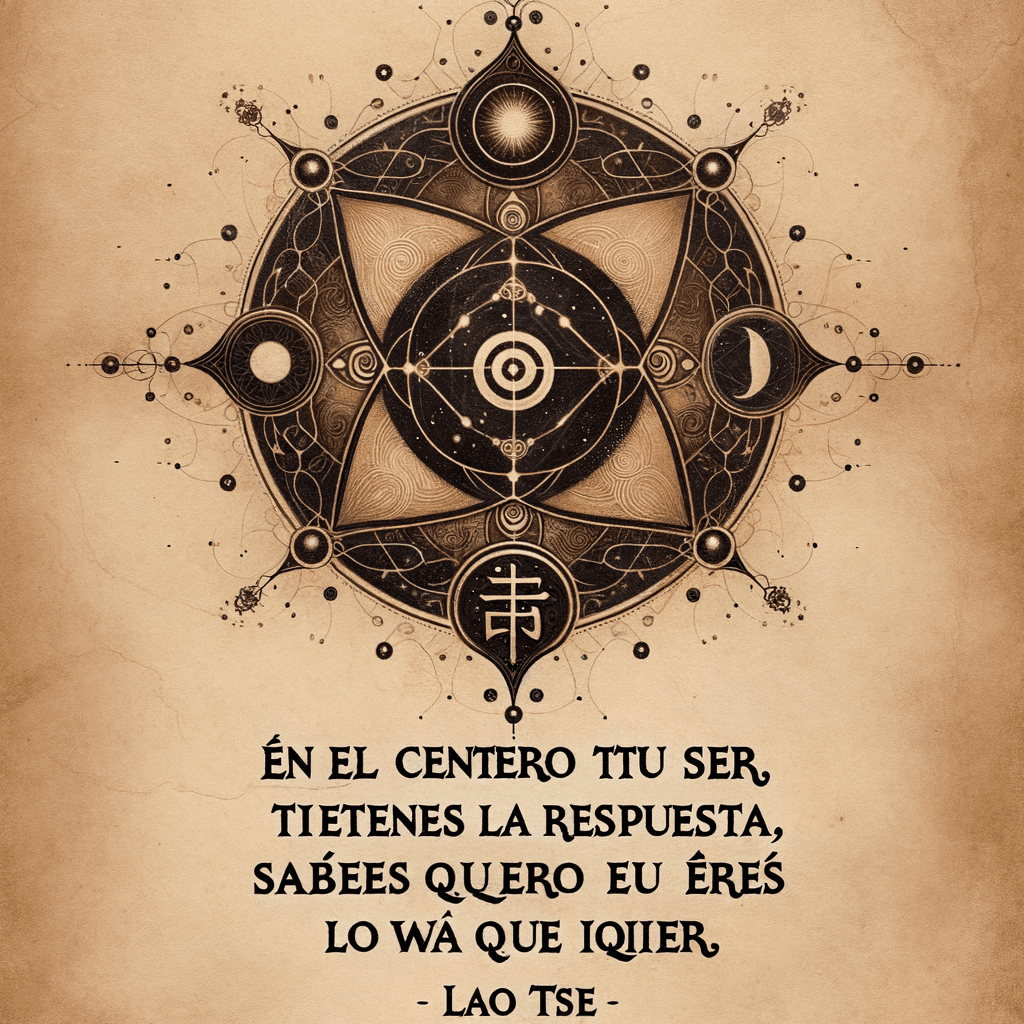
In the center of your being, you have the answer; you know who you are and you know what you want. - Laozi
—What lingers after this line?
Self-Discovery
This quote emphasizes the importance of looking inward for answers. It suggests that self-awareness and introspection are key to understanding one's true identity and desires.
Inner Wisdom
Laozi implies that each person possesses inherent wisdom within themselves. By connecting with this inner wisdom, one can find guidance and clarity in life.
Authenticity
By knowing who you are and what you want, the quote encourages living an authentic life aligned with your true self, rather than being influenced by external pressures or opinions.
Philosophical Context
Laozi, an ancient Chinese philosopher and the founder of Taoism, often highlighted the importance of harmony with the Tao (the Way). This quote reflects the Taoist belief in the natural, intuitive understanding that lies within each individual.
Personal Empowerment
The quote empowers individuals to trust their own instincts and judgments. It advocates for a self-reliant approach to life's decisions and challenges.
One-minute reflection
What does this quote ask you to notice today?
Related Quotes
6 selectedKnowing others is intelligence; knowing yourself is true wisdom. Mastering others is strength; mastering yourself is true power. — Lao Tzu
Lao Tzu
The quote contrasts intelligence, which is understanding others, with wisdom, which comes from self-understanding.
Read full interpretation →Those who know others are wise; those who know themselves are enlightened. Those who defeat others have strength; those who defeat themselves are strong. -- Laozi
Laozi
Laozi opens by placing “knowing others” and “knowing oneself” side by side, as if they were neighboring skills that lead to very different destinations. Understanding other people—reading motives, predicting reactions, n...
Read full interpretation →To have passed through life and never experienced solitude is to have never known oneself. — Joseph Krutch
Joseph Krutch
Joseph Krutch’s statement begins with a striking reversal: what many people avoid—solitude—he treats as essential to a meaningful life. In his view, simply moving through the world surrounded by noise, duties, and compan...
Read full interpretation →One's own self is well worth knowing. — Sappho
Sappho
At first glance, Sappho’s brief statement seems simple, yet its force lies in its directness: the self is not a trivial subject but a worthy one. In a world that often rewards attention to status, duty, or appearance, he...
Read full interpretation →The highest purpose of intellectual cultivation is to give a man a perfect knowledge and mastery of his own inner self. — Marcus Tullius Cicero
Marcus Tullius Cicero
Cicero’s statement immediately shifts the meaning of education away from mere information gathering and toward self-command. In his view, the finest result of intellectual cultivation is not public applause or argumentat...
Read full interpretation →True confidence is not the need to be heard, but the comfort of knowing who you are in the silence. — Susan Cain
Susan Cain
Susan Cain’s quote immediately challenges the loud, outward model of confidence that many cultures celebrate. Rather than equating strength with constant self-assertion, she suggests that real confidence appears in a qui...
Read full interpretation →More From Author
More from Lao Tzu →If you want to be out front, then act as if you were behind. — Lao Tzu
Lao Tzu’s saying begins with a paradox: to move ahead of others, one must behave as though one is behind them. Rather than urging weakness or hesitation, the quote points to a subtler form of strength—leadership that doe...
Read full interpretation →Do you have the patience to wait until your mud settles and the water is clear? — Lao Tzu
Lao Tzu’s question frames patience not as passive delay but as an active kind of wisdom. The image of muddy water settling on its own suggests that confusion often clears not through force, but through restraint.
Read full interpretation →Anything that is living must have a rest. If it does not rest, it will lose its strength. — Lao Tzu
Lao Tzu’s insight begins with a simple observation: all living things move in cycles, not in endless exertion. By saying that anything alive must rest, he frames rest not as laziness but as a biological and spiritual nec...
Read full interpretation →Yield and overcome, bend and be straight. — Lao Tzu
At first glance, Lao Tzu’s line seems contradictory: how can yielding lead to overcoming, or bending result in straightness? Yet this paradox lies at the heart of Taoist thought.
Read full interpretation →