
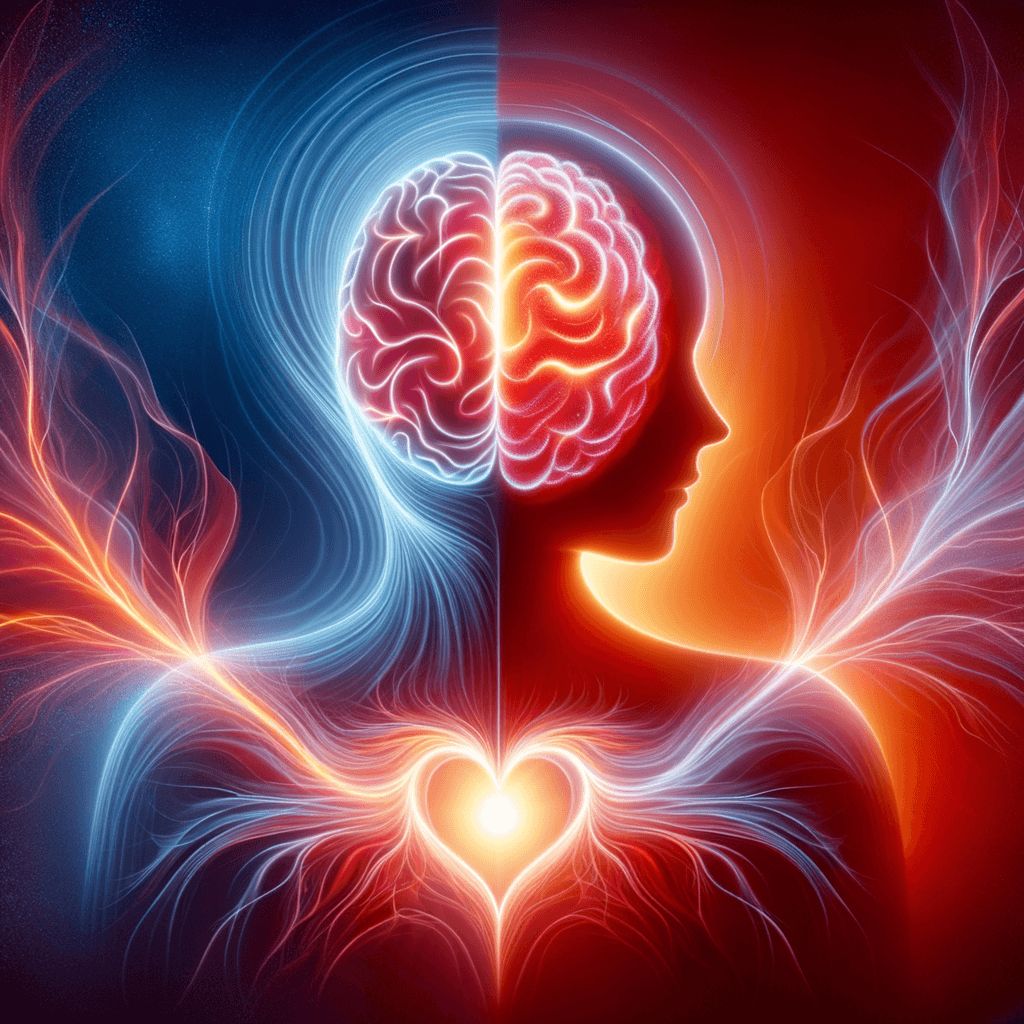
What's in your heart is what's in your head. — T.K. Morrow
—What lingers after this line?
Connection Between Heart and Mind
This quote highlights the deep link between emotions (heart) and thoughts (head). It suggests that what we feel strongly in our hearts often aligns with the thoughts that occupy our minds.
Emotional and Rational Balance
It signifies that emotions and logic are not necessarily separate entities. Rather, our thoughts are influenced by our emotions, and vice versa, creating a balance between the two.
Authenticity and Integrity
The quote may also refer to the idea of being true to oneself. If what you think matches what you feel, you are likely acting out of genuine conviction and integrity.
Holistic Self-Understanding
This could imply that achieving harmony between your head and heart allows for a more holistic understanding of yourself. When emotions and thoughts align, it can lead to clarity in decision-making and actions.
Psychological and Philosophical Insights
The concept echoes ideas in both psychology and philosophy about the interconnectedness of feelings and thoughts. It suggests that inner peace or wisdom comes when one's emotional and intellectual states are in harmony.
One-minute reflection
What does this quote ask you to notice today?
Related Quotes
6 selectedThere is a quiet power in the ability to simply be, to exist without the need for constant performance. — Eileen Caddy
Eileen Caddy
Eileen Caddy’s words begin with a gentle challenge to modern restlessness: we often feel compelled to prove our worth through productivity, charm, achievement, or constant visibility. Yet her phrase “quiet power” suggest...
Read full interpretation →When you are friends with your storm, you dance, instead of getting blown away. — Michael Bassey Johnson
Michael Bassey Johnson
Michael Bassey Johnson’s line begins with a striking reversal: the storm is not merely an enemy to survive, but a force one can learn to understand. In this sense, the storm may represent grief, fear, conflict, uncertain...
Read full interpretation →Be who you are and say what you feel, because those who mind don't matter, and those who matter don't mind. — Bernard M. Baruch
Bernard M. Baruch
Baruch’s quote begins with a simple but demanding instruction: be yourself and speak honestly. At its core, the line argues that authenticity is not merely a personality trait but an act of courage, especially in a world...
Read full interpretation →You're born an original—don't die a copy. — John Mason
John Mason
At its core, John Mason’s line is a sharp reminder that every person begins life with a distinct combination of temperament, talent, and perspective. To be “born an original” suggests that individuality is not something...
Read full interpretation →Authenticity is a habit. It is a road we are comfortable with. — Ai Weiwei
Ai Weiwei
At first glance, Ai Weiwei’s statement shifts authenticity away from dramatic self-revelation and toward repetition. By calling it a habit, he suggests that being genuine is not an occasional act of courage but a pattern...
Read full interpretation →Quietly persist. The world is loud, but your work only needs to be true. — Anne Lamott
Anne Lamott
Anne Lamott’s line begins with a simple imperative: “Quietly persist.” At once, it rejects the idea that meaningful work must announce itself to be real. Instead, she points toward a steadier form of effort, one rooted i...
Read full interpretation →More From Author
More from T.K. Morrow →