
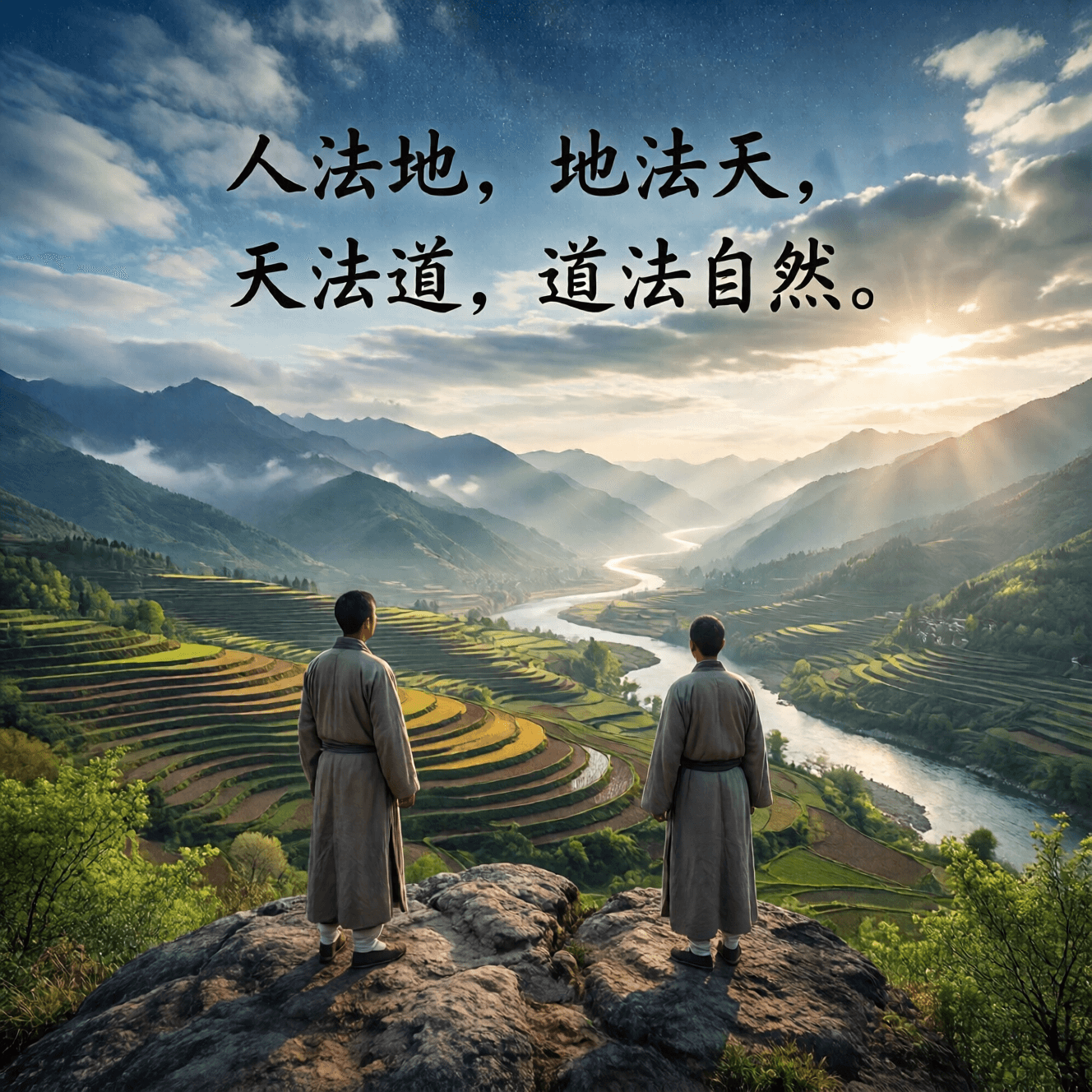
人法地,地法天,天法道,道法自然。-- 老子
—读完这句,什么在心中回响?
A Ladder of Imitation and Learning
“人法地,地法天,天法道,道法自然” sets up a descending-and-ascending ladder of guidance: humans take the earth as a model, the earth takes heaven as a model, heaven takes the Dao as a model, and the Dao takes what is “natural” (ziran) as its model. Rather than presenting a rigid chain of command, Laozi sketches how each level finds its proper pattern by observing what is broader, steadier, and less self-serving than itself. In this way, the line reads like a method of learning: when confused about how to live, look outward to larger rhythms and then inward to the principle that makes those rhythms possible. From the start, the message implies that wisdom is not invented by force of will. Instead, it is discovered by aligning with realities that predate personal preference—an idea that prepares the ground for the poem’s final pivot toward “nature as such.”
Humans Model the Earth: Practical Grounding
Beginning with “人法地,” Laozi points to the earth as the immediate teacher because it is close, tangible, and dependable. The earth nourishes without boasting, bears weight without complaint, and follows seasons without anxiety. To model the earth, then, is to cultivate steadiness: doing what sustains life, keeping one’s feet on the ground, and accepting cycles of growth and rest rather than demanding constant expansion. This is also a quiet critique of human restlessness. When people chase status or speed as if they could outrun consequence, Laozi redirects attention to what cannot be hurried: soil needs time, bodies need sleep, communities need trust. By learning from the earth’s patience, human action becomes less brittle—and that shift naturally leads to the next question: what pattern does the earth itself follow?
Earth Models Heaven: Rhythm, Timing, and Order
“地法天” suggests that even the earth is not arbitrary; it moves in resonance with “heaven,” a term that in classical Chinese thought often points to overarching order—day and night, weather, the turning of seasons, and the regularities that make agriculture and navigation possible. Earth’s fertility, winds, and waters respond to these larger cycles, which is why traditional life paid so much attention to timing: planting too early or too late breaks harmony and invites loss. In daily terms, the teaching nudges us to respect timing and context. Effort matters, but effort that ignores the season becomes wasteful or violent. Once we see that “heaven” names a wider pattern than local needs, Laozi moves again toward what stands behind that pattern—what gives “heaven” its way.
Heaven Models the Dao: Source Beyond Appearances
With “天法道,” Laozi distinguishes between visible order and the deeper principle that makes order possible. Heaven’s rhythms may appear regular, yet they are not ultimate; they are expressions. The Dao, as portrayed in the Dao De Jing (c. 4th–3rd century BC), is the underlying “Way” that cannot be fully captured by names, yet manifests as the coherence of the world. In other words, the sky’s patterns are not self-grounding; they are traces of something more fundamental. This shift matters because it prevents us from mistaking any single system—calendar, ritual, ideology, even science—as the final authority. Systems can illuminate patterns, but the Dao is prior to them. Having moved from the human scale to cosmic order, Laozi’s final line then clarifies what even the Dao “follows.”
Dao Models Ziran: The Meaning of “Natural”
“道法自然” is the philosophical climax: the Dao “models” ziran, often rendered as “naturalness” or “self-so-ness”—things being what they are by their own unfolding rather than by coercion. This does not mean “do whatever you want.” It means that the deepest order is not imposed from outside like a decree; it arises from within as an organic fittingness. A river finds the low place; a tree grows toward light; a community stabilizes when roles and resources match realities. Consequently, Laozi implies that the highest wisdom is not maximal control but minimal distortion. The more we force outcomes against the grain of situations, the more resistance and unintended harm we create. By honoring ziran, we let the Dao appear as ease, simplicity, and proportional action.
Wuwei in Practice: Acting Without Forcing
Once “naturalness” becomes the measure, the practical ethic that follows is wuwei—often misunderstood as passivity, but better read as “effortless” or “non-coercive” action. A small anecdote captures it: a skilled butcher in Zhuangzi (c. 3rd century BC) cuts along the natural gaps between joints, so the knife stays sharp; he is not inactive, but he does not fight the structure of the ox. The same logic applies to leadership, work, and relationships: progress comes from seeing the grain of things and moving with it. Therefore, Laozi’s chain is not abstract cosmology; it is an instruction in craft. Observe what is larger than you, find the hidden structure, and act in ways that cooperate with it. In the end, “following nature” becomes a discipline of attention—one that turns restraint into power and simplicity into durability.
一分钟思考
这句话让你今天注意到什么?
相关名言
已选6条大自然不急不躁,却完成了一切。——老子
老子
“大自然不急不躁,却完成了一切”把一个看似矛盾的事实摆在眼前:最深的力量往往不以喧哗的方式出现。老子在《道德经》(约公元前4世纪)中反复强调“道法自然”,意指万物的生成与运行并不依赖外在催逼,而是遵循内在的秩序与节律。因而,这句话并非鼓励消极等待,而是提醒我们:真正的成就常来自顺势而为,而非焦虑驱动的强推。 顺着这一层意思看,自然之“完成”不是瞬间的爆发,而是长期的积累与连续的变化;它不抢跑,也不拖延,只是稳定地向前。
阅读完整解读 →大自然不急不躁,却完成了一切。——老子
老子
“大自然不急不躁,却完成了一切” points to an apparently simple but demanding insight: the world’s most reliable productivity is not frantic. In this line attributed to Laozi and consistent with the tone of the Daoist classic *Dao De Ji...
阅读完整解读 →大自然不匆忙,然而万事皆成。——老子
老子
老子说“大自然不匆忙,然而万事皆成”,表面像是在赞美慢,实则指出一种更深的秩序:真正有效的成就,往往来自顺势而为,而非强行催逼。在《道德经》的语境里,“无为”不是无所作为,而是不以私欲扰乱事物自身的生长规律。 因此,这句话首先把我们的注意力从“立刻见效”移向“长期成形”。当我们接受过程的必要长度,就更容易理解:许多成果不是靠速度堆出来的,而是靠节律养出来的。
阅读完整解读 →自然不急躁,然而一切都得以完成。——老子
老子
老子说“自然不急躁”,并不是劝人消极等待,而是提醒我们:天地运行自有节律,不因人的焦虑而加速。与其把“快”当作唯一目标,不如先辨认事情自身的成熟条件——时机、资源、因果链条。由此起步,这句话首先把注意力从“我想立刻做到”转向“事物需要怎样的过程”。 因此,“自然”并非口号,而是一种校正过度用力的尺度:当我们以焦虑驱动行动,往往会忽略结构性问题,最后只剩更大的消耗;当我们顺着规律组织步骤,反而能让投入更有效率。
阅读完整解读 →大自然从不匆忙,然而万事皆得以完成。——老子
老子
老子说“大自然从不匆忙,然而万事皆得以完成”,首先把目光从人类的焦虑拉回到天地的节律:四时更替不催促,草木生长不争先,却都能在合适的节点开花结果。这里的关键不在于“慢”,而在于“顺其时”。当我们以自然为参照,就会发现完成并不必然依赖急迫,而更依赖持续与节律。由此,老子的提醒并不是让人懈怠,而是让人重新理解效率的来源:不违背规律,反而更快抵达结果。
阅读完整解读 →执古之道,以御今之有。能知古始,是谓道纪。- 老子
老子
“执古之道,以御今之有”先提出方法:抓住“古之道”;再指出用途:用它来驾驭、调理当下纷繁的“有”。紧接着“能知古始,是谓道纪”把重点从操作层面推进到源头层面:若能理解“古始”,也就是万事万物之所以如此的起点与根脉,才算真正把握了“道纪”——道的纲纪与准绳。 因此,这段话并非怀旧,而是把“回到源头”当作处理现实的最高效率路径:越是变化剧烈的时代,越需要稳定的尺度来校准行动。
阅读完整解读 →更多作者内容
来自老子的更多内容 →希言自然,故飘风不终朝,骤雨不终日。-- 老子
老子说“希言自然”,先点出一种顺乎万物的生活态度:真正合于大道者,不以喧哗示强,不以多言立威,而是让事物依其本性展开。紧接着,他以“飘风不终朝,骤雨不终日”作比,说明即使最猛烈的风雨也无法长久,因此凡是过度张扬、过分激烈的状态,往往都难以持久。 由此看,这句话并不只是劝人沉默,更是在提醒人们观察天地运行的节奏。自然本身并不依靠夸饰来维持秩序,反而在简静中完成生成与转化,这正是《道德经》一贯强调的“少私寡欲”与“无为而治”的基础。
阅读完整解读 →知人者智,自知者明。胜人者有力,自胜者强。-- 老子
“知人者智,自知者明。胜人者有力,自胜者强”以两组并列对照展开:先谈认知,再谈力量;先谈外部对象,再谈内部主体。它像一把标尺,把人们习惯追逐的“看得准别人、压得过别人”与更难、更深的“看清自己、赢过自己”区分开来。 顺着这种结构往下读,会发现老子并非否定外在能力,而是重新排序:智与力固然可贵,但若缺少明与强,它们容易沦为短期的技巧与一时的胜负。于是,全句自然引出一个核心:真正稳固的成就,来自向内的觉察与克制。
阅读完整解读 →希言自然,故飘风不终朝,骤雨不终日。-- 老子
老子以“希言自然”起笔,先把“少说”与“合乎自然”并置:言语越稀少,越接近万物自发的秩序。这不是鼓励沉默寡言,而是提醒人们,语言一旦过度,就容易变成控制、辩解与装饰,反而背离事情本来的走向。 顺着这一点往下看,“希言”更像一种审慎:只在必要处落子,不用话语填满空隙。如此,言语不再是情绪的喷涌,而成为对规律的回应,也为后文的风雨譬喻埋下伏笔。
阅读完整解读 →知其荣,守其辱,为天下谷。-- 老子
“知其荣,守其辱,为天下谷”表面上看像是矛盾:既然知道荣耀与尊贵,为什么还要守住屈辱与卑下?老子在这里并非劝人自贬,而是提醒人即便拥有地位、才能或成功,也要把自己的姿态放在“低处”。这种“守辱”是一种自我约束:不因得势而傲,不因被赞而飘。 进一步说,这句话把“知”与“守”并列:你可以清楚地理解世俗的荣光如何运作,但真正的功夫在于能否在诱惑与掌声中仍保持克制。于是,荣耀成了你看得懂却不必抓紧的东西,低处才是你愿意长期站稳的位置。
阅读完整解读 →