
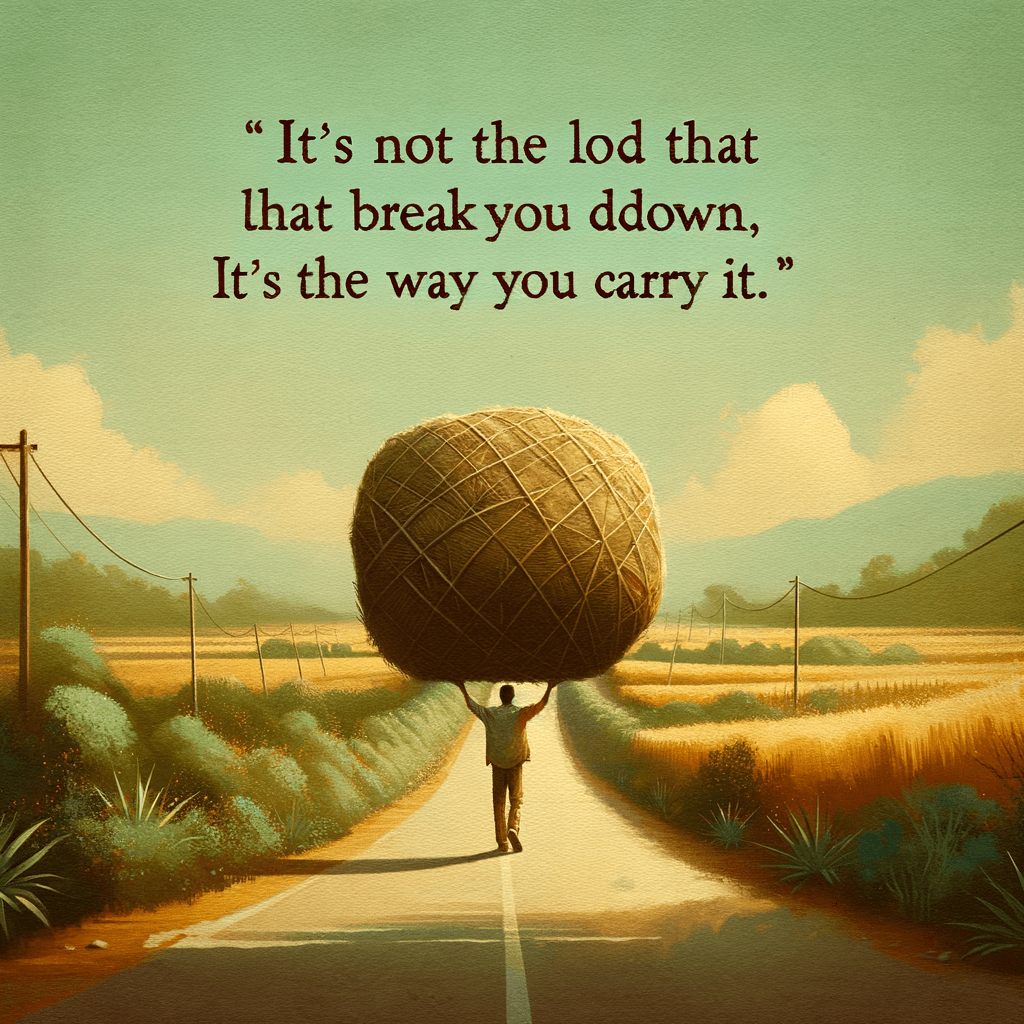
It's not the load that breaks you down, it's the way you carry it. — Lou Holtz
—What lingers after this line?
Perspective on Challenges
This quote emphasizes that the burden itself is not the cause of one's downfall, but rather the approach and mindset in handling the challenges are key.
Resilience and Adaptability
It suggests that resilience and the ability to adapt are crucial for overcoming difficulties. How one manages stress and pressure can significantly impact their well-being and success.
Coping Mechanisms
Effective coping mechanisms and strategies are implied as essential. Learning how to distribute weight, seek support, and maintain balance can prevent being overwhelmed.
Mental Attitude
The quote underscores the importance of maintaining a positive and constructive mental attitude. A healthy mindset can transform how challenges are perceived and dealt with.
Lou Holtz's Background
Lou Holtz is a renowned American football coach and motivational speaker. His experiences in coaching likely informed his insights on stress management, teamwork, and perseverance.
Recommended Reading
As an Amazon Associate, we earn from qualifying purchases.
One-minute reflection
Where does this idea show up in your life right now?
Related Quotes
6 selectedPeace is not freedom from the storm, but peace amid the storm. — William Frederick Kinsey
William Frederick Kinsey
At first glance, Kinsey’s statement overturns a common assumption: peace is not the absence of trouble, but a steady inner condition that survives trouble. Rather than imagining serenity as a sheltered life, the quote in...
Read full interpretation →The two hardest tests on the spiritual road are the patience to wait for the right moment and the courage not to be disappointed with what we encounter. — Paul Coelho
Paul Coelho
At its core, Paulo Coelho’s reflection presents spiritual growth as a journey marked by two intertwined tests. The first is patience: the ability to endure uncertainty without forcing outcomes before their time.
Read full interpretation →The world is filled with chaos, so you must build your own windmills. — John F. Kennedy
John F. Kennedy
At first glance, Kennedy’s remark accepts a hard truth: the world rarely offers perfect order, fairness, or clarity. Instead of promising stability, it acknowledges confusion as a permanent feature of human life.
Read full interpretation →Stay positive does not mean that things will turn out okay. Rather it is knowing that you will be okay no matter how things turn out. — Garth Ennis
Garth Ennis
At first glance, positivity is often mistaken for optimism about outcomes, as if a hopeful person must believe everything will end well. Garth Ennis challenges that softer cliché by offering a sturdier definition: being...
Read full interpretation →Peace is not freedom from the storm, but peace within it. — Laura Ingalls Wilder
Laura Ingalls Wilder
Laura Ingalls Wilder’s line immediately shifts the meaning of peace away from perfect circumstances and toward an inner steadiness. Rather than promising a life without conflict, grief, or uncertainty, it suggests that c...
Read full interpretation →Recovery is not passive, it is performance for life. — Erica Diamond
Erica Diamond
At first glance, Erica Diamond’s statement overturns a common misconception: recovery is not simply rest, waiting, or the passive passage of time. Instead, it is an intentional process, something lived and enacted throug...
Read full interpretation →More From Author
More from Lou Holtz →When all is said and done, more is said than done. — Lou Holtz
Lou Holtz’s quip distills a stubborn truth: in many endeavors, output skews toward conversation rather than completion. We discuss goals, outline plans, and celebrate intentions, yet the ledger of finished work remains t...
Read full interpretation →Ability is what you're capable of doing. Motivation determines what you do. Attitude determines how well you do it. — Lou Holtz
Lou Holtz compresses the journey from capacity to excellence into three levers: ability, motivation, and attitude. Together they form a sequence—what you can do, what you choose to do, and how well you do it—shaping outc...
Read full interpretation →