
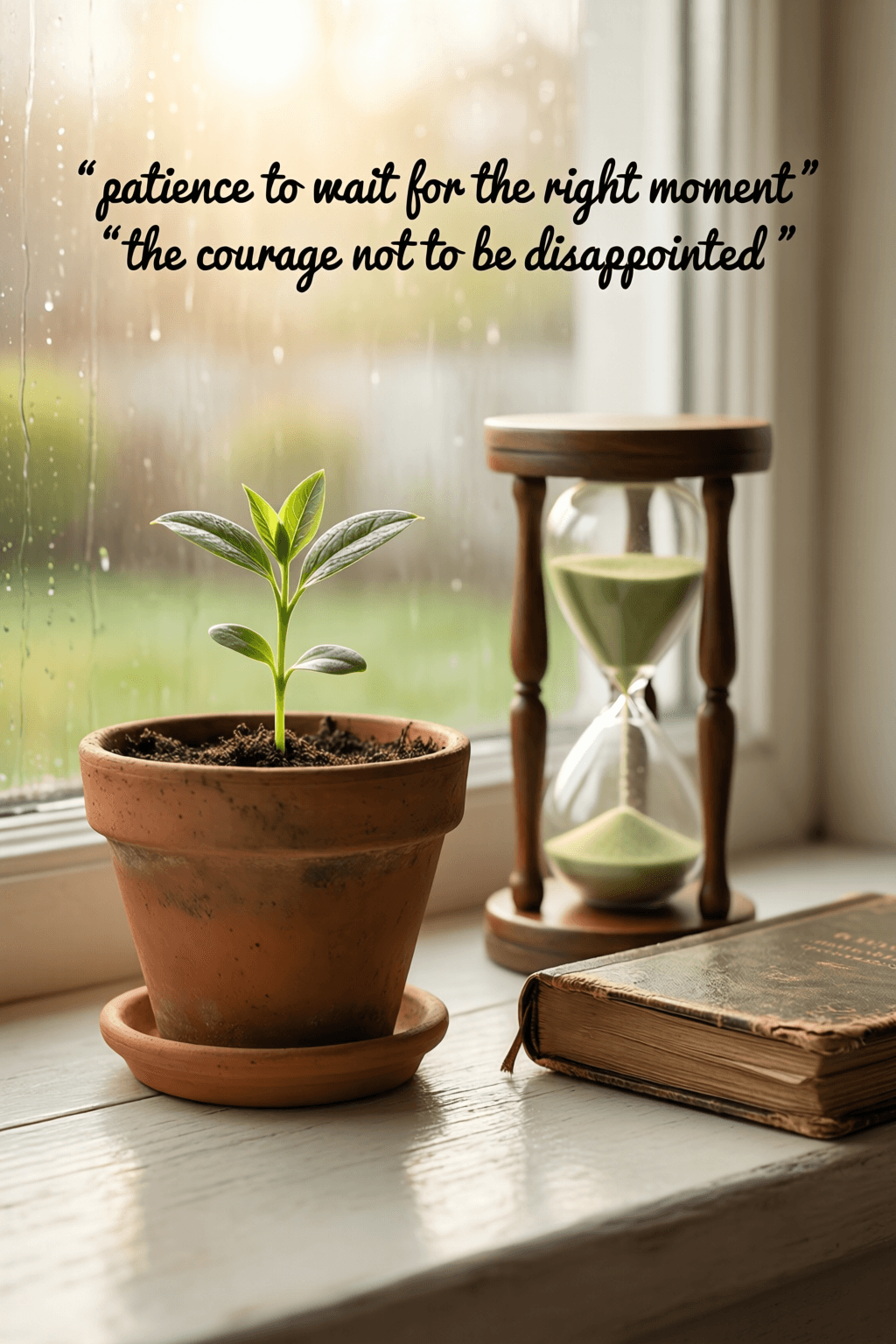
The two hardest tests on the spiritual road are the patience to wait for the right moment and the courage not to be disappointed with what we encounter. — Paul Coelho
—What lingers after this line?
A Double Trial of the Soul
At its core, Paulo Coelho’s reflection presents spiritual growth as a journey marked by two intertwined tests. The first is patience: the ability to endure uncertainty without forcing outcomes before their time. The second is courage: the strength to meet reality as it arrives, rather than collapsing into bitterness when it differs from our hopes. Together, these virtues suggest that the spiritual road is not only about seeking meaning, but also about learning how to receive life honestly.
Why Waiting Becomes a Discipline
From there, the idea of waiting takes on deeper significance. Patience is not mere passivity; it is an active discipline of trust, restraint, and attentiveness. In many traditions, this kind of waiting is sacred: the Psalms repeatedly urge believers to “wait on the Lord,” while Rumi’s poetry often frames longing itself as a form of transformation. Thus, the delay we resent may actually be the space in which character ripens.
The Shock of Reality
Yet waiting alone is not enough, which leads to Coelho’s second test. Even when the long-anticipated moment finally comes, reality may appear ordinary, incomplete, or painfully different from what we imagined. Buddhist teachings on non-attachment, especially in texts like the Dhammapada, emphasize that suffering often arises from clinging to expectations. In this light, disappointment is not simply bad luck; it reveals the distance between our fantasies and the world before us.
Courage as Spiritual Maturity
Because of this, courage becomes more than bold action; it becomes emotional and spiritual steadiness. To remain open-hearted after unmet expectations is a demanding form of strength. Consider the biblical story of Elijah in 1 Kings 19: after dramatic hopes of renewal, he encounters exhaustion and silence, yet the divine appears not in spectacle but in a “still small voice.” The anecdote suggests that spiritual maturity often means accepting quieter truths than the ones we expected.
Letting Go of Idealized Outcomes
In turn, Coelho’s quote invites us to loosen our grip on idealized endings. Many people imagine that spiritual breakthroughs will feel unmistakably radiant, yet real insight often arrives in humble forms: a difficult conversation, an unwanted delay, or a moment of clarity born from failure. As the Stoic Epictetus argued in the Enchiridion, peace depends less on controlling events than on shaping our response to them. What disappoints us may still teach us.
A Faithful Way of Moving Forward
Ultimately, the two tests belong together. Patience prepares us to receive the future without panic, while courage helps us face that future without resentment. This creates a spirituality grounded not in fantasy, but in resilient hope. Coelho’s insight, then, is quietly demanding: the real challenge is not simply to reach the right moment, but to greet it with enough humility and strength to accept what it truly is.
Recommended Reading
As an Amazon Associate, we earn from qualifying purchases.
One-minute reflection
What's one small action this suggests?
Related Quotes
6 selectedReject your sense of injury and the injury itself disappears. — Marcus Aurelius
Marcus Aurelius
At first glance, Marcus Aurelius’s line seems severe, yet its central claim is distinctly Stoic: much of suffering arises not from the event itself but from our judgment about it. In his Meditations (c.
Read full interpretation →I learned that when life pulls you under, you can kick against the bottom, break the surface, and breathe again. — Sheryl Sandberg
Sheryl Sandberg
At first glance, Sandberg’s image of being pulled underwater captures the disorienting force of grief, failure, or crisis. The metaphor feels physical: when life overwhelms us, we lose direction, panic sets in, and even...
Read full interpretation →It is easy finding reasons why other folks should be patient. — George Eliot
George Eliot
George Eliot’s remark turns on a quiet but piercing irony: patience is a virtue we readily prescribe when someone else must practice it. In other words, distance makes endurance look simple.
Read full interpretation →Learning is a lifelong process of unlearning the need for immediate results. Patience is the discipline of trusting the slow, quiet compounding of your efforts. — Confucius
Confucius
At its core, this saying presents learning not as a race toward instant achievement, but as a gradual reshaping of expectation. The phrase “unlearning the need for immediate results” suggests that education is not only a...
Read full interpretation →If you want to move forward, you must first give yourself permission to stand still. Perspective is often the result of stopping long enough to actually see. — Alain de Botton
Alain de Botton
At first glance, Alain de Botton’s line seems contradictory: how can standing still help us move forward? Yet that tension is precisely his point.
Read full interpretation →When you feel like you are drowning in life, don't blame the ocean. You have to learn how to swim. — Anne Lamott
Anne Lamott
Anne Lamott’s line begins with a blunt but compassionate shift in perspective: when life feels overwhelming, the first impulse is often to blame circumstances, other people, or fate itself. Yet the quote redirects attent...
Read full interpretation →More From Author
More from Paul Coelho →