
Sowing Curiosity to Harvest a Vivid Life
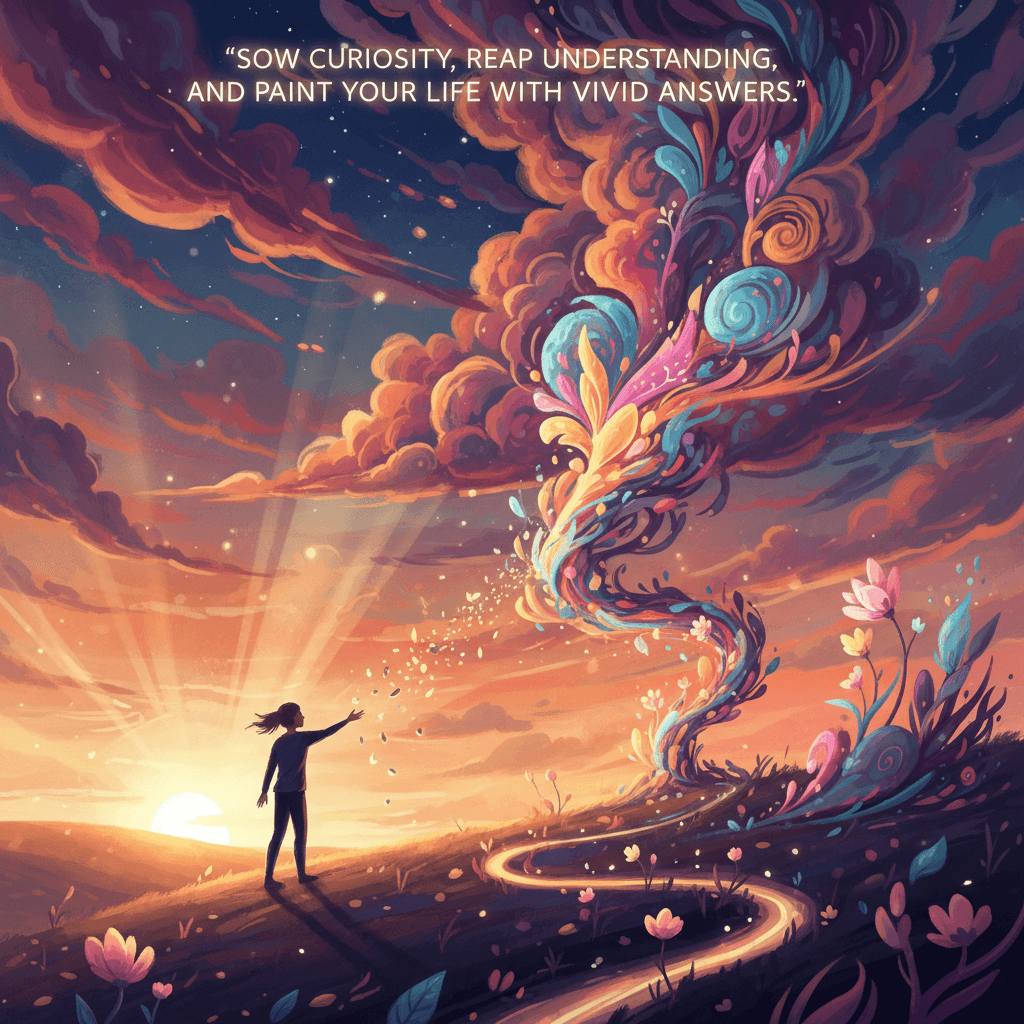
Sow curiosity, reap understanding, and paint your life with vivid answers — Pablo Neruda
—What lingers after this line?
From Seeds of Curiosity to Fields of Insight
Neruda’s metaphor begins in the soil of the mind: when we ‘sow curiosity,’ we plant questions instead of settling for easy assumptions. Like any seed, a question appears small and insignificant, yet it holds the potential for entire landscapes of understanding. This framing suggests that knowledge is not a gift handed down from above but a living crop that grows from our own appetite to know more. By choosing to be curious—about people, ideas, and the hidden workings of everyday things—we prepare the ground for genuine learning. Thus, understanding becomes less an abstract goal and more a natural harvest, the inevitable result of tending the questions we dare to ask.
Reaping Understanding as an Ongoing Harvest
Once curiosity is planted, Neruda implies that understanding does not arrive all at once, like a sudden revelation, but ripens gradually, season by season. In the way a farmer watches weather, soil, and time, the curious person observes patterns, reflects on experience, and revises beliefs. This ongoing harvest echoes Socrates’ method in Plato’s dialogues, where each answer leads to a deeper question, refining insight rather than closing inquiry. Therefore, to ‘reap understanding’ is to accept that learning is cyclical: we gather what we can for now, knowing that future questions will yield richer crops. This perspective transforms mistakes and confusion into compost that enriches the next season of growth.
Painting Life With the Colors of Answers
Having moved from sowing to reaping, Neruda shifts imagery from agriculture to art, inviting us to ‘paint your life with vivid answers.’ Answers here are not dry conclusions but pigments that give shape, contour, and color to existence. Just as a painter’s palette transforms a blank canvas into a landscape or portrait, the explanations we arrive at—about who we are, what we value, and where we are going—add definition and vibrancy to our days. Furthermore, the choice of ‘vivid’ suggests that clear, hard-won answers are more luminous than borrowed opinions. In this way, the inner work of questioning becomes outwardly visible as a life filled with purpose, coherence, and emotional depth.
Curiosity as Resistance to a Faded Existence
This artistic metaphor also implies a warning: without curiosity, life risks remaining a sketch in dull graphite, technically complete yet emotionally flat. History offers many examples of how unasked questions perpetuate injustice or personal stagnation. When people accepted that disease was a curse rather than investigated it, preventable suffering continued; when individuals accept limiting stories about themselves, their potential remains uncolored. Thus, to sow curiosity is quietly radical: it resists passivity and inherited certainty. Much like the surreal images in Neruda’s own poetry, questioning destabilizes the obvious and invites richer interpretations. In doing so, it protects us from living in grayscale when a fuller spectrum of meaning is available.
Transforming Daily Life Into a Creative Inquiry
Carrying these ideas into everyday practice, Neruda’s line can guide simple habits: asking ‘why?’ one more time in a meeting, exploring a stranger’s background with genuine interest, or researching a concept instead of scrolling past it. Each small act of curiosity contributes another brushstroke to our personal canvas. Over time, patterns emerge—insights about our strengths, recurring mistakes, and deeply held desires—allowing us to choose bolder colors in work, relationships, and play. Rather than viewing life as something that happens to us, we become co-creators, blending knowledge and imagination. Consequently, the quote invites us to live as both gardeners and painters of our own story, cultivating questions and then using the harvest of answers to craft a more vivid, intelligible world.
Recommended Reading
As an Amazon Associate, we earn from qualifying purchases.
One-minute reflection
What's one small action this suggests?
Related Quotes
6 selectedRaise your gaze; the ordinary sky holds unfamiliar constellations. — Pablo Neruda
Pablo Neruda
Neruda’s line beckons us to tilt the chin and tilt the mind. The ordinary sky, unremarked in its daily blue, becomes a canvas where new patterns can emerge if we allow them.
Read full interpretation →Stay curious like a child; questions open doors that answers try to lock — Rainer Maria Rilke
Rainer Maria Rilke
Rilke’s line urges a posture toward life that favors inquiry over conclusion. To “stay curious like a child” is not to be naïve, but to remain receptive—willing to admit what you don’t know and to approach the familiar a...
Read full interpretation →Turn curiosity into craft; practice is where dreams learn to behave. — John Steinbeck
John Steinbeck
Steinbeck begins with a familiar engine of creativity: curiosity. It’s the restless question—“What if?”—that nudges a person toward a story, a song, a business, or a skill.
Read full interpretation →Plant curiosity like a garden and harvest a lifetime of discovery. — Rabindranath Tagore
Rabindranath Tagore
Tagore’s metaphor turns curiosity from a fleeting impulse into something alive—an ongoing practice that can be nurtured, tended, and expanded. By comparing it to a garden, he implies that wonder is not merely a trait som...
Read full interpretation →Work with wild curiosity; a single brushstroke can begin a new horizon. — Vincent van Gogh
Vincent van Gogh
Van Gogh’s line opens by treating curiosity not as a casual interest, but as a way of moving through the world—“wild” enough to break routine perception. Rather than waiting for certainty, the artist begins by wondering,...
Read full interpretation →Share curiosity freely; it grows richer the more it is given. — Carl Sagan
Carl Sagan
Carl Sagan frames curiosity not as something that diminishes with use, but as a resource that replenishes—甚至 expands—when distributed. Unlike money or fuel, curiosity can multiply because it lives in questions, and quest...
Read full interpretation →More From Author
More from Pablo Neruda →Let the rain kiss you. Let the rain beat upon your head with silver liquid drops. — Pablo Neruda
Neruda’s lines open as a gentle imperative: instead of bracing against bad weather, we are asked to welcome it. “Let the rain kiss you” reframes rain as a gesture offered to the body rather than an inconvenience imposed...
Read full interpretation →Build a bridge of resolve and walk across it one brave step at a time. — Pablo Neruda
Neruda’s image begins with a striking implication: resolve is not merely a feeling you wait for, but a structure you build. A bridge doesn’t appear because the river is intimidating; it exists because someone decided to...
Read full interpretation →Let each sunrise find you leaning toward action. — Pablo Neruda
Neruda’s line frames each sunrise as more than scenery; it’s a daily reset that gently pressures us to move. “Leaning” matters because it suggests a posture, not a perfect performance—an inclination toward doing, even be...
Read full interpretation →Make your hands busy with making—words, gardens, music—and life answers back. — Pablo Neruda
Neruda’s line frames creativity less as self-expression and more as initiation: when you keep your hands busy making, you open a channel through which the world can respond. The emphasis on “hands” matters, because it gr...
Read full interpretation →