
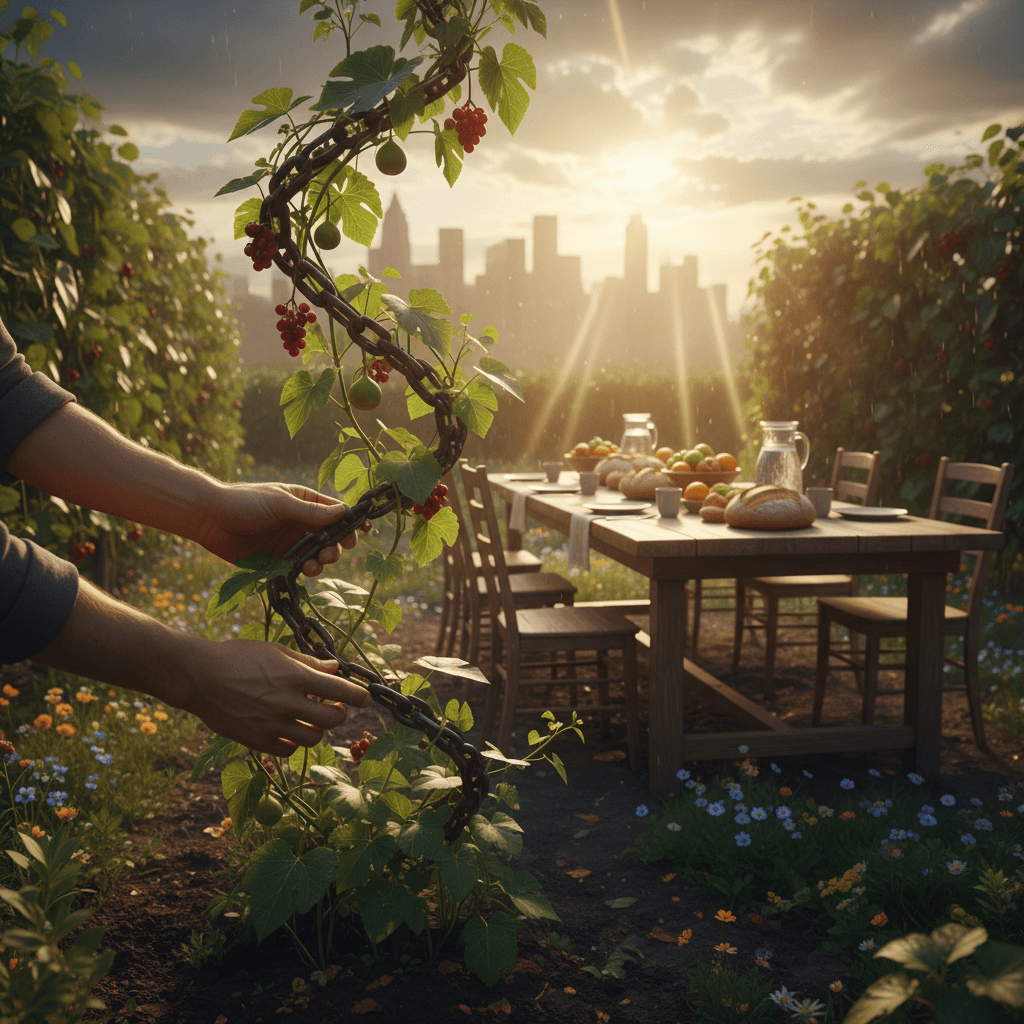
Make your resistance an instrument of beauty and a source of sustenance. — Audre Lorde
—What lingers after this line?
Resistance as Creative Power
Audre Lorde’s line reframes resistance from a purely defensive posture into an active, generative force. Rather than merely enduring or opposing injustice, she urges the transformation of struggle into something that can make meaning—an “instrument of beauty” that shapes the world instead of simply reacting to it. In this sense, resistance becomes a craft, requiring intention, skill, and a vision of what could be. From here, the quote invites a shift in mindset: if resistance can be made, played, and refined like an instrument, then it can produce more than noise. It can produce art, language, community practices, and new ways of living that outlast the moment of conflict.
Beauty as a Way of Telling Truth
Moving from power to expression, Lorde’s idea of beauty is not decorative—it is clarifying. Beauty can carry hard truths in forms people can feel and remember, whether through poetry, speech, song, or communal ritual. Lorde’s own essays and poems, such as those gathered in *Sister Outsider* (1984), exemplify how precise language can be both aesthetically striking and politically incisive. In that light, beauty becomes a strategy: it helps suffering and anger avoid being dismissed as incoherent. By giving resistance shape and resonance, beauty makes it communicable, sharable, and harder to erase.
Sustenance Beyond Survival
Yet Lorde doesn’t stop at expression; she insists resistance must also feed us. “Sustenance” suggests daily nourishment—emotional, spiritual, and practical—something that supports continued life and action over the long haul. This is resistance as a renewable resource rather than a one-time expenditure of energy. Consequently, the quote points toward practices that prevent burnout: rest, mutual care, and small rituals that restore dignity. Sustenance is what allows a person to remain fully human while confronting conditions designed to diminish them.
The Alchemy of Anger and Pain
Bridging beauty and sustenance is the difficult work of transforming intense feeling into constructive force. Lorde’s “The Uses of Anger” (keynote delivered 1981; published 1981) argues that anger, when focused and articulated, can become information and energy for change rather than a corrosive weight carried alone. Seen this way, resistance isn’t the denial of pain—it is the refusal to let pain be the final author of one’s life. The “instrument” metaphor implies practice: learning how to translate raw emotion into actions, words, and solidarities that create movement instead of collapse.
Community as the Amplifier
Resistance becomes more beautiful and more nourishing when it is not isolated. Transitioning from the inner to the collective, Lorde’s vision aligns with the idea that community can function like an amplifier: it increases reach, sustains morale, and turns individual insight into shared direction. Even small acts—sharing meals, organizing childcare, making space for testimony—can become part of the infrastructure of endurance. This communal dimension also protects beauty from becoming a private consolation. When resistance is made together, it can challenge systems while simultaneously building the relationships that make freedom livable.
A Daily Practice of Transfiguration
Finally, the quote reads as instruction for everyday life: make resistance not only loud, but crafted; not only urgent, but sustaining. That might mean writing a poem after a long shift, learning the history that clarifies your anger, or creating something—music, mutual aid, teaching—that nourishes others while strengthening your own spine. In the end, Lorde’s sentence offers a standard for durability. If resistance can be made beautiful, it becomes harder to extinguish; if it can provide sustenance, it becomes possible to keep going—until the world that demanded resistance is changed.
One-minute reflection
What does this quote ask you to notice today?
Related Quotes
6 selectedThe act of making is an act of defiance against a culture that demands everything be instant and disposable. — Ursula K. Le Guin
Ursula K. Le Guin
At its core, Ursula K. Le Guin’s statement reframes making—whether writing, building, sewing, painting, or planting—as more than simple production.
Read full interpretation →If the world asks for your struggle, give it your art — Octavio Paz
Octavio Paz
Octavio Paz’s line pivots on a subtle refusal: if society demands your “struggle,” you are not obligated to hand over raw suffering as proof of worth. Instead, he proposes a transformation—give “your art,” the shaped and...
Read full interpretation →Imagination is the only weapon in the war against reality. — Jules de Gaultier
Jules de Gaultier
This quote highlights the strength of imagination as a vital tool for coping with and challenging the harshness of reality. It portrays imagination as a creative force that allows individuals to envision alternatives to...
Read full interpretation →A drop of water is worth more than a sack of gold to a thirsty man. — Persian Proverb
Persian Proverb
This proverb illustrates that essential needs, such as water for survival, hold greater value than wealth when in dire circumstances. For someone who is thirsty, a drop of water becomes a priceless treasure.
Read full interpretation →Keep striking at the knot of injustice with steady, imaginative hands. — James Baldwin
James Baldwin
Baldwin’s metaphor invites us to picture injustice not as a single lock but as a tangled knot—interlaced threads of law, culture, economy, and memory. In The Fire Next Time (1963), he portrays racism as a web binding bot...
Read full interpretation →Craft hope into habit, and resilience will follow as habit's child. — Audre Lorde
Audre Lorde
Audre Lorde’s line reframes hope from a fleeting feeling into something you can craft—worked at with intention, repetition, and care. By calling it a habit, she implies that hope can be trained even when circumstances ar...
Read full interpretation →More From Author
More from Audre Lorde →We are powerful because we have survived, and that is what it is all about—survival and growth. — Audre Lorde
At its core, Audre Lorde’s statement redefines power not as domination, status, or control, but as the hard-won strength that comes from continuing despite adversity. To survive is already to have resisted erasure, and L...
Read full interpretation →Community does not mean that we all agree on everything. It means that we respect each other enough to stay in the room. — Audre Lorde
At its core, Audre Lorde’s statement challenges the comforting but shallow idea that community is built on sameness. Instead, she argues that real belonging depends on the willingness to remain present with one another e...
Read full interpretation →Caring for myself is not self-indulgence, it is self-preservation. — Audre Lorde
Audre Lorde’s line begins by dismantling a familiar accusation: that tending to oneself is frivolous or vain. By rejecting “self-indulgence,” she separates care from consumption, suggesting that rest, nourishment, and em...
Read full interpretation →Caring for myself is not self-indulgence, it is self-preservation. — Audre Lorde
Audre Lorde’s statement pivots on a crucial reframing: what many dismiss as “self-indulgence” can be, in reality, the basic work of staying alive and whole. By pairing “caring for myself” with “self-preservation,” she ch...
Read full interpretation →