
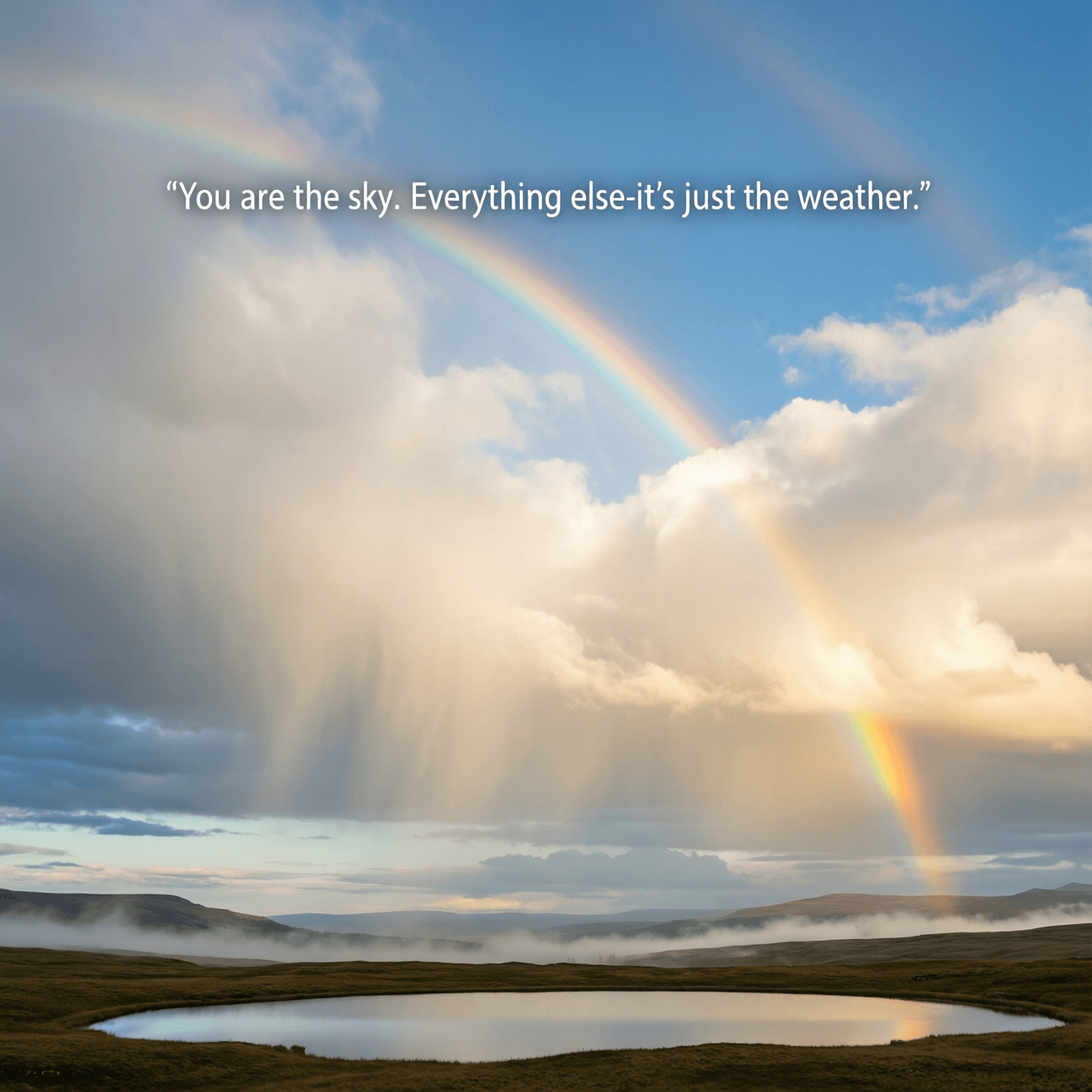
You are the sky. Everything else—it’s just the weather. — Pema Chödrön
—What lingers after this line?
A Metaphor for Inner Freedom
Pema Chödrön’s line begins with a deceptively simple image: the mind as vast sky and our experiences as passing weather. Rather than denying storms, it reframes them as temporary movements within something much larger. In that shift, suffering is no longer proof that something is wrong; it becomes a momentary condition that can be held without being owned. From this starting point, the quote offers a kind of inner freedom. If you are the sky, then fear, anger, and grief can appear without becoming your identity, just as thunder doesn’t redefine the sky itself.
Disentangling Identity from Emotion
Building on the metaphor, the core practice is disidentification: noticing an emotion without turning it into “me.” People often say “I am anxious,” as if anxiety were a fixed self, but the weather framing invites “Anxiety is here.” That small grammatical change can reduce the sense of permanence and personal failure. This matters because emotions are persuasive narrators. When sadness arrives, it can claim it has always been this way and will never end. Seeing it as weather interrupts that trance and makes room for a wider, steadier perspective.
Mindfulness as Watching the Weather Pass
Next comes the method: mindfulness trains attention to stay present with whatever arises, the way one might watch clouds move without chasing them. In Buddhist practice, this resembles observing thoughts and feelings as phenomena—events in awareness—rather than directives that must be obeyed. Chödrön’s teaching aligns with this broader tradition of cultivating a witness-like stability. Over time, the mind learns that sensations peak and subside on their own. Like a squall that seems endless until it suddenly breaks, emotions often change when met with patient, nonreactive attention.
Choosing Response Over Reaction
Once you recognize weather as weather, you can respond instead of react. A harsh email, a sudden conflict, or a spike of panic can feel like an emergency demanding immediate action; yet the “sky” stance creates a pause. In that pause, wiser options become visible—asking a clarifying question, taking a walk, or simply waiting. This doesn’t make life passive. Rather, it supports skillful action rooted in clarity. Just as a pilot respects the storm without becoming the storm, you can respect strong feelings while still steering your choices.
Compassion Through Spaciousness
Furthermore, identifying with the sky can soften how we treat ourselves and others. If everyone is experiencing their own weather—irritation, insecurity, grief—then a person’s harshness may be read less as a final judgment and more as a passing squall. That perspective can support compassion without excusing harm. Chödrön often emphasizes friendliness toward what is. When we stop declaring inner weather to be unacceptable, we become less likely to shame ourselves for having normal human reactions, which in turn makes it easier to repair and reconnect.
Practicing the Sky in Daily Life
Finally, the quote points to a daily discipline rather than a one-time insight. In practice, you might silently label what’s present—“worrying,” “planning,” “resentment”—and then return to breath or bodily sensation as an anchor. The goal isn’t perfect calm; it’s remembering the larger context in which calm and chaos both arise. With repetition, this remembrance becomes more accessible in difficult moments. The weather still changes, sometimes dramatically, but the lived sense of being the sky—spacious, stable, and inclusive—grows easier to return to.
One-minute reflection
What's one small action this suggests?
Related Quotes
6 selectedYou are the sky. Everything else—it's just the weather. — Pema Chödrön
Pema Chödrön
Pema Chödrön’s line hinges on a simple but expansive metaphor: awareness is the sky, while thoughts, emotions, and circumstances are weather. The sky is vast enough to hold anything without being permanently altered by i...
Read full interpretation →You are the sky. Everything else—it’s just the weather. — Pema Chödrön
Pema Chödrön
Pema Chödrön’s line offers a simple but radical reframe: who you are is not the passing content of experience, but the spacious awareness in which experience appears. If the mind is “the sky,” then thoughts, moods, and e...
Read full interpretation →You are the sky. Everything else—it’s just the weather. — Pema Chödrön
Pema Chödrön
Pema Chödrön’s line begins with a simple but radical reframing: what we most fundamentally are is not the swirl of thoughts and feelings, but the open awareness in which they appear. By calling you “the sky,” she points...
Read full interpretation →You are the sky. Everything else—it’s just the weather. — Pema Chödrön
Pema Chödrön
Pema Chödrön’s line draws a clean distinction between what we are and what we experience. If you are the sky, then thoughts, emotions, and external events are like weather systems—temporary patterns moving through a much...
Read full interpretation →You are the sky. Everything else—it’s just the weather. — Pema Chödrön
Pema Chödrön
Pema Chödrön’s line opens with an arresting reversal: you are not the shifting content of experience, but the vast capacity in which experience appears. By naming you “the sky,” she points to a stable, open awareness tha...
Read full interpretation →You are the sky. Everything else—it’s just the weather. — Pema Chödrön
Pema Chödrön
Pema Chödrön’s line begins with a simple reversal: instead of identifying with everything that happens inside you, she invites you to identify with the capacity that can hold it. The “sky” points to awareness itself—wide...
Read full interpretation →More From Author
More from Pema Chödrön →The real flex is not looking busy. It is having the audacity to enjoy silence without reaching for your phone. — Pema Chödrön
At first glance, the quote challenges a modern status symbol: busyness. In many workplaces and social circles, looking overloaded can seem like proof of importance.
Read full interpretation →When we resist change, it's called suffering. But when we can completely let go and not struggle against it, that's called enlightenment. — Pema Chödrön
Pema Chödrön’s quote begins with a stark insight: suffering often arises not simply from pain or loss, but from our refusal to accept that life is constantly shifting. We want relationships, identities, and circumstances...
Read full interpretation →You do not have to be fearless to be brave. You only need to be present enough to take the next deliberate action. — Pema Chödrön
At first glance, Pema Chödrön’s quote gently overturns a common misconception: that bravery belongs only to people untouched by fear. Instead, she presents courage as something far more accessible.
Read full interpretation →Stop seeking permission to prioritize your peace; your boundaries are the only line of defense you have. — Pema Chödrön
Pema Chödrön’s statement begins with a striking reversal: instead of waiting for others to approve our need for rest, distance, or refusal, we are asked to grant that permission to ourselves. In this sense, peace is not...
Read full interpretation →