
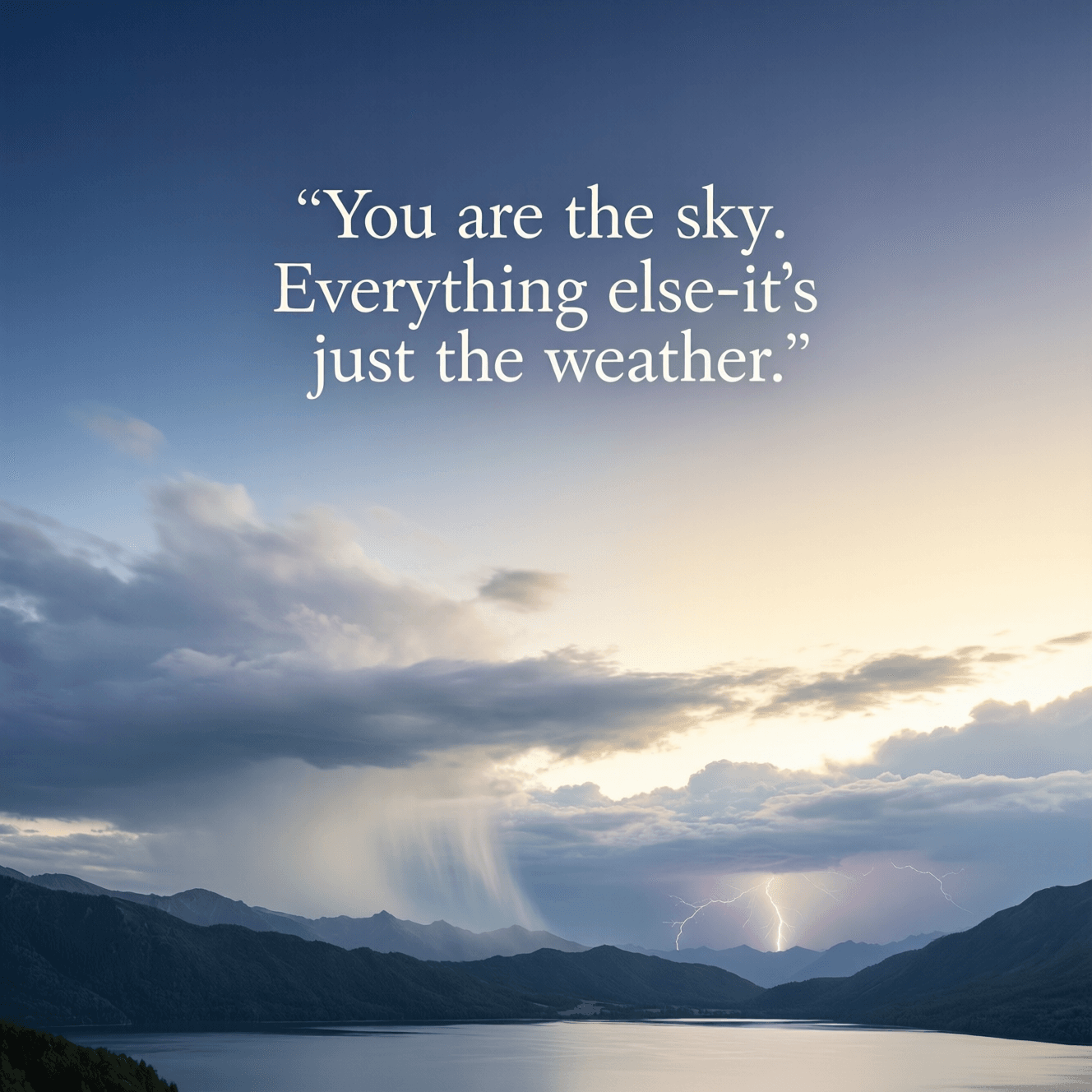
You are the sky. Everything else—it’s just the weather. — Pema Chödrön
—What lingers after this line?
The Metaphor That Reorients the Self
Pema Chödrön’s line offers a simple but radical reframe: who you are is not the passing content of experience, but the spacious awareness in which experience appears. If the mind is “the sky,” then thoughts, moods, and events are merely “weather”—noticeable, sometimes intense, yet not definitive of the whole. From this starting point, the quote gently shifts identity away from what fluctuates toward what can hold fluctuation. The point is not to deny pain or joy, but to stop treating them as the final verdict on who you are.
Weather as Thoughts, Feelings, and Circumstances
Once the metaphor lands, “weather” becomes an everyday inventory: anxiety before a meeting, irritation in traffic, a burst of confidence, a disappointing message. These inner and outer conditions roll through like storms and sunbreaks, and their impermanence is part of their nature. In Buddhist teaching, this aligns with the observation of constant change (anicca). Rather than making a permanent home in any one mental state, the quote encourages recognizing each state as a temporary pattern—real, felt, and yet not fixed.
Sky as Awareness and Basic Spaciousness
If weather is content, then sky is context: the open capacity to know what is happening without being reduced to it. This resembles the Buddhist emphasis on mindful awareness—seeing thoughts as thoughts and emotions as emotions, instead of collapsing into them as identity. As a transition from theory to experience, consider a moment of anger: the “weather” says, “This is unbearable.” The “sky” notices, “Anger is here.” That small shift creates room for choice, which is often the beginning of freedom.
Non-Attachment Without Numbing Out
At this point, the metaphor can be misunderstood as emotional detachment, but Chödrön’s teaching typically aims at a warmer kind of non-attachment: allowing experience without clinging or aversion. The sky does not suppress storms; it permits them to pass. This matters because suppression is still a form of fixation—another kind of weather pattern. In contrast, staying as the sky supports full human feeling while loosening the reflex to dramatize, deny, or outsource responsibility for our inner life.
A Practical Way to Work With Difficult Moments
Bringing the quote into daily practice can be as simple as pausing and labeling: “worry is here,” “grief is here,” “restlessness is here.” Then, instead of asking how to eliminate the feeling immediately, you ask what it is like to make space for it for one more breath. Over time, this builds trust in the sky-like quality of mind—an ability to remain present even when conditions are messy. The weather may not cooperate, but you can still relate to it without being pushed around by every forecast.
What Changes When Identity Stops Chasing Weather
Finally, the quote points to a steadier form of confidence: not the confidence of always feeling good, but the confidence of knowing you can meet whatever arises. When identity is fused with weather, life becomes a constant negotiation with mood and circumstance. When identity is rooted in sky, you still care, act, and make decisions—yet with less panic and less self-blame. In that sense, Chödrön’s image is both compassionate and pragmatic: it doesn’t promise perfect weather, only a wider place to live from.
One-minute reflection
Where does this idea show up in your life right now?
Related Quotes
6 selectedYou are the sky. Everything else—it's just the weather. — Pema Chödrön
Pema Chödrön
Pema Chödrön’s line hinges on a simple but expansive metaphor: awareness is the sky, while thoughts, emotions, and circumstances are weather. The sky is vast enough to hold anything without being permanently altered by i...
Read full interpretation →You are the sky. Everything else—it’s just the weather. — Pema Chödrön
Pema Chödrön
Pema Chödrön’s line begins with a simple but radical reframing: what we most fundamentally are is not the swirl of thoughts and feelings, but the open awareness in which they appear. By calling you “the sky,” she points...
Read full interpretation →You are the sky. Everything else—it’s just the weather. — Pema Chödrön
Pema Chödrön
Pema Chödrön’s line draws a clean distinction between what we are and what we experience. If you are the sky, then thoughts, emotions, and external events are like weather systems—temporary patterns moving through a much...
Read full interpretation →You are the sky. Everything else—it’s just the weather. — Pema Chödrön
Pema Chödrön
Pema Chödrön’s line opens with an arresting reversal: you are not the shifting content of experience, but the vast capacity in which experience appears. By naming you “the sky,” she points to a stable, open awareness tha...
Read full interpretation →You are the sky. Everything else—it’s just the weather. — Pema Chödrön
Pema Chödrön
Pema Chödrön’s line begins with a simple reversal: instead of identifying with everything that happens inside you, she invites you to identify with the capacity that can hold it. The “sky” points to awareness itself—wide...
Read full interpretation →You are the sky. Everything else is just the weather. — Pema Chödrön
Pema Chödrön
Pema Chödrön’s line begins with a simple reversal of identity: instead of defining yourself by what passes through you, you identify with what can hold it all. The “sky” represents the open, steady awareness that remains...
Read full interpretation →More From Author
More from Pema Chödrön →The only way to move forward is to stop pretending that the past is still happening. — Pema Chödrön
Pema Chödrön’s line begins with a gentle but piercing insight: suffering often persists not only because something painful happened, but because part of us keeps reliving it as if it were still unfolding. In that sense,...
Read full interpretation →The best parts of your life are the ones that happen when absolutely no one is looking. — Pema Chödrön
Pema Chödrön’s quote turns attention away from applause and toward the private texture of living. At first glance, it suggests that life’s richest moments are not always the dramatic ones shared with an audience, but the...
Read full interpretation →Learning is not a sprint toward an end goal; it is a life-long rhythm of shedding what no longer serves you to make room for what does. — Pema Chödrön
At first glance, Pema Chödrön’s reflection challenges one of the most common assumptions about education: that learning is a race with a clear endpoint. Degrees, promotions, and certifications often tempt us to think of...
Read full interpretation →The truth is rarely comfortable, but it is the only thing that will actually set you free. Stop hiding from your reality and start owning your choices. — Pema Chödrön
At its core, Pema Chödrön’s statement argues that freedom does not come from denial, distraction, or carefully managed appearances. Instead, it begins with the willingness to confront what is real, even when that reality...
Read full interpretation →