
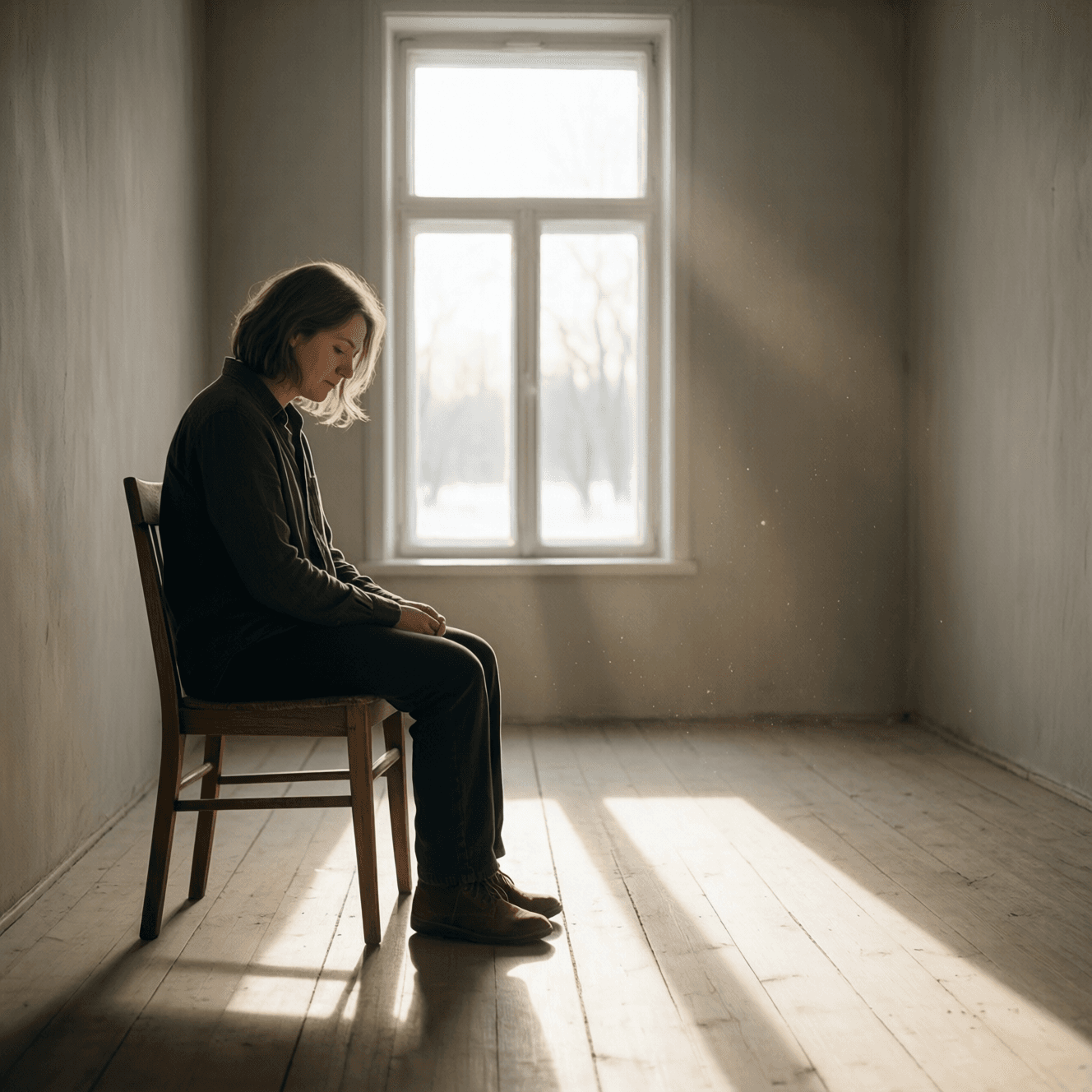
All of humanity's problems stem from man's inability to sit quietly in a room alone. — Blaise Pascal
—What lingers after this line?
Pascal’s Provocative Diagnosis
Pascal’s line compresses an entire moral psychology into a single image: one person, one room, and the unnerving demand to be alone with oneself. Rather than blaming politics, fate, or scarcity first, he points to an inner incapacity—restlessness—as the hidden engine behind many outward disasters. In this framing, the inability to “sit quietly” is not a quaint weakness but a root condition that spills into families, institutions, and nations. From there, the quote invites a reversal of the usual story: instead of viewing distraction as a harmless escape from problems, Pascal suggests it is often the birthplace of them. What looks like harmless busyness may be the very mechanism by which we avoid reflection, responsibility, and change.
Diversion as a Flight From the Self
In Pascal’s *Pensées* (published posthumously in 1670), he famously describes “divertissement”—diversion—as the human strategy for outrunning misery, boredom, and thoughts of mortality. Sitting alone in silence removes the usual buffers, so the mind confronts uncomfortable questions: What am I doing with my life? What have I avoided? What will I lose? The room becomes a mirror. Consequently, people seek motion—games, gossip, ambition, conflict—anything that keeps the inner monologue from growing too loud. Pascal’s point is not that activity is wrong, but that compulsive activity can be a sophisticated form of avoidance, and avoidance rarely stays private; it leaks into how we treat others.
How Inner Noise Turns Into Outer Conflict
Once distraction becomes a need rather than a choice, it can recruit ever-larger stages. Personal unease may be soothed by status-seeking, rivalries, or the thrill of being “against” something, because conflict is noisy and noise feels like relief. Pascal implies that many social dramas are not purely ideological but also psychological: people externalize internal discomfort, then call it destiny or principle. This helps explain why arguments can escalate beyond their apparent stakes. When the real threat is silence—being alone with doubt or regret—then winning, dominating, or staying perpetually engaged becomes a way to avoid the room. The more we fear solitude, the more we may manufacture emergencies to escape it.
Boredom, Meaning, and the Search for Stimulation
Modern research gives Pascal’s intuition contemporary language. Studies on boredom and self-control suggest that when people experience understimulation, they often seek novelty and intensity, sometimes at the cost of long-term goals; for example, Roy Baumeister’s work on self-regulation (1990s) links depleted self-control to impulsive choices. Silence can feel like deprivation to a mind trained on constant input, and deprivation can prompt reckless substitution. As a result, “not sitting quietly” becomes more than impatience—it becomes a pattern of trading meaning for stimulation. If the mind can’t tolerate a low-noise moment, it may chase high-noise experiences, and those pursuits can damage health, relationships, and civic life.
Solitude as a Moral and Spiritual Skill
Pascal’s world was deeply shaped by Christian thought, where solitude and contemplation were seen as disciplines that clarify desire and conscience. This theme echoes older traditions as well: Marcus Aurelius’ *Meditations* (c. 170–180 AD) repeatedly returns to the idea that peace depends less on changing circumstances than on governing the inner life. The “quiet room” becomes a training ground for honesty. Seen this way, solitude is not isolation but a capacity: the ability to be present without running. It allows self-examination before action, which in turn makes action less reactive. Where diversion scatters attention, solitude gathers it, and gathered attention is where responsibility can actually take root.
A Practical Reading for the Present
Applied today, Pascal’s claim lands on ordinary habits: constant scrolling, perpetual background noise, and the reflex to fill every pause. These behaviors may seem trivial, yet they can prevent the slow processes that mature judgment—grief, reflection, reconciliation, and planning. If we cannot endure even brief quiet, we may outsource our inner life to trends, outrage cycles, or endless entertainment. So the quote ultimately offers a remedy hidden inside the criticism: learn to sit quietly. Not to withdraw from the world, but to enter it less compulsively. When a person can tolerate the room—silence, self-awareness, and limits—many downstream problems lose their fuel, because fewer decisions are made as escapes.
One-minute reflection
What does this quote ask you to notice today?
Related Quotes
6 selectedIf you want to be happy, learn to be alone without being lonely. Learn that being alone does not mean being unhappy. — Michael Josephson
Michael Josephson
Michael Josephson’s remark turns on a subtle but life-changing distinction: being alone is a circumstance, while being lonely is an emotional interpretation of that circumstance. In other words, solitude does not automat...
Read full interpretation →You do not need to leave your room. Remain sitting at your table and listen. Do not even listen, simply wait, be quiet, still and solitary. The world will freely offer itself to you to be unmasked. — Franz Kafka
Franz Kafka
Kafka begins with a striking command: do not chase the world, but remain in place. At first, this seems to reject ordinary habits of ambition and movement, yet that reversal is precisely his point.
Read full interpretation →Solitude is the place of purification. — Martin Buber
Martin Buber
At first glance, Martin Buber’s statement presents solitude not as emptiness, but as a refining space. By calling it “the place of purification,” he suggests that stepping away from noise, social performance, and distrac...
Read full interpretation →In a world bustling with voices, the solitude of one's own company becomes a sanctuary. — Jonathan Harnisch
Jonathan Harnisch
At its core, Jonathan Harnisch’s quote sets up a vivid contrast: the world is crowded with voices, demands, and distractions, while solitude offers a place of quiet restoration. Rather than depicting aloneness as emptine...
Read full interpretation →Being alone at home is like having a sanctuary for your soul, where you can recharge, reflect, and rediscover the beauty of your own company. — Melody Beattie
Melody Beattie
At its core, Melody Beattie’s quote transforms the ordinary idea of being alone at home into something sacred. Rather than framing solitude as emptiness, she presents it as a sanctuary—a place where the self is protected...
Read full interpretation →Everyone needs a place to retreat; a spot where the world grows quiet enough for the soul to speak. — Angie Wyland Crosby
Angie Wyland Crosby
At its core, Angie Wyland Crosby’s reflection suggests that retreat is not escapism but renewal. A private place—whether physical or emotional—offers relief from noise, pressure, and constant demands.
Read full interpretation →More From Author
More from Blaise Pascal →Let us strive to improve ourselves, for we cannot Blaise Pascal. — Blaise Pascal
This quote encourages individuals to actively seek self-improvement. It emphasizes the idea that continual personal growth is essential for a fulfilling life and should be a primary focus.
Read full interpretation →The heart has its reasons which reason knows not. — Blaise Pascal
This quote highlights the distinction between emotions and logic, suggesting that the heart operates on emotional instincts that cannot always be explained rationally.
Read full interpretation →Kind words do not cost much. Yet they accomplish much. — Blaise Pascal
This quote highlights that kindness, especially through words, is valuable and impactful, even though it requires little effort or expense.
Read full interpretation →Man’s greatness lies in his power of thought. — Blaise Pascal
Blaise Pascal, renowned mathematician and philosopher, distilled humanity’s unique worth into its capacity for thought. When he observes, 'Man’s greatness lies in his power of thought,' he isn’t merely highlighting intel...
Read full interpretation →