
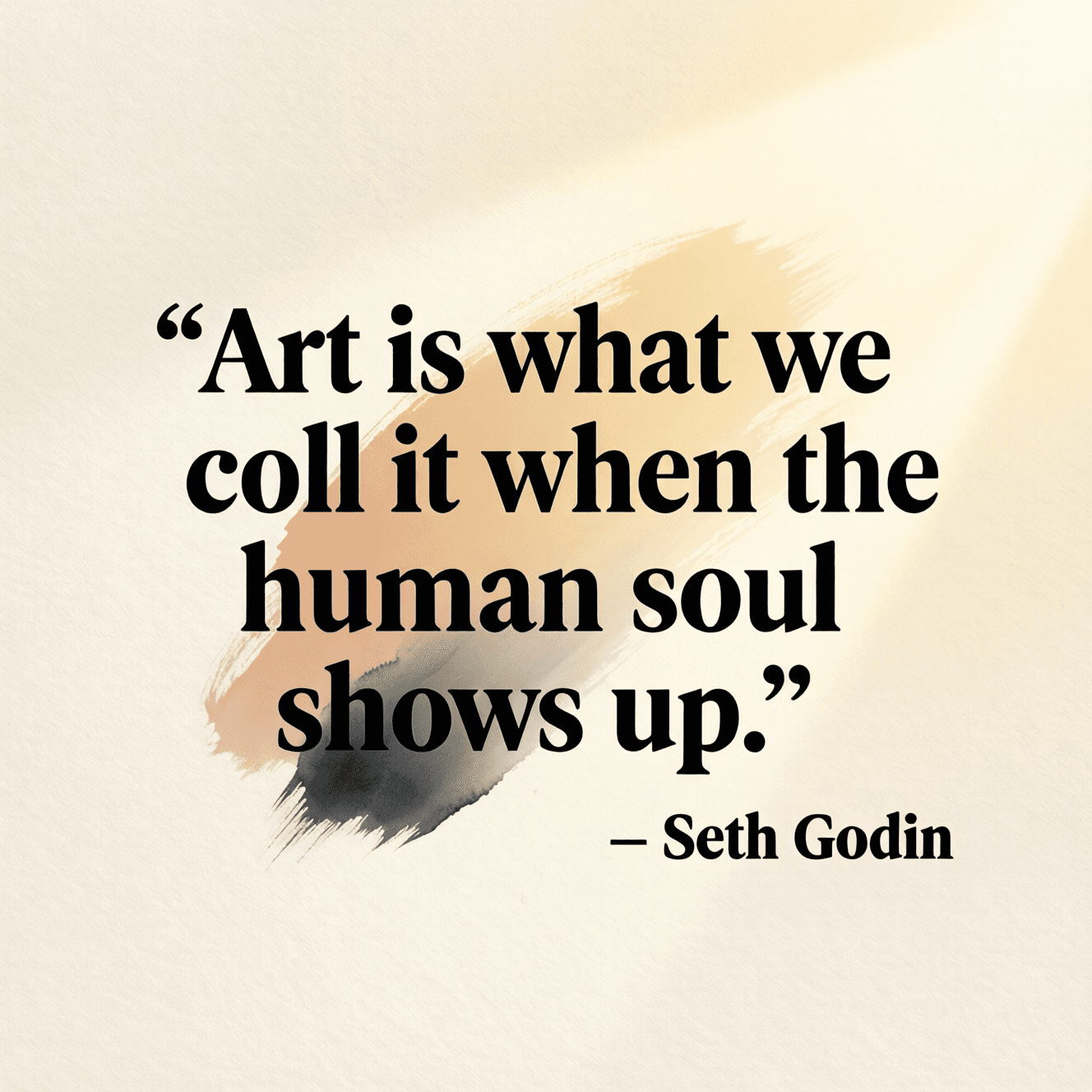
Art is what we call it when the human soul shows up. — Seth Godin
—What lingers after this line?
Art as Presence, Not Just Product
Seth Godin’s line reframes art as a moment of arrival: art happens when something distinctly human becomes visible through what we make. In this view, technique and output matter, but they are secondary to presence—the feeling that a person, with a point of view and a set of stakes, is actually in the work. From there, the quote subtly challenges the common assumption that art is defined by category (painting, music, writing) or by status (museum-worthy, award-winning). Instead, it defines art by an encounter: the audience senses a living interiority behind the surface.
The “Soul” as Voice and Vulnerability
To say “the human soul shows up” doesn’t require a religious reading; it can mean voice, sincerity, and vulnerability. The soul shows up when a creator risks being seen—when choices reveal values, longing, humor, grief, or wonder rather than hiding behind safe imitation. This is why two works with similar skill can feel radically different: one feels manufactured, the other inhabited. As the transition suggests, Godin is pointing to an emotional signature—the unmistakable trace of a maker who is not merely executing but expressing.
Why Imperfection Can Feel More Alive
Once art is understood as presence, imperfection becomes less of a flaw and more of a clue. A cracked note, a rough brushstroke, or an unpolished sentence can signal that a real person made a real choice, in real time, rather than optimizing for uniform smoothness. This is the logic behind practices like kintsugi, the Japanese tradition of repairing pottery with gold, where breakage is not erased but integrated into meaning. In the same way, art often gains power when it carries the texture of human limitation—effort, uncertainty, and the courage to continue anyway.
Connection: The Audience Recognizes a Person
With the soul present, art becomes relational. The viewer or listener isn’t only consuming an object; they are sensing another consciousness. Even across centuries, a diary entry, a song lyric, or a portrait can feel like a direct address—evidence that someone else once stood where we stand now. This helps explain why art can be consoling: it reduces isolation. A single honest line in a poem can function like a small bridge between inner worlds, because it carries the implication, “I felt this too,” and invites the audience to respond with their own inner life.
Creativity Beyond Credentials and Gatekeepers
Godin’s framing also democratizes art. If art is what we call it when the human soul shows up, then art is not limited to those with formal training or institutional permission. A carefully written apology, a handmade gift, a home-cooked meal shaped by memory—each can become art when it expresses a human depth rather than mere function. That shift matters because it relocates authority from gatekeepers to intention and resonance. The question becomes less “Does this qualify?” and more “Did someone show up honestly here, and can another person feel it?”
A Practical Invitation to Make Braver Work
Finally, the quote reads like a creative directive: show up. Instead of aiming first for perfection or applause, it suggests starting with attention and truth—making choices that reveal what you actually care about. In that sense, art is less a special talent than a practice of presence. The next step is simple but demanding: remove one layer of camouflage. Say the truer sentence, choose the bolder color, keep the odd detail that feels personal. When the maker’s inner life is allowed into the work, the work stops being only a thing—and becomes an encounter.
One-minute reflection
What feeling does this quote bring up for you?
Related Quotes
6 selectedPaint your days with fearless colors. — Yoko Ono
Yoko Ono
Yoko Ono’s line reads like a simple instruction, yet it carries an expansive challenge: treat your daily life as a canvas and yourself as the painter. Rather than waiting for rare, dramatic moments to feel alive, it asks...
Read full interpretation →Step into the studio of life and sculpt meaning from motion — Pablo Picasso
Pablo Picasso
Picasso’s line begins by relocating creativity from the gallery into daily experience: life itself becomes the studio. In that space, nothing is fully finished or perfectly arranged; instead, each moment arrives like raw...
Read full interpretation →If the world asks for your struggle, give it your art — Octavio Paz
Octavio Paz
Octavio Paz’s line pivots on a subtle refusal: if society demands your “struggle,” you are not obligated to hand over raw suffering as proof of worth. Instead, he proposes a transformation—give “your art,” the shaped and...
Read full interpretation →Begin the poem of your life with one bold line, then write without fear. — Emily Dickinson
Emily Dickinson
Emily Dickinson’s line treats a human life as something authored rather than merely endured. By calling it “the poem of your life,” she implies that identity is shaped through choices, patterns, and revisions—much like s...
Read full interpretation →Sing even if the stage trembles beneath you — Sappho
Sappho
Sappho’s injunction to “sing even if the stage trembles beneath you” distills a timeless call to courage. The stage stands in for any exposed place in life—a classroom, a protest line, a hospital corridor—where your voic...
Read full interpretation →Sing the bold line, then live it; beauty loves the brave. — Sappho
Sappho
Read as a compact manifesto, the line urges sequence and integrity: first voice the brave truth, then embody it. The second clause clinches the wager—beauty, here, is not passive ornament but an active responder that “lo...
Read full interpretation →More From Author
More from Seth Godin →Connection is not a warm-fuzzy. It's a strategic tool that helps you connect and engage with others. Empathy is essential for understanding why people care. — Seth Godin
At first glance, Seth Godin challenges the common idea that connection is merely a soft, sentimental feeling. By calling it “not a warm-fuzzy,” he reframes connection as something more deliberate: a practical way to reac...
Read full interpretation →Art is the act of navigating without a map. — Seth Godin
At its core, Seth Godin’s line defines art not as technical polish but as a willingness to move forward without guaranteed direction. To create without a map is to accept uncertainty as part of the process, trusting intu...
Read full interpretation →The rest of the world isn't nearly as important as the few who are here. — Seth Godin
At first glance, Seth Godin’s line challenges a deeply ingrained assumption: that importance is measured by scale. Instead of chasing the approval of ‘the rest of the world,’ he redirects attention to the people who are...
Read full interpretation →You don't have enough time to be both unhappy and mediocre. It's not just pointless, it's painful. — Seth Godin
Seth Godin’s line compresses a hard truth: carrying both unhappiness and mediocrity is an expensive way to live. Mediocrity already implies a quieter life—less agency, fewer risks, and smaller rewards—yet unhappiness add...
Read full interpretation →