
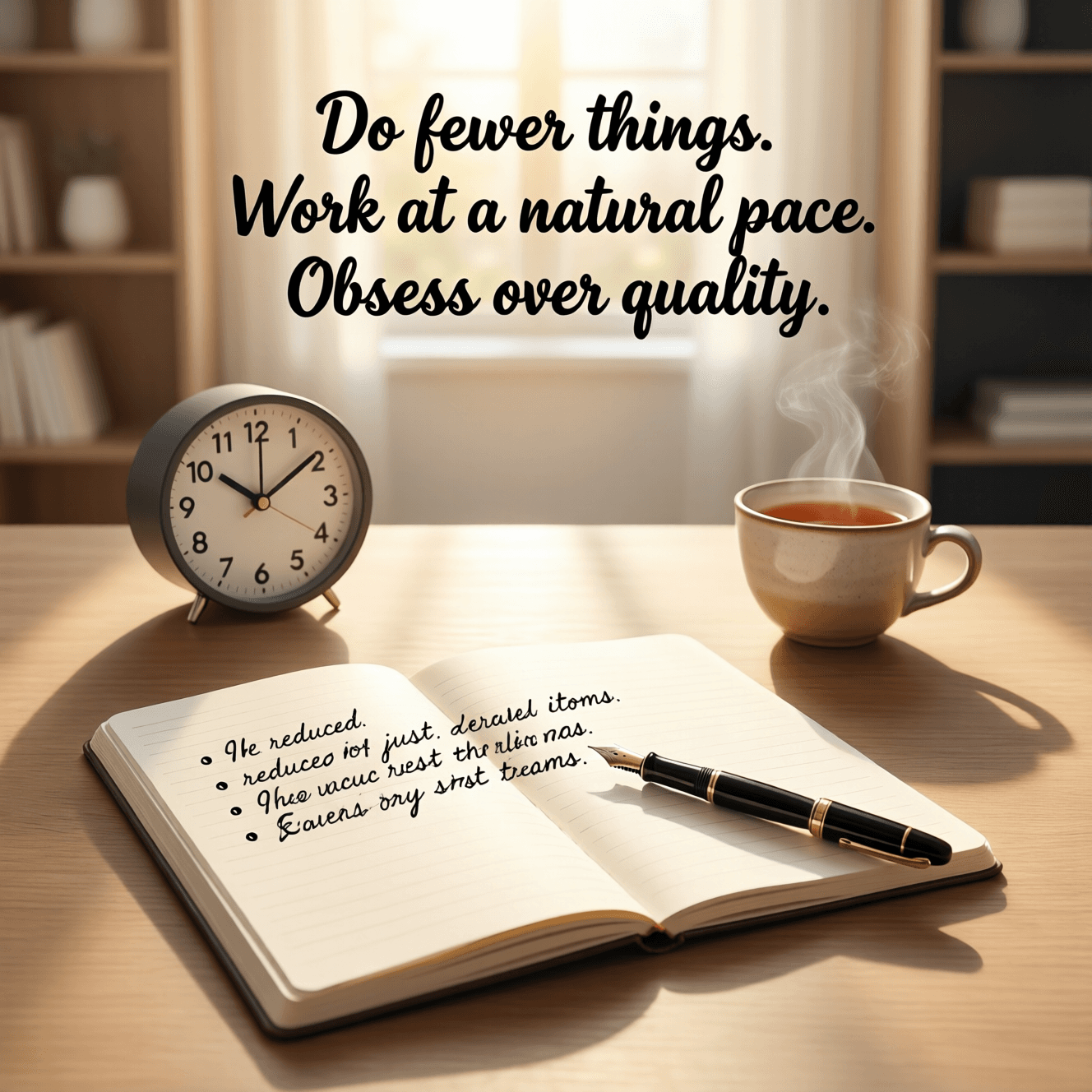
Do fewer things. Work at a natural pace. Obsess over quality. — Cal Newport
—What lingers after this line?
A Countercultural Productivity Rule
Cal Newport’s line reads like a quiet rebellion against modern busyness: instead of doing more, do fewer things—and do them better. Implicitly, it challenges the default assumption that a full calendar signals ambition or effectiveness. Rather than celebrating frantic motion, Newport points toward a different metric: the depth and durability of what you produce. This shift matters because most knowledge work is now measured in visible activity—messages answered, tasks checked off, meetings attended—while the real value often comes from less visible concentration. From the outset, the quote asks you to trade performative productivity for meaningful output.
Fewer Commitments, Clearer Priorities
Doing fewer things is not laziness; it is selection. When you reduce your active projects, you stop spreading attention so thin that everything becomes mediocre. In practice, this often means saying no more often, shrinking scope, or choosing one primary goal for a season rather than five competing ones. Once the list is shorter, priorities become legible. You can see what deserves your best energy and what merely creates noise. As a result, your time starts aligning with your values instead of with whoever is loudest in your inbox.
The Power of a Natural Pace
Working at a natural pace suggests sustainable effort rather than sprinting from urgency to urgency. Newport’s phrasing implies respecting human limits: concentration, creativity, and judgment degrade when you force speed that your mind cannot maintain. Over time, constant rushing can also teach you to fear slower moments—the very moments in which thinking matures. By contrast, a natural pace creates room for iteration. You draft, test, reflect, and refine, which is how complex work—writing, designing, engineering, studying—actually improves. This pacing isn’t about moving slowly; it’s about moving steadily enough to stay sharp.
Quality as a Daily Practice
“Obsess over quality” reframes excellence as something you return to repeatedly, not a lucky outcome. It suggests standards: checking assumptions, revising drafts, cleaning up details, and refusing to ship work you know is flimsy. Importantly, quality obsession is most effective when paired with fewer commitments; otherwise, it collapses into perfectionism without time. Seen this way, quality is not an add-on at the end—it becomes the organizing principle of the process. Each step is done with care because you’ve protected enough attention to do it well.
Depth Over Velocity in Knowledge Work
Taken together, the three sentences describe a philosophy of depth: reduce what competes for attention, proceed in a sustainable rhythm, and use the freed capacity to produce something excellent. This aligns with Newport’s broader argument in Deep Work (2016) that focused, cognitively demanding effort is increasingly valuable and increasingly rare. The quote’s internal logic is simple: fewer things create space; a natural pace preserves stamina; obsession with quality converts that space and stamina into results that last. The outcome isn’t just better work—it’s a calmer life that doesn’t require constant emergency to feel productive.
One-minute reflection
Where does this idea show up in your life right now?
Related Quotes
6 selectedThe task of a craftsman is not to generate meaning, but rather to cultivate in himself the skill of discerning the meanings that are already there. — Cal Newport
Cal Newport
At its core, Cal Newport’s quote overturns a popular modern assumption: that fulfillment is something we simply fabricate through self-expression alone. Instead, he argues that meaning already exists in the structure of...
Read full interpretation →In the end, you win through superior craftsmanship, not marketing. — Robert Greene
Robert Greene
Robert Greene’s statement cuts through the glamour of promotion by placing true advantage in the work itself. Marketing may attract attention, but craftsmanship earns trust, loyalty, and endurance.
Read full interpretation →The beauty of a finely worked object points to the beauty of the craftsmanship. — Paul Klee
Paul Klee
Paul Klee’s statement begins with a simple but powerful observation: a beautiful object does not merely please the eye; it points beyond itself to the intelligence, patience, and skill that shaped it. The object becomes...
Read full interpretation →Quality, manual labor, and a lot of time: that is the essence of craftsmanship. — Katarzyna Maniak
Katarzyna Maniak
At its core, Katarzyna Maniak’s statement reduces craftsmanship to three inseparable elements: quality, manual labor, and time. Rather than treating a finished object as merely a product, the quote frames it as the visib...
Read full interpretation →I would almost prefer the word 'craftsman'. He is like one of those old-fashioned ship builders who conceived the build of the boat in their mind and after that touched every single piece. — William Golding
William Golding
At first glance, Golding’s preference for the word “craftsman” shifts attention away from the romantic image of effortless genius and toward disciplined making. The term suggests someone who does not merely imagine a wor...
Read full interpretation →The object with visible human error, with a maker behind it, with time baked into its surface, is the luxury of the AI age. — Venkatesh Rao
Venkatesh Rao
At first glance, Venkatesh Rao’s line reframes luxury in a striking way: instead of rarity defined by price or exclusivity, he points to objects that visibly carry human touch. In an age when AI can generate flawless tex...
Read full interpretation →More From Author
More from Cal Newport →The greatest luxury in a modern world is not things, but the ability to disconnect and reclaim your own attention. — Cal Newport
At first glance, Newport’s statement overturns the traditional idea of luxury as something material. Instead of wealth being measured by rare objects, he suggests it is now measured by the freedom to step away from noise...
Read full interpretation →Technology should empower us, not overwhelm us. Digital wellness is about reclaiming control over our attention and time. — Cal Newport
At its core, Cal Newport’s statement draws a clear boundary between empowerment and domination. Technology, he suggests, fulfills its promise only when it serves human aims rather than dictating them.
Read full interpretation →We are not defined by the speed of our output, but by the depth of our attention. — Cal Newport
At first glance, Cal Newport’s line challenges one of modern life’s favorite assumptions: that worth is proven through visible speed. In many workplaces and social spaces, quick replies, rapid delivery, and constant acti...
Read full interpretation →The task of a craftsman is not to generate meaning, but rather to cultivate in himself the skill of discerning the meanings that are already there. — Cal Newport
At its core, Cal Newport’s quote overturns a popular modern assumption: that fulfillment is something we simply fabricate through self-expression alone. Instead, he argues that meaning already exists in the structure of...
Read full interpretation →