
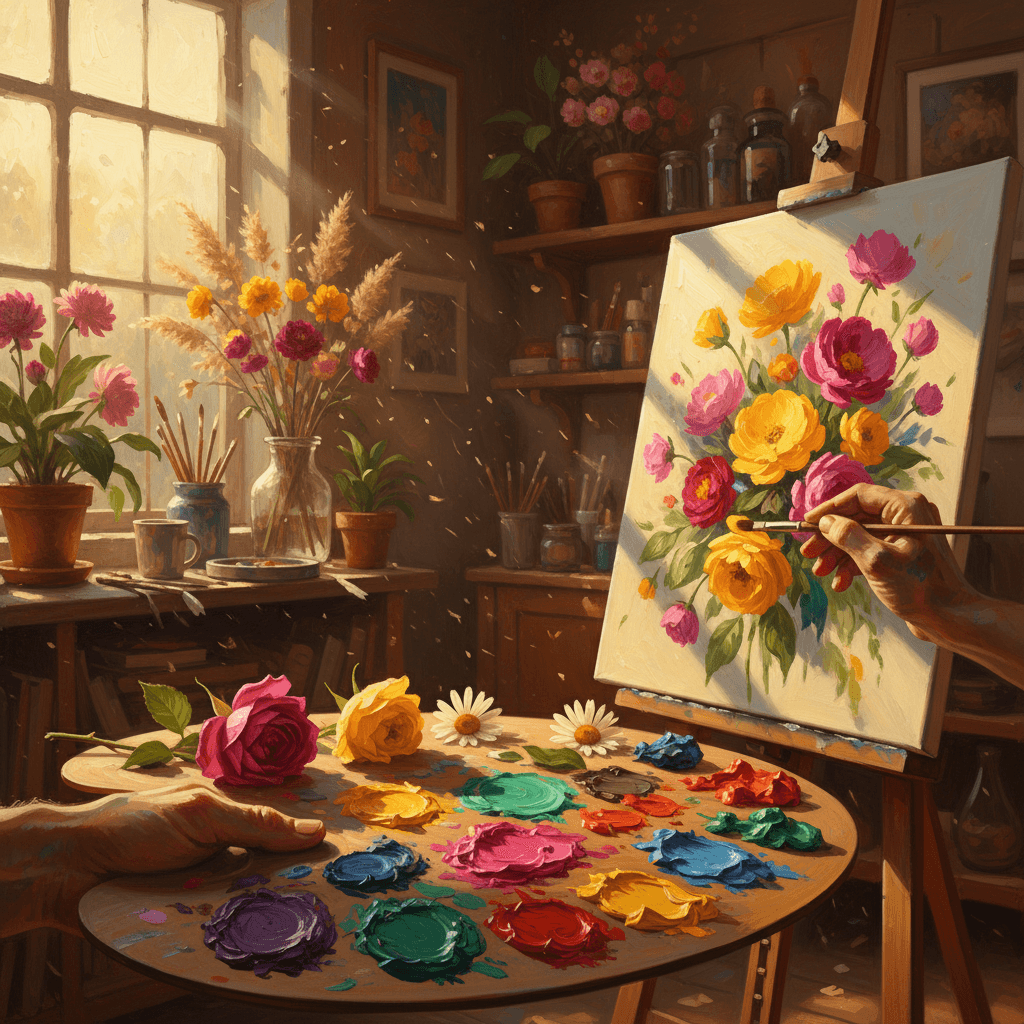
I paint flowers so they will not die. — Frida Kahlo
—What lingers after this line?
A Quiet Defiance of Death
Frida Kahlo’s line reads like a gentle spell: by painting flowers, she resists the most ordinary tragedy—things fading despite our care. A bouquet wilts, a season ends, a beloved moment slips away; the canvas, however, offers a different contract with time. In that sense, the quote is less about botany than about refusal: art becomes a place where what is fragile can be kept from vanishing. This defiance is not loud or heroic, and that is precisely its power. Instead of fighting death head-on, Kahlo sidesteps it, preserving beauty through attention and labor, as if the act of looking closely enough could grant an afterlife.
Still Life as an Archive of the Living
Building on that impulse, flower painting sits within a long tradition of still life that turns perishable objects into records. Dutch vanitas paintings of the 17th century often paired blossoms with symbols of time—skulls, hourglasses, bruised fruit—reminding viewers that life is brief even as the painting itself endures. Kahlo’s sentence echoes that logic, but with a shift in emphasis: rather than moralizing about decay, she foregrounds preservation. The still life, then, becomes an archive—not of facts, but of felt experience. A painted flower can store the memory of color, scent, and season, allowing the viewer to revisit what the world would otherwise reclaim.
Kahlo’s Intimacy with Pain and Permanence
From there, the quote gains additional weight when read against Kahlo’s biography, in which the body’s fragility is never abstract. After the 1925 bus accident and years of medical complications, her work repeatedly negotiates injury, endurance, and the limits of flesh. If the body cannot be made permanent, the image can at least testify, holding what hurts and what blooms in the same frame. Flowers in this context are not merely decorative; they become counterpoints to suffering—proof that vitality exists even near pain. Painting them “so they will not die” suggests a personal economy of survival: what life threatens to take, art returns as image.
Nature’s Ephemeral Beauty and Human Longing
Yet the statement also speaks to a universal longing: we love what changes, and that love creates anxiety. A flower’s beauty is inseparable from its short life, which is why it feels precious; but that same brevity provokes the wish to hold it still. Kahlo articulates the human paradox of desire—wanting the world to remain itself while also fearing its inevitable transformations. In response, painting becomes a technology of time. It does not stop nature’s cycles, but it allows one moment of nature to be revisited, as if the artist could say: it died in the garden, but not in my seeing.
Art as Preservation Rather Than Possession
Crucially, Kahlo’s approach implies preservation without ownership. To paint a flower is not to keep it in a vase until it browns; it is to translate it into another medium where it can persist without being physically trapped. In that translation, the flower becomes both more and less than the original—less in scent and texture, more in endurance and meaning. This helps the quote avoid sentimentality: she is not pretending the painting is the same as the living bloom. Instead, she frames art as a compassionate substitute, a way to honor what cannot be held and still refuse to forget it.
How Images Grant a Second Life
Finally, the line points to what viewers contribute: a painted flower stays alive each time it is seen anew. The canvas survives, but the “not dying” depends on attention—on someone entering the image and letting it matter again. In that sense, Kahlo’s statement is also about relationship: between artist and subject, between artwork and audience, between memory and the present moment. What begins as a simple claim about painting concludes as a philosophy of tenderness. If mortality is unavoidable, Kahlo suggests, we can still practice care by making—and remaking—what we love in forms that endure.
One-minute reflection
Where does this idea show up in your life right now?
Related Quotes
6 selectedAt the end of the day, we can endure much more than we think we can. - Frida Kahlo
Frida Kahlo
This quote highlights the incredible resilience and strength inherent in each person. It suggests that individuals have the capacity to withstand and overcome challenges that they may initially perceive as insurmountable...
Read full interpretation →Paint a future with the colors of your persistent hope. — Frida Kahlo
Frida Kahlo
This line treats the future as a blank canvas and hope as pigment—suggesting that outcomes are not merely awaited but mixed, layered, and applied. The modifier “persistent” evokes glazing in painting: thin coats built up...
Read full interpretation →Chisel patience into your craft; masterpieces are often patient accidents. — Frida Kahlo
Frida Kahlo
Kahlo’s line marries the sculptor’s verb—chisel—with an ethic: patience must be worked into the grain of our methods, not merely tacked on at the end. The image suggests that time itself is a medium; each careful stroke...
Read full interpretation →I tried to drown my sorrows, but the bastards learned how to swim. — Frida Kahlo
Frida Kahlo
Frida Kahlo’s line opens with the familiar promise of escape—“I tried to drown my sorrows”—and then snaps into a punchline that refuses sentimentality. The sudden insult, “the bastards,” is more than comic shock; it’s a...
Read full interpretation →I used to think I was the strangest person in the world, but there must be someone just like me who feels bizarre and flawed. — Frida Kahlo
Frida Kahlo
Frida Kahlo’s reflection begins in a familiar loneliness: the belief that one’s inner life is uniquely strange, even irredeemably flawed. That kind of self-story can make ordinary differences feel like permanent exile.
Read full interpretation →Embrace risk as the price of progress; comfort keeps the clock of your life frozen. — Frida Kahlo
Frida Kahlo
Frida Kahlo’s line frames progress as a purchase: you pay for it with risk. In that sense, “embrace” is not a motivational flourish but an instruction to stop treating uncertainty as an error and start treating it as a t...
Read full interpretation →More From Author
More from Frida Kahlo →I tried to drown my sorrows, but the bastards learned how to swim. — Frida Kahlo
Frida Kahlo’s line opens with the familiar promise of escape—“I tried to drown my sorrows”—and then snaps into a punchline that refuses sentimentality. The sudden insult, “the bastards,” is more than comic shock; it’s a...
Read full interpretation →I used to think I was the strangest person in the world, but there must be someone just like me who feels bizarre and flawed. — Frida Kahlo
Frida Kahlo’s reflection begins in a familiar loneliness: the belief that one’s inner life is uniquely strange, even irredeemably flawed. That kind of self-story can make ordinary differences feel like permanent exile.
Read full interpretation →Embrace risk as the price of progress; comfort keeps the clock of your life frozen. — Frida Kahlo
Frida Kahlo’s line frames progress as a purchase: you pay for it with risk. In that sense, “embrace” is not a motivational flourish but an instruction to stop treating uncertainty as an error and start treating it as a t...
Read full interpretation →Stand where your heart points, even if your feet tremble — Frida Kahlo
Frida Kahlo’s line frames the heart as a compass: not a sentimental impulse, but an inner conviction that points toward what feels most true. “Stand where your heart points” implies choosing a position—an identity, a rel...
Read full interpretation →